
Mindmap
Endocrine Glands
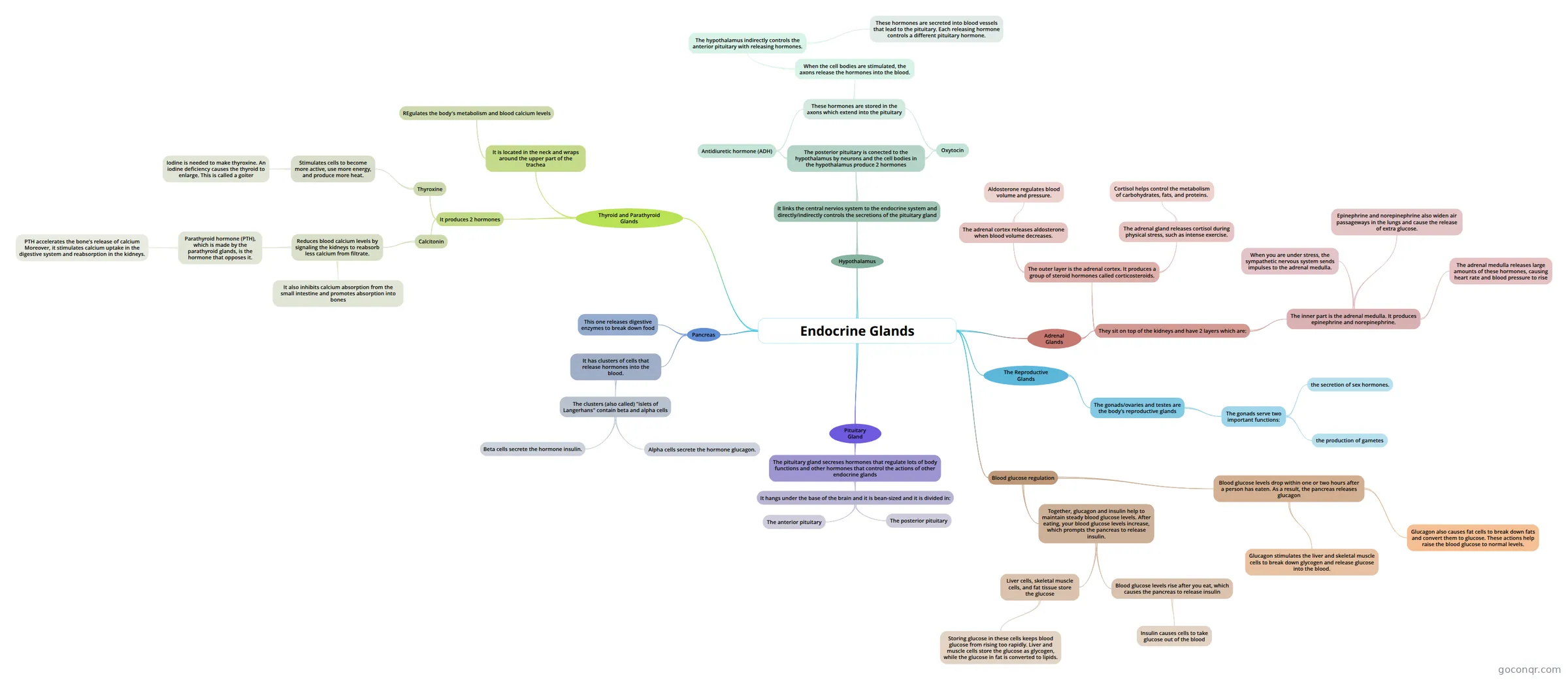
Mind map: Endocrine Glands
Inhalt der Mindmap
Endocrine Glands
Pituitary Gland
- The pituitary gland secreses hormones that regulate lots of body functions and other hormones that control the actions of other endocrine glands
- It hangs under the base of the brain and it is bean-sized and it is divided in:
- The anterior pituitary
- The posterior pituitary
- It hangs under the base of the brain and it is bean-sized and it is divided in:
- The pituitary gland secreses hormones that regulate lots of body functions and other hormones that control the actions of other endocrine glands
Hypothalamus
- It links the central nervios system to the endocrine system and directly/indirectly controls the secretions of the pituitary gland
- The posterior pituitary is conected to the hypothalamus by neurons and the cell bodies in the hypothalamus produce 2 hormones
- Antidiuretic hormone (ADH)
- These hormones are stored in the axons which extend into the pituitary
- When the cell bodies are stimulated, the axons release the hormones into the blood.
- The hypothalamus indirectly controls the anterior pituitary with releasing hormones.
- These hormones are secreted into blood vessels that lead to the pituitary. Each releasing hormone controls a different pituitary hormone.
- The hypothalamus indirectly controls the anterior pituitary with releasing hormones.
- When the cell bodies are stimulated, the axons release the hormones into the blood.
- These hormones are stored in the axons which extend into the pituitary
- Oxytocin
- Antidiuretic hormone (ADH)
- The posterior pituitary is conected to the hypothalamus by neurons and the cell bodies in the hypothalamus produce 2 hormones
- It links the central nervios system to the endocrine system and directly/indirectly controls the secretions of the pituitary gland
Adrenal Glands
- They sit on top of the kidneys and have 2 layers which are:
- The outer layer is the adrenal cortex. It produces a group of steroid hormones called corticosteroids.
- The adrenal cortex releases aldosterone when blood volume decreases.
- Aldosterone regulates blood volume and pressure.
- The adrenal gland releases cortisol during physical stress, such as intense exercise.
- Cortisol helps control the metabolism of carbohydrates, fats, and proteins.
- The adrenal cortex releases aldosterone when blood volume decreases.
- The inner part is the adrenal medulla. It produces epinephrine and norepinephrine.
- When you are under stress, the sympathetic nervous system sends impulses to the adrenal medulla.
- The adrenal medulla releases large amounts of these hormones, causing heart rate and blood pressure to rise
- Epinephrine and norepinephrine also widen air passageways in the lungs and cause the release of extra glucose.
- The outer layer is the adrenal cortex. It produces a group of steroid hormones called corticosteroids.
- They sit on top of the kidneys and have 2 layers which are:
Pancreas
- This one releases digestive enzymes to break down food
- It has clusters of cells that release hormones into the blood.
- The clusters (also called) "islets of Langerhans" contain beta and alpha cells
- Beta cells secrete the hormone insulin.
- Alpha cells secrete the hormone glucagon.
- The clusters (also called) "islets of Langerhans" contain beta and alpha cells
Thyroid and Parathyroid Glands
- It is located in the neck and wraps around the upper part of the trachea
- REgulates the body's metabolism and blood calcium levels
- It produces 2 hormones
- Thyroxine
- Stimulates cells to become more active, use more energy, and produce more heat.
- Iodine is needed to make thyroxine. An iodine deficiency causes the thyroid to enlarge. This is called a goiter
- Stimulates cells to become more active, use more energy, and produce more heat.
- Calcitonin
- Reduces blood calcium levels by signaling the kidneys to reabsorb less calcium from filtrate.
- It also inhibits calcium absorption from the small intestine and promotes absorption into bones
- Parathyroid hormone (PTH), which is made by the parathyroid glands, is the hormone that opposes it.
- PTH accelerates the bone's release of calcium Moreover, it stimulates calcium uptake in the digestive system and reabsorption in the kidneys.
- Reduces blood calcium levels by signaling the kidneys to reabsorb less calcium from filtrate.
- Thyroxine
- It is located in the neck and wraps around the upper part of the trachea
The Reproductive Glands
- The gonads/ovaries and testes are the body’s reproductive glands
- The gonads serve two important functions:
- the production of gametes
- the secretion of sex hormones.
- The gonads serve two important functions:
- The gonads/ovaries and testes are the body’s reproductive glands
Blood glucose regulation
- Together, glucagon and insulin help to maintain steady blood glucose levels. After eating, your blood glucose levels increase, which prompts the pancreas to release insulin.
- Liver cells, skeletal muscle cells, and fat tissue store the glucose
- Storing glucose in these cells keeps blood glucose from rising too rapidly. Liver and muscle cells store the glucose as glycogen, while the glucose in fat is converted to lipids.
- Blood glucose levels rise after you eat, which causes the pancreas to release insulin
- Insulin causes cells to take glucose out of the blood
- Liver cells, skeletal muscle cells, and fat tissue store the glucose
- Blood glucose levels drop within one or two hours after a person has eaten. As a result, the pancreas releases glucagon
- Glucagon stimulates the liver and skeletal muscle cells to break down glycogen and release glucose into the blood.
- Glucagon also causes fat cells to break down fats and convert them to glucose. These actions help raise the blood glucose to normal levels.
- Together, glucagon and insulin help to maintain steady blood glucose levels. After eating, your blood glucose levels increase, which prompts the pancreas to release insulin.
Informationen
- Beschreibung
- Mindmap am Endocrine Glands, erstellt von Tyrongamer 3 am 21/10/2021.
- Erstellt von
- Tyrongamer 3
- Aufrufe
- 3
- Bewertung