
Mindmap
Crypto U3, Theoretical vs. Practical Security
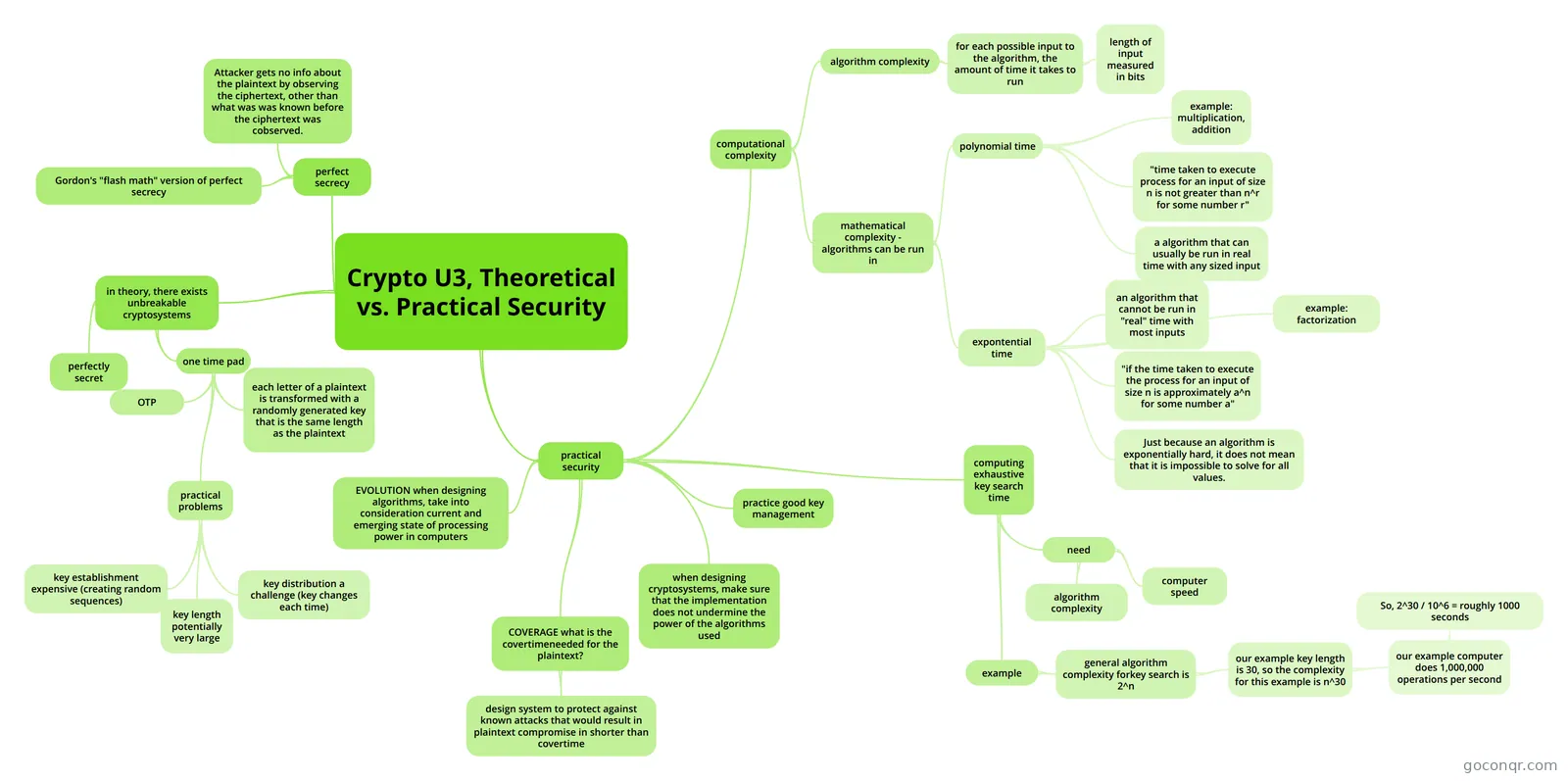
Mind map: theoretical vs practical security in cryptography
Inhalt der Mindmap
Crypto U3, Theoretical vs. Practical Security
perfect secrecy
- Attacker gets no info about the plaintext by observing the ciphertext, other than what was was known before the ciphertext was cobserved.
- Gordon's "flash math" version of perfect secrecy
- [Image: https://lh5.googleusercontent.com/-bm3mNTn_vpY/UVf2zUjHt8I/AAAAAAAAAbM/2PH9xvxP4QQ/s582/flashymathdefinitionofperfectsecrecy.png]
in theory, there exists unbreakable cryptosystems
- perfectly secret
- one time pad
- each letter of a plaintext is transformed with a randomly generated key that is the same length as the plaintext
- practical problems
- key establishment expensive (creating random sequences)
- key distribution a challenge (key changes each time)
- key length potentially very large
- OTP
practical security
- COVERAGE what is the covertimeneeded for the plaintext?
- design system to protect against known attacks that would result in plaintext compromise in shorter than covertime
- computational complexity
- algorithm complexity
- for each possible input to the algorithm, the amount of time it takes to run
- length of input measured in bits
- for each possible input to the algorithm, the amount of time it takes to run
- mathematical complexity - algorithms can be run in
- polynomial time
- a algorithm that can usually be run in real time with any sized input
- "time taken to execute process for an input of size n is not greater than n^r for some number r"
- example: multiplication, addition
- expontential time
- an algorithm that cannot be run in "real" time with most inputs
- "if the time taken to execute the process for an input of size n is approximately a^n for some number a"
- example: factorization
- Just because an algorithm is exponentially hard, it does not mean that it is impossible to solve for all values.
- polynomial time
- algorithm complexity
- computing exhaustive key search time
- need
- algorithm complexity
- computer speed
- example
- general algorithm complexity forkey search is 2^n
- our example key length is 30, so the complexity for this example is n^30
- our example computer does 1,000,000 operations per second
- So, 2^30 / 10^6 = roughly 1000 seconds
- our example computer does 1,000,000 operations per second
- our example key length is 30, so the complexity for this example is n^30
- general algorithm complexity forkey search is 2^n
- need
- EVOLUTION when designing algorithms, take into consideration current and emerging state of processing power in computers
- when designing cryptosystems, make sure that the implementation does not undermine the power of the algorithms used
- practice good key management
- COVERAGE what is the covertimeneeded for the plaintext?
Informationen
- Beschreibung
- IYM002 (Unit 3 - Further basics of Crypto Design) Mindmap am Crypto U3, Theoretical vs. Practical Security, erstellt von jjanesko am 31/03/2013.
- Erstellt von
- jjanesko
- Aufrufe
- 219
- Tags
- Bewertung