
Mindmap
SIMPLE PRESENT X PRESENTCONTINUOUS
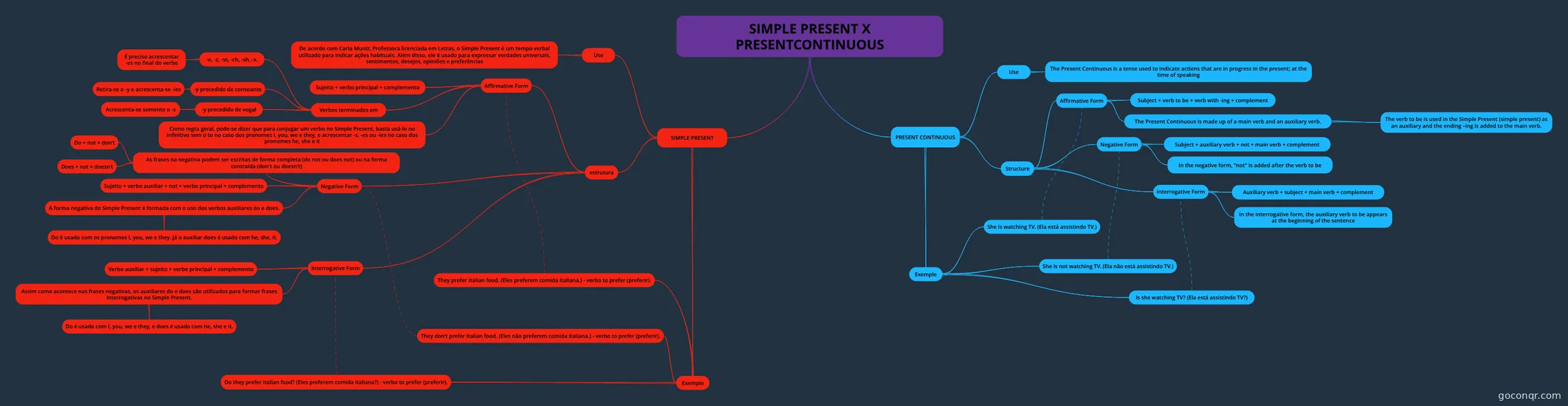
Mapa mental: Simple present x present continuous
Inhalt der Mindmap
SIMPLE PRESENT X PRESENTCONTINUOUS
PRESENT CONTINUOUS
- Use
- The Present Continuous is a tense used to indicate actions that are in progress in the present; at the time of speaking
- Structure
- Affirmative Form
- Subject + verb to be + verb with -ing + complement
- The Present Continuous is made up of a main verb and an auxiliary verb.
- The verb to be is used in the Simple Present (simple present) as an auxiliary and the ending –ing is added to the main verb.
- Negative Form
- Subject + auxiliary verb + not + main verb + complement
- In the negative form, "not" is added after the verb to be
- Interrogative Form
- Auxiliary verb + subject + main verb + complement
- In the interrogative form, the auxiliary verb to be appears at the beginning of the sentence
- Affirmative Form
- Exemple
- She is watching TV. (Ela está assistindo TV.)
- She is not watching TV. (Ela não está assistindo TV.)
- Is she watching TV? (Ela está assistindo TV?)
- Use
SIMPLE PRESENT
- Use
- De acordo com Carla Muniz, Professora licenciada em Letras, o Simple Present é um tempo verbal utilizado para indicar ações habituais. Além disso, ele é usado para expressar verdades universais, sentimentos, desejos, opiniões e preferências
- estrutura
- Affirmative Form
- Sujeito + verbo principal + complemento
- Verbos terminados em
- -o, -z, -ss, -ch, -sh, -x.
- É preciso acrescentar -es no final do verbo
- -y precedido de consoante
- Retira-se o -y e acrescenta-se -ies
- -y precedido de vogal
- Acrescenta-se somente o -s
- -o, -z, -ss, -ch, -sh, -x.
- Como regra geral, pode-se dizer que para conjugar um verbo no Simple Present, basta usá-lo no infinitivo sem o to no caso dos pronomes I, you, we e they, e acrescentar -s, -es ou -ies no caso dos pronomes he, she e it
- Negative Form
- Sujeito + verbo auxiliar + not + verbo principal + complemento
- A forma negativa do Simple Present é formada com o uso dos verbos auxiliares do e does.
- Do é usado com os pronomes I, you, we e they. Já o auxiliar does é usado com he, she, it.
- As frases na negativa podem ser escritas de forma completa (do not ou does not) ou na forma contraída (don't ou doesn't)
- Do + not = don’t
- Does + not = doesn’t
- Interrogative Form
- Verbo auxiliar + sujeito + verbo principal + complemento
- Assim como acontece nas frases negativas, os auxiliares do e does são utilizados para formar frases interrogativas no Simple Present.
- Do é usado com I, you, we e they, e does é usado com he, she e it.
- Affirmative Form
- Exemple
- They prefer Italian food. (Eles preferem comida italiana.) - verbo to prefer (preferir).
- They don't prefer Italian food. (Eles não preferem comida italiana.) - verbo to prefer (preferir).
- Do they prefer Italian food? (Eles preferem comida italiana?) - verbo to prefer (preferir).
- Use
Informationen
- Beschreibung
- Você deverá fazer um resumo sobre os tempos verbais SIMPLE PRESENT X PRESENT CONTINUOUS, no qual deverá conter: O uso de cada tempo verbal e a diferença entre os dois; A estrutura de cada: affirmative, negative and interrogative. Exemplos.
- Erstellt von
- Vitor Batista
- Aufrufe
- 30
- Bewertung
Mehr zu Simple present e present continuous