
Mindmap
INTRODUCTION TO LOGISTICS
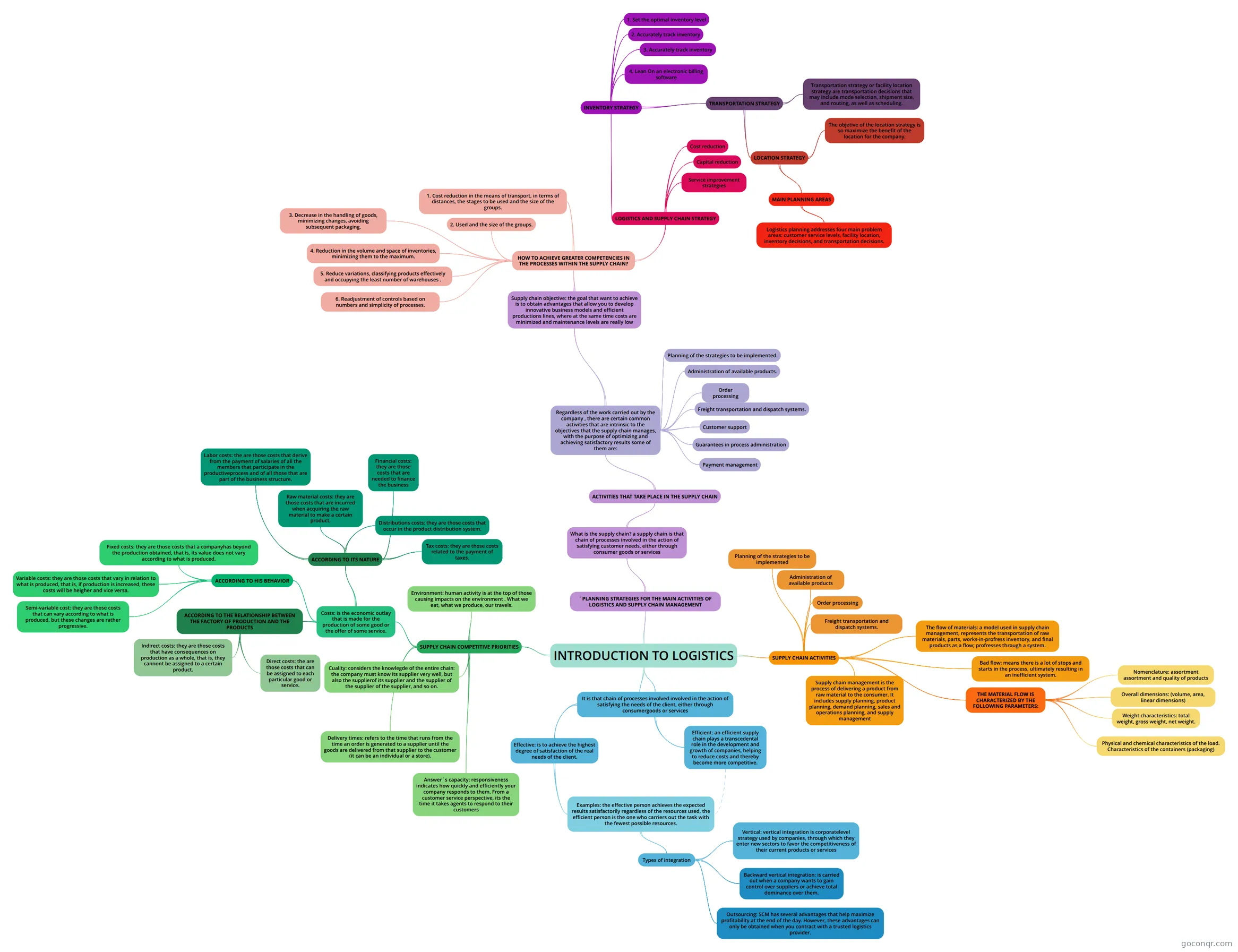
Mind map: Introduction to logistics
Inhalt der Mindmap
INTRODUCTION TO LOGISTICS
It is that chain of processes involved involved in the action of satisfying the needs of the client, either through consumergoods or services
- Effective: is to achieve the highest degree of satisfaction of the real needs of the client.
- Examples: the effective person achieves the expected results satisfactorily regardless of the resources used, the efficient person is the one who carriers out the task with the fewest possible resources.
- Types of integration
- Vertical: vertical integration is corporatelevel strategy used by companies, through which they enter new sectors to favor the competitiveness of their current products or services
- Backward vertical integration: is carried out when a company wants to gain control over suppliers or achieve total dominance over them.
- Outsourcing: SCM has several advantages that help maximize profitability at the end of the day. However, these advantages can only be obtained when you contract with a trusted logistics provider.
- Types of integration
- Examples: the effective person achieves the expected results satisfactorily regardless of the resources used, the efficient person is the one who carriers out the task with the fewest possible resources.
- Efficient: an efficient supply chain plays a transcedental role in the development and growth of companies, helping to reduce costs and thereby become more competitive.
- Effective: is to achieve the highest degree of satisfaction of the real needs of the client.
´PLANNING STRATEGIES FOR THE MAIN ACTIVITIES OF LOGISTICS AND SUPPLY CHAIN MANAGEMENT
- What is the supply chain? a supply chain is that chain of processes involved in the action of satisfying customer needs, either through consumer goods or services
- ACTIVITIES THAT TAKE PLACE IN THE SUPPLY CHAIN
- Regardless of the work carried out by the company , there are certain common activities that are intrinsic to the objectives that the supply chain manages, with the purpose of optimizing and achieving satisfactory results some of them are:
- Planning of the strategies to be implemented.
- Administration of available products.
- Order processing
- Freight transportation and dispatch systems.
- Customer support
- Guarantees in process administration
- Payment management
- Supply chain objective: the goal that want to achieve is to obtain advantages that allow you to develop innovative business models and efficient productions lines, where at the same time costs are minimized and maintenance levels are really low
- HOW TO ACHIEVE GREATER COMPETENCIES IN THE PROCESSES WITHIN THE SUPPLY CHAIN?
- 1. Cost reduction in the means of transport, in terms of distances, the stages to be used and the size of the groups.
- 2. Used and the size of the groups.
- 3. Decrease in the handling of goods, minimizing changes, avoiding subsequent packaging.
- 4. Reduction in the volume and space of inventories, minimizing them to the maximum.
- 5. Reduce variations, classifying products effectively and occupying the least number of warehouses .
- 6. Readjustment of controls based on numbers and simplicity of processes.
- LOGISTICS AND SUPPLY CHAIN STRATEGY
- Cost reduction
- Capital reduction
- Service improvement strategies
- INVENTORY STRATEGY
- 1. Set the optimal inventory level
- 2. Accurately track inventory
- 3. Accurately track inventory
- 4. Lean On an electronic billing software
- TRANSPORTATION STRATEGY
- Transportation strategy or facility location strategy are transportation decisions that may include mode selection, shipment size, and routing, as well as scheduling.
- LOCATION STRATEGY
- The objetive of the location strategy is so maximize the benefit of the location for the company.
- MAIN PLANNING AREAS
- Logistics planning addresses four main problem areas: customer service levels, facility location, inventory decisions, and transportation decisions.
- HOW TO ACHIEVE GREATER COMPETENCIES IN THE PROCESSES WITHIN THE SUPPLY CHAIN?
- Regardless of the work carried out by the company , there are certain common activities that are intrinsic to the objectives that the supply chain manages, with the purpose of optimizing and achieving satisfactory results some of them are:
- ACTIVITIES THAT TAKE PLACE IN THE SUPPLY CHAIN
- What is the supply chain? a supply chain is that chain of processes involved in the action of satisfying customer needs, either through consumer goods or services
SUPPLY CHAIN COMPETITIVE PRIORITIES
- Cuality: considers the knowlegde of the entire chain: the company must know its supplier very well, but also the supplierof its supplier and the supplier of the supplier of the supplier, and so on.
- Costs: is the economic outlay that is made for the production of some good or the offer of some service.
- ACCORDING TO HIS BEHAVIOR
- Fixed costs: they are those costs that a companyhas beyond the production obtained, that is, its value does not vary according to what is produced.
- Variable costs: they are those costs that vary in relation to what is produced, that is, if production is increased, these costs will be heigher and vice versa.
- Semi-variable cost: they are those costs that can vary according to what is produced, but these changes are rather progressive.
- ACCORDING TO THE RELATIONSHIP BETWEEN THE FACTORY OF PRODUCTION AND THE PRODUCTS
- Indirect costs: they are those costs that have consequences on production as a whole, that is, they cannont be assigned to a certain product.
- Direct costs: the are those costs that can be assigned to each particular good or service.
- ACCORDING TO ITS NATURE
- Labor costs: the are those costs that derive from the payment of salaries of all the members that participate in the productiveprocess and of all those that are part of the business structure.
- Raw material costs: they are those costs that are incurred when acquiring the raw material to make a certain product.
- Financial costs: they are those costs that are needed to finance the business
- Distributions costs: they are those costs that occur in the product distribution system.
- Tax costs: they are those costs related to the payment of taxes.
- ACCORDING TO HIS BEHAVIOR
- Delivery times: refers to the time that runs from the time an order is generated to a supplier until the goods are delivered from that supplier to the customer (it can be an individual or a store).
- Answer´s capacity: responsiveness indicates how quickly and efficiently your company responds to them. From a customer service perspective, its the time it takes agents to respond to their customers
- Environment: human activity is at the top of those causing impacts on the environment . What we eat, what we produce, our travels.
SUPPLY CHAIN ACTIVITIES
- Planning of the strategies to be implemented
- Administration of available products
- Order processing
- Freight transportation and dispatch systems.
- Supply chain management is the process of delivering a product from raw material to the consumer. It includes supply planning, product planning, demand planning, sales and operations planning, and supply management
- The flow of materials: a model used in supply chain management, represents the transportation of raw materials, parts, works-in-profress inventory, and final products as a flow; profresses through a system.
- Bad flow: means there is a lot of stops and starts in the process, ultimately resulting in an inefficient system.
- THE MATERIAL FLOW IS CHARACTERIZED BY THE FOLLOWING PARAMETERS:
- Nomenclature: assortment assortment and quality of products
- Overall dimensions: (volume, area, linear dimensions)
- Weight characteristics: total weight, gross weight, net weight.
- Physical and chemical characteristics of the load. Characteristics of the containers (packaging)
Informationen
- Beschreibung
- Mindmap am INTRODUCTION TO LOGISTICS, erstellt von ANA LAURA DIAZ SANDOVAL am 07/04/2022.
- Erstellt von
- ANA LAURA DIAZ SANDOVAL
- Aufrufe
- 4
- Bewertung