
Mindmap
VICTOR FRANKENTSTEIN
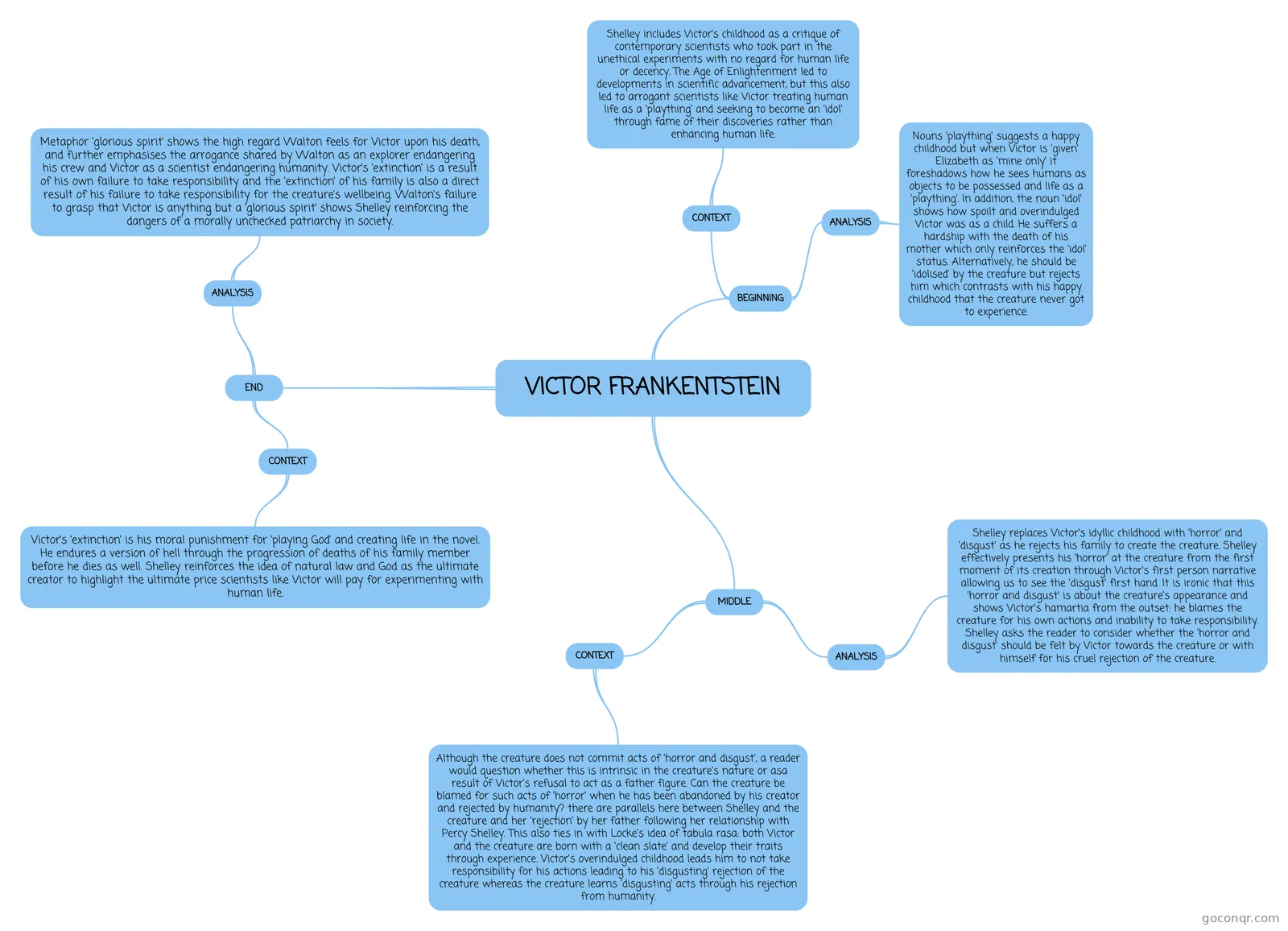
Mind map: Victor Frankenstein
Inhalt der Mindmap
VICTOR FRANKENTSTEIN
BEGINNING
- ANALYSIS
- Nouns 'plaything' suggests a happy childhood but when Victor is 'given' Elizabeth as 'mine only' it foreshadows how he sees humans as objects to be possessed and life as a 'plaything'. In addition, the noun 'idol' shows how spoilt and overindulged Victor was as a child. He suffers a hardship with the death of his mother which only reinforces the 'idol' status. Alternatively, he should be 'idolised' by the creature but rejects him which contrasts with his happy childhood that the creature never got to experience.
- CONTEXT
- Shelley includes Victor's childhood as a critique of contemporary scientists who took part in the unethical experiments with no regard for human life or decency. The Age of Enlightenment led to developments in scientific advancement, but this also led to arrogant scientists like Victor treating human life as a 'plaything' and seeking to become an 'idol' through fame of their discoveries rather than enhancing human life.
- ANALYSIS
MIDDLE
- ANALYSIS
- Shelley replaces Victor's idyllic childhood with 'horror' and 'disgust' as he rejects his family to create the creature. Shelley effectively presents his 'horror' at the creature from the first moment of its creation through Victor's first person narrative allowing us to see the 'disgust' first hand. It is ironic that this 'horror and disgust' is about the creature's appearance and shows Victor's hamartia from the outset: he blames the creature for his own actions and inability to take responsibility. Shelley asks the reader to consider whether the 'horror and disgust' should be felt by Victor towards the creature or with himself for his cruel rejection of the creature.
- CONTEXT
- Although the creature does not commit acts of 'horror and disgust', a reader would question whether this is intrinsic in the creature's nature or asa result of Victor's refusal to act as a father figure. Can the creature be blamed for such acts of 'horror' when he has been abandoned by his creator and rejected by humanity? there are parallels here between Shelley and the creature and her 'rejection' by her father following her relationship with Percy Shelley. This also ties in with Locke's idea of tabula rasa: both Victor and the creature are born with a 'clean slate' and develop their traits through experience. Victor's overindulged childhood leads him to not take responsibility for his actions leading to his 'disgusting' rejection of the creature whereas the creature learns 'disgusting' acts through his rejection from humanity.
- ANALYSIS
END
- ANALYSIS
- Metaphor ‘glorious spirit’ shows the high regard Walton feels for Victor upon his death, and further emphasises the arrogance shared by Walton as an explorer endangering his crew and Victor as a scientist endangering humanity. Victor’s ‘extinction’ is a result of his own failure to take responsibility and the ‘extinction’ of his family is also a direct result of his failure to take responsibility for the creature’s wellbeing. Walton’s failure to grasp that Victor is anything but a ‘glorious spirit’ shows Shelley reinforcing the dangers of a morally unchecked patriarchy in society.
- CONTEXT
- Victor’s ‘extinction’ is his moral punishment for ‘playing God’ and creating life in the novel. He endures a version of hell through the progression of deaths of his family member before he dies as well. Shelley reinforces the idea of natural law and God as the ultimate creator to highlight the ultimate price scientists like Victor will pay for experimenting with human life.
- ANALYSIS
Informationen
- Beschreibung
- Mindmap am VICTOR FRANKENTSTEIN, erstellt von Sarah Mawson am 31/05/2022.
- Erstellt von
- Sarah Mawson
- Aufrufe
- 0
- Bewertung