
Mindmap
The Instruments of Trade Policy
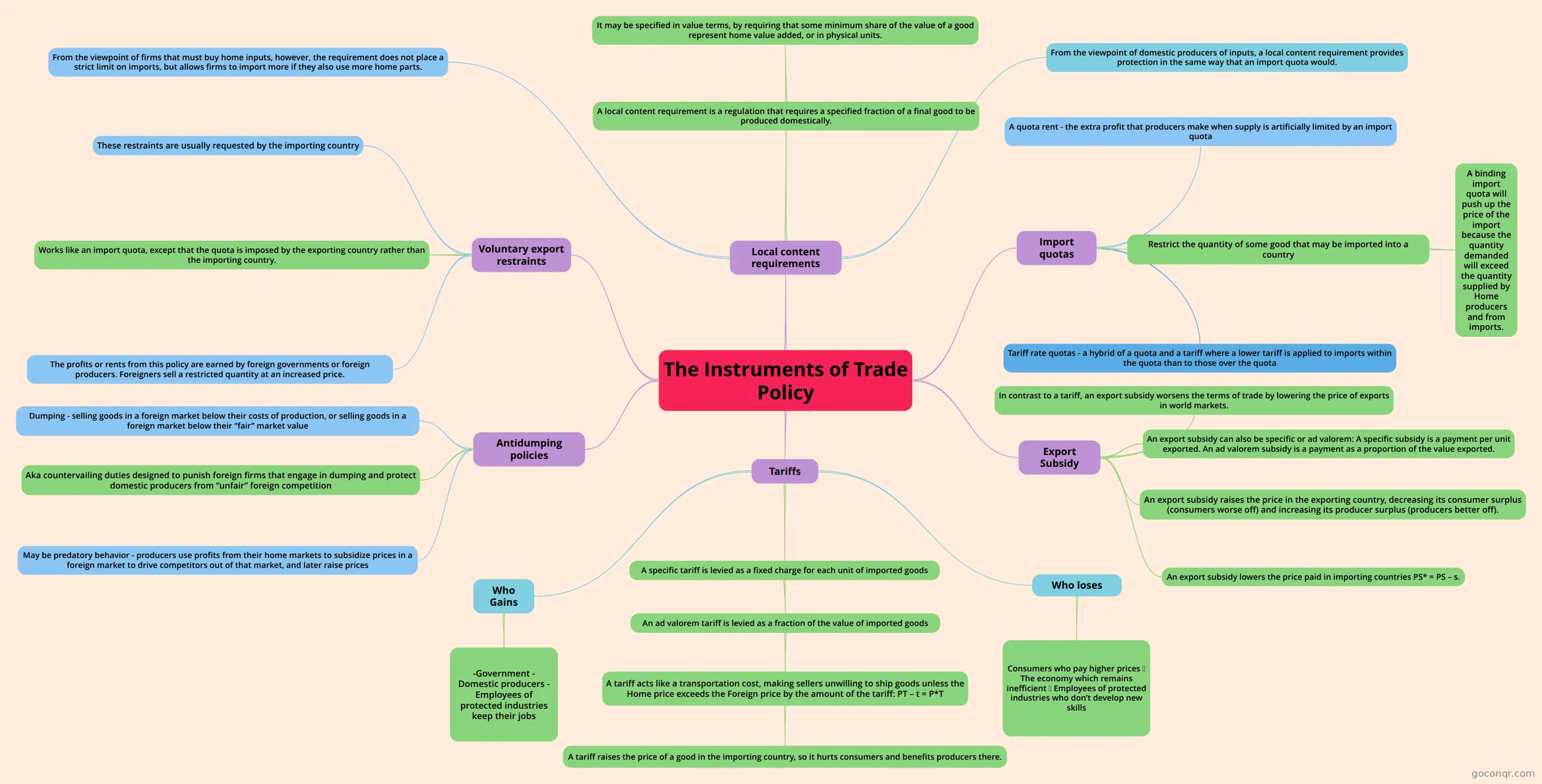
Mind map: The instruments of trade policy
Inhalt der Mindmap
The Instruments of Trade Policy
Tariffs
- A specific tariff is levied as a fixed charge for each unit of imported goods
- An ad valorem tariff is levied as a fraction of the value of imported goods
- A tariff acts like a transportation cost, making sellers unwilling to ship goods unless the Home price exceeds the Foreign price by the amount of the tariff: PT – t = P*T
- A tariff raises the price of a good in the importing country, so it hurts consumers and benefits producers there.
- A tariff acts like a transportation cost, making sellers unwilling to ship goods unless the Home price exceeds the Foreign price by the amount of the tariff: PT – t = P*T
- An ad valorem tariff is levied as a fraction of the value of imported goods
- Who loses
- Consumers who pay higher prices The economy which remains inefficient Employees of protected industries who don’t develop new skills
- Who Gains
- -Government - Domestic producers - Employees of protected industries keep their jobs
- A specific tariff is levied as a fixed charge for each unit of imported goods
Export Subsidy
- An export subsidy can also be specific or ad valorem: A specific subsidy is a payment per unit exported. An ad valorem subsidy is a payment as a proportion of the value exported.
- An export subsidy raises the price in the exporting country, decreasing its consumer surplus (consumers worse off) and increasing its producer surplus (producers better off).
- In contrast to a tariff, an export subsidy worsens the terms of trade by lowering the price of exports in world markets.
- An export subsidy lowers the price paid in importing countries PS* = PS – s.
Import quotas
- Restrict the quantity of some good that may be imported into a country
- A binding import quota will push up the price of the import because the quantity demanded will exceed the quantity supplied by Home producers and from imports.
- Tariff rate quotas - a hybrid of a quota and a tariff where a lower tariff is applied to imports within the quota than to those over the quota
- A quota rent - the extra profit that producers make when supply is artificially limited by an import quota
- Restrict the quantity of some good that may be imported into a country
Voluntary export restraints
- Works like an import quota, except that the quota is imposed by the exporting country rather than the importing country.
- These restraints are usually requested by the importing country
- The profits or rents from this policy are earned by foreign governments or foreign producers. Foreigners sell a restricted quantity at an increased price.
Local content requirements
- A local content requirement is a regulation that requires a specified fraction of a final good to be produced domestically.
- It may be specified in value terms, by requiring that some minimum share of the value of a good represent home value added, or in physical units.
- From the viewpoint of domestic producers of inputs, a local content requirement provides protection in the same way that an import quota would.
- From the viewpoint of firms that must buy home inputs, however, the requirement does not place a strict limit on imports, but allows firms to import more if they also use more home parts.
- A local content requirement is a regulation that requires a specified fraction of a final good to be produced domestically.
Antidumping policies
- Aka countervailing duties designed to punish foreign firms that engage in dumping and protect domestic producers from “unfair” foreign competition
- Dumping - selling goods in a foreign market below their costs of production, or selling goods in a foreign market below their “fair” market value
- May be predatory behavior - producers use profits from their home markets to subsidize prices in a foreign market to drive competitors out of that market, and later raise prices
Informationen
- Beschreibung
- Instruments of a Trade Policy
- Erstellt von
- Sofia Elizabeth 8004
- Aufrufe
- 86
- Tags
- Bewertung