
Mindmap
Organization Design
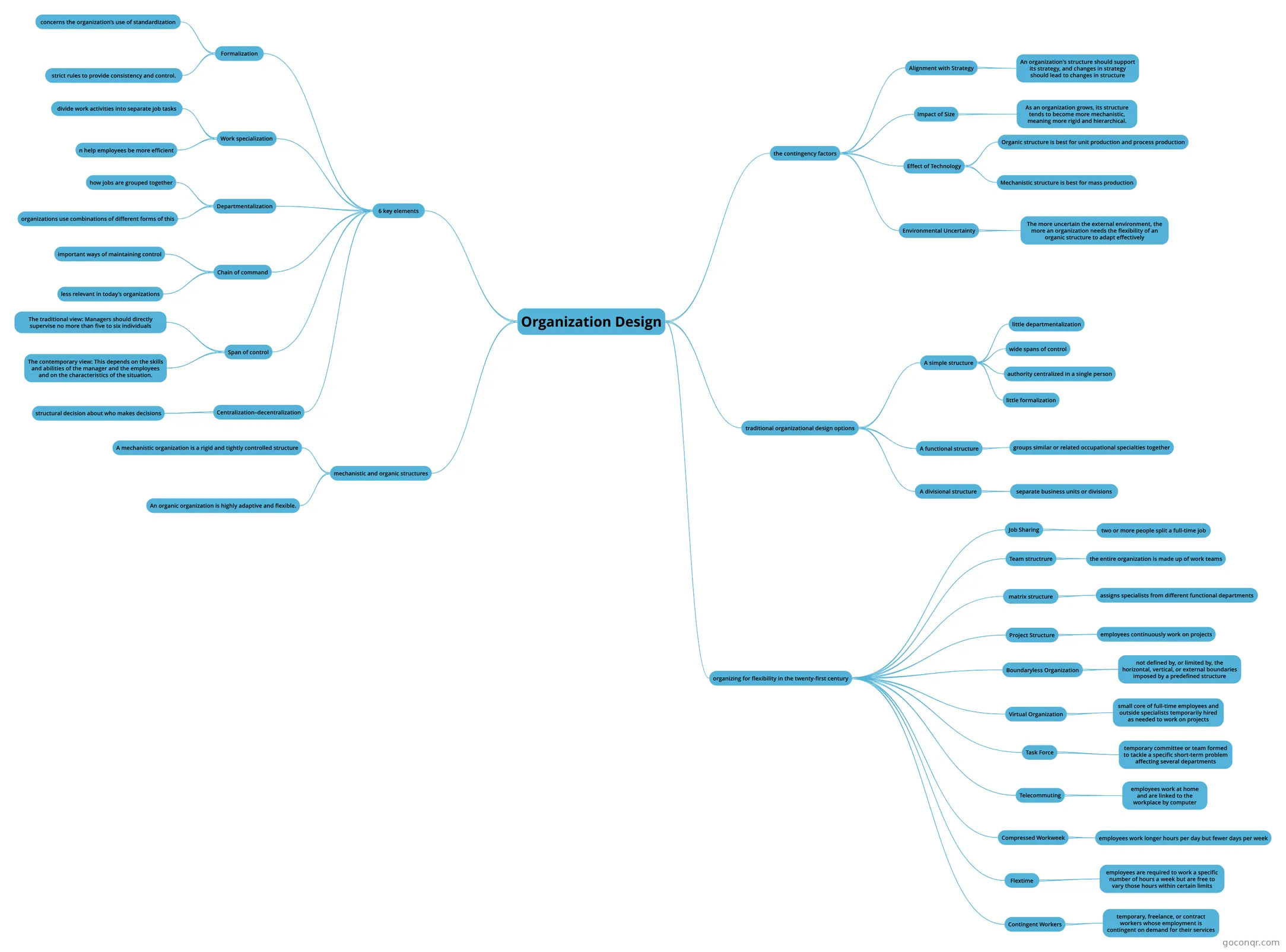
Mind map: Organization design
Inhalt der Mindmap
Organization Design
6 key elements
- Work specialization
- divide work activities into separate job tasks
- n help employees be more efficient
- Departmentalization
- how jobs are grouped together
- organizations use combinations of different forms of this
- Chain of command
- important ways of maintaining control
- less relevant in today’s organizations
- Centralization–decentralization
- structural decision about who makes decisions
- Span of control
- The traditional view: Managers should directly supervise no more than five to six individuals
- The contemporary view: This depends on the skills and abilities of the manager and the employees and on the characteristics of the situation.
- Formalization
- concerns the organization’s use of standardization
- strict rules to provide consistency and control.
- Work specialization
mechanistic and organic structures
- A mechanistic organization is a rigid and tightly controlled structure
- An organic organization is highly adaptive and flexible.
the contingency factors
- Alignment with Strategy
- An organization's structure should support its strategy, and changes in strategy should lead to changes in structure
- Impact of Size
- As an organization grows, its structure tends to become more mechanistic, meaning more rigid and hierarchical.
- Effect of Technology
- Organic structure is best for unit production and process production
- Mechanistic structure is best for mass production
- Environmental Uncertainty
- The more uncertain the external environment, the more an organization needs the flexibility of an organic structure to adapt effectively
- Alignment with Strategy
traditional organizational design options
- A simple structure
- little departmentalization
- wide spans of control
- authority centralized in a single person
- little formalization
- A functional structure
- groups similar or related occupational specialties together
- A divisional structure
- separate business units or divisions
- A simple structure
organizing for flexibility in the twenty-first century
- Team structrure
- the entire organization is made up of work teams
- matrix structure
- assigns specialists from different functional departments
- Project Structure
- employees continuously work on projects
- Boundaryless Organization
- not defined by, or limited by, the horizontal, vertical, or external boundaries imposed by a predefined structure
- Virtual Organization
- small core of full-time employees and outside specialists temporarily hired as needed to work on projects
- Task Force
- temporary committee or team formed to tackle a specific short-term problem affecting several departments
- Telecommuting
- employees work at home and are linked to the workplace by computer
- Compressed Workweek
- employees work longer hours per day but fewer days per week
- Flextime
- employees are required to work a specific number of hours a week but are free to vary those hours within certain limits
- Job Sharing
- two or more people split a full-time job
- Contingent Workers
- temporary, freelance, or contract workers whose employment is contingent on demand for their services
- Team structrure
Informationen
- Beschreibung
- Mindmap am Organization Design, erstellt von Phát Đinh Trần Tấn am 07/11/2024.
- Erstellt von
- Phát Đinh Trần Tấn
- Aufrufe
- 0
- Bewertung