
Mindmap
MASS MEDIA TOPIC 1
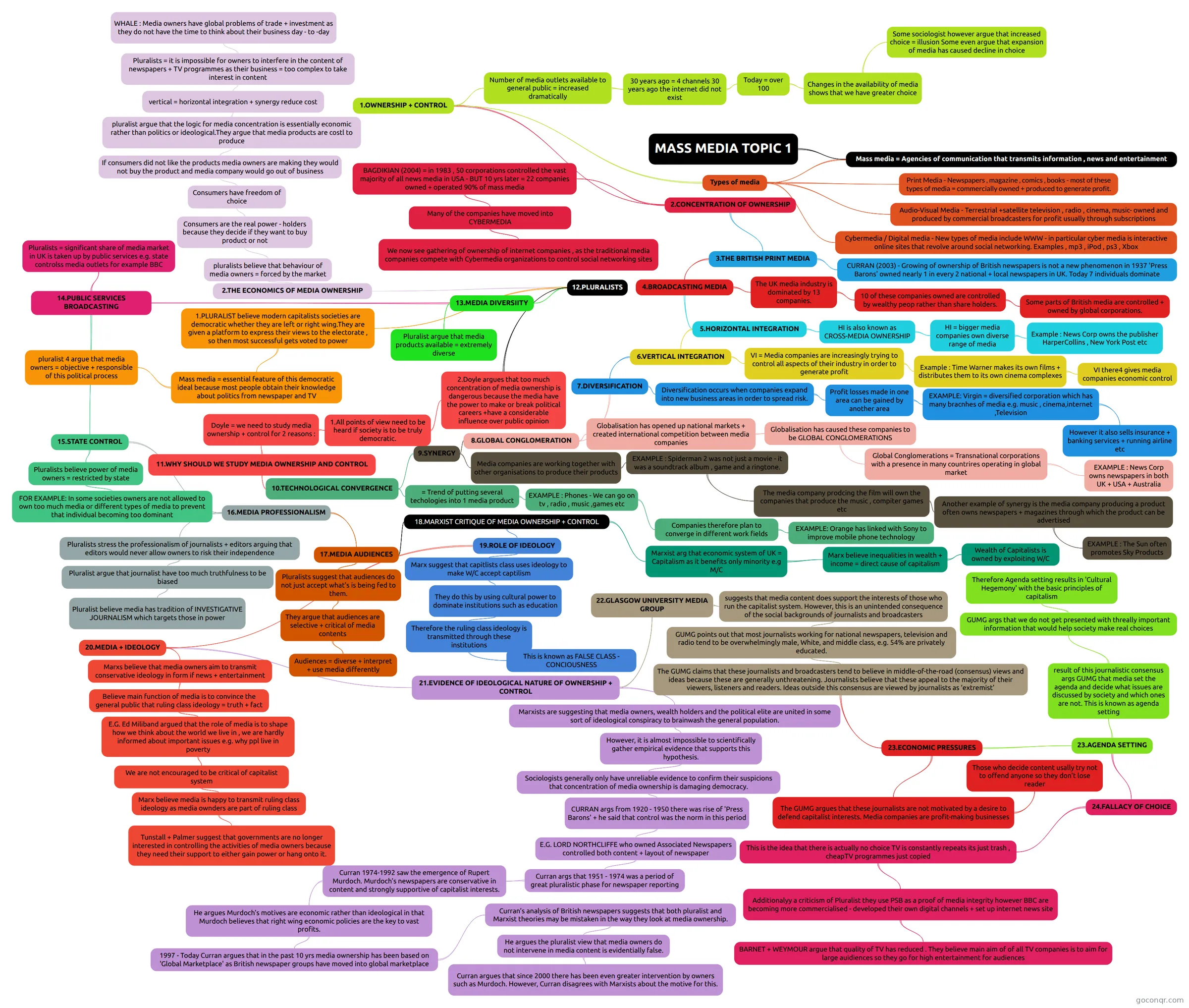
Mind map: Mass media
Inhalt der Mindmap
MASS MEDIA TOPIC 1
Mass media = Agencies of communication that transmits information , news and entertainment
- Types of media
- Print Media - Newspapers , magazine , comics , books - most of these types of media = commercially owned + produced to generate profit.
- Audio-Visual Media - Terrestrial +satellite television , radio , cinema, music- owned and produced by commercial broadcasters for profit usually through subscriptions
- Cybermedia / Digital media - New types of media include WWW - in particular cyber media is interactive online sites that revolve around social networking. Examples , mp3 , iPod , ps3 , Xbox
- 1.OWNERSHIP + CONTROL
- Number of media outlets available to general public = increased dramatically
- 30 years ago = 4 channels 30 years ago the internet did not exist
- Today = over 100
- Changes in the availability of media shows that we have greater choice
- Some sociologist however argue that increased choice = illusion Some even argue that expansion of media has caused decline in choice
- Changes in the availability of media shows that we have greater choice
- Today = over 100
- 30 years ago = 4 channels 30 years ago the internet did not exist
- 2.CONCENTRATION OF OWNERSHIP
- BAGDIKIAN (2004) = in 1983 , 50 corporations controlled the vast majority of all news media in USA - BUT 10 yrs later = 22 companies owned + operated 90% of mass media
- Many of the companies have moved into CYBERMEDIA
- We now see gathering of ownership of internet companies , as the traditional media companies compete with Cybermedia organizations to control social networking sites
- Many of the companies have moved into CYBERMEDIA
- 3.THE BRITISH PRINT MEDIA
- CURRAN (2003) - Growing of ownership of British newspapers is not a new phenomenon in 1937 'Press Barons' owned nearly 1 in every 2 national + local newspapers in UK. Today 7 individuals dominate
- 4.BROADCASTING MEDIA
- The UK media industry is dominated by 13 companies.
- 10 of these companies owned are controlled by wealthy peop rather than share holders.
- Some parts of British media are controlled + owned by global corporations.
- 10 of these companies owned are controlled by wealthy peop rather than share holders.
- 5.HORIZONTAL INTEGRATION
- HI is also known as CROSS-MEDIA OWNERSHIP
- HI = bigger media companies own diverse range of media
- Example : News Corp owns the publisher HarperCollins , New York Post etc
- HI = bigger media companies own diverse range of media
- 6.VERTICAL INTEGRATION
- VI = Media companies are increasingly trying to control all aspects of their industry in order to generate profit
- Example : Time Warner makes its own films + distributes them to its own cinema complexes
- VI there4 gives media companies economic control
- Example : Time Warner makes its own films + distributes them to its own cinema complexes
- 7.DIVERSIFICATION
- Diversification occurs when companies expand into new business areas in order to spread risk.
- Profit losses made in one area can be gained by another area
- EXAMPLE: Virgin = diversified corporation which has many bracnhes of media e.g. music , cinema,internet ,Television
- However it also sells insurance + banking services + running airline etc
- EXAMPLE: Virgin = diversified corporation which has many bracnhes of media e.g. music , cinema,internet ,Television
- Profit losses made in one area can be gained by another area
- 8.GLOBAL CONGLOMERATION
- Globalisation has opened up national markets + created international competition between media companies
- Globalisation has caused these companies to be GLOBAL CONGLOMERATIONS
- Global Conglomerations = Transnational corporations with a presence in many countrires operating in global market
- EXAMPLE : News Corp owns newspapers in both UK + USA + Australia
- Global Conglomerations = Transnational corporations with a presence in many countrires operating in global market
- Globalisation has caused these companies to be GLOBAL CONGLOMERATIONS
- 9.SYNERGY
- Media companies are working together with other organisations to produce their products
- EXAMPLE : Spiderman 2 was not just a movie - it was a soundtrack album , game and a ringtone.
- The media company prodcing the film will own the companies that produce the music , compiter games etc
- Another example of synergy is the media company producing a product often owns newspapers + magazines through which the product can be advertised
- EXAMPLE : The Sun often promotes Sky Products
- Another example of synergy is the media company producing a product often owns newspapers + magazines through which the product can be advertised
- The media company prodcing the film will own the companies that produce the music , compiter games etc
- EXAMPLE : Spiderman 2 was not just a movie - it was a soundtrack album , game and a ringtone.
- 10.TECHNOLOGICAL CONVERGENCE
- = Trend of putting several techologies into 1 media product
- EXAMPLE : Phones - We can go on tv , radio , music ,games etc
- Companies therefore plan to converge in different work fields
- EXAMPLE: Orange has linked with Sony to improve mobile phone technology
- Companies therefore plan to converge in different work fields
- EXAMPLE : Phones - We can go on tv , radio , music ,games etc
- 11.WHY SHOULD WE STUDY MEDIA OWNERSHIP AND CONTROL
- Doyle = we need to study media ownership + control for 2 reasons :
- 1.All points of view need to be heard if society is to be truly democratic.
- 2.Doyle argues that too much concentration of media ownership is dangerous because the media have the power to make or break political careers +have a considerable influence over public opinion
- 12.PLURALISTS
- 1.PLURALIST believe modern capitalists societies are democratic whether they are left or right wing.They are given a platform to express their views to the electorate , so then most successful gets voted to power
- Mass media = essential feature of this democratic ideal because most people obtain their knowledge about politics from newspaper and TV
- pluralist 4 argue that media owners = objective + responsible of this political process
- Mass media = essential feature of this democratic ideal because most people obtain their knowledge about politics from newspaper and TV
- 2.THE ECONOMICS OF MEDIA OWNERSHIP
- pluralists believe that behaviour of media owners = forced by the market
- Consumers are the real power - holders because they decide if they want to buy product or not
- Consumers have freedom of choice
- If consumers did not like the products media owners are making they would not buy the product and media company would go out of business
- pluralist argue that the logic for media concentration is essentially economic rather than politics or ideological.They argue that media products are costl to produce
- vertical = horizontal integration + synergy reduce cost
- Pluralists = it is impossible for owners to interfere in the content of newspapers + TV programmes as their business = too complex to take interest in content
- WHALE : Media owners have global problems of trade + investment as they do not have the time to think about their business day - to -day
- Pluralists = it is impossible for owners to interfere in the content of newspapers + TV programmes as their business = too complex to take interest in content
- vertical = horizontal integration + synergy reduce cost
- pluralist argue that the logic for media concentration is essentially economic rather than politics or ideological.They argue that media products are costl to produce
- If consumers did not like the products media owners are making they would not buy the product and media company would go out of business
- Consumers have freedom of choice
- Consumers are the real power - holders because they decide if they want to buy product or not
- pluralists believe that behaviour of media owners = forced by the market
- 13.MEDIA DIVERSIITY
- Pluralist argue that media products available = extremely diverse
- 14.PUBLIC SERVICES BROADCASTING
- Pluralists = significant share of media market in UK is taken up by public services e.g. state controlss media outlets for example BBC
- 15.STATE CONTROL
- Pluralists believe power of media owners = restricted by state
- FOR EXAMPLE: In some societies owners are not allowed to own too much media or different types of media to prevent that individual becoming too dominant
- 16.MEDIA PROFESSIONALISM
- Pluralists stress the professionalism of journalists + editors arguing that editors would never allow owners to risk their independence
- Pluralist argue that journalist have too much truthfulness to be biased
- Pluralist believe media has tradition of INVESTIGATIVE JOURNALISM which targets those in power
- Pluralist argue that journalist have too much truthfulness to be biased
- 17.MEDIA AUDIENCES
- Pluralists suggest that audiences do not just accept what's is being fed to them.
- They argue that audiences are selective + critical of media contents
- Audiences = diverse + interpret + use media differently
- They argue that audiences are selective + critical of media contents
- 18.MARXIST CRITIQUE OF MEDIA OWNERSHIP + CONTROL
- Marxist arg that economic system of UK = Capitalism as it benefits only minority e.g M/C
- Marx believe inequalities in wealth + income = direct cause of capitalism
- Wealth of Capitalists is owned by exploiting W/C
- Marx believe inequalities in wealth + income = direct cause of capitalism
- 19.ROLE OF IDEOLOGY
- Marx suggest that capitlists class uses ideology to make W/C accept captilism
- They do this by using cultural power to dominate institutions such as education
- Therefore the ruling class ideology is transmitted through these institutions
- This is known as FALSE CLASS - CONCIOUSNESS
- Therefore the ruling class ideology is transmitted through these institutions
- They do this by using cultural power to dominate institutions such as education
- 20.MEDIA + IDEOLOGY
- Marxs believe that media owners aim to transmit conservative ideology in form if news + entertainment
- Believe main function of media is to convince the general public that ruling class ideology = truth + fact
- E.G. Ed Miliband argued that the role of media is to shape how we think about the world we live in , we are hardly informed about important issues e.g. why ppl live in poverty
- We are not encouraged to be critical of capitalist system
- Marx believe media is happy to transmit ruling class ideology as media ownders are part of ruling class
- Tunstall + Palmer suggest that governments are no longer interested in controlling the activities of media owners because they need their support to either gain power or hang onto it.
- Marx believe media is happy to transmit ruling class ideology as media ownders are part of ruling class
- We are not encouraged to be critical of capitalist system
- E.G. Ed Miliband argued that the role of media is to shape how we think about the world we live in , we are hardly informed about important issues e.g. why ppl live in poverty
- Believe main function of media is to convince the general public that ruling class ideology = truth + fact
- 21.EVIDENCE OF IDEOLOGICAL NATURE OF OWNERSHIP + CONTROL
- Marxists are suggesting that media owners, wealth holders and the political elite are united in some sort of ideological conspiracy to brainwash the general population.
- However, it is almost impossible to scientifically gather empirical evidence that supports this hypothesis.
- Sociologists generally only have unreliable evidence to confirm their suspicions that concentration of media ownership is damaging democracy.
- CURRAN args from 1920 - 1950 there was rise of 'Press Barons' + he said that control was the norm in this period
- E.G. LORD NORTHCLIFFE who owned Associated Newspapers controlled both content + layout of newspaper
- Curran args that 1951 - 1974 was a period of great pluralistic phase for newspaper reporting
- Curran 1974-1992 saw the emergence of Rupert Murdoch. Murdoch’s newspapers are conservative in content and strongly supportive of capitalist interests.
- He argues Murdoch’s motives are economic rather than ideological in that Murdoch believes that right wing economic policies are the key to vast profits.
- 1997 - Today Curran argues that in the past 10 yrs media ownership has been based on 'Global Marketplace' as British newspaper groups have moved into global marketplace
- Curran’s analysis of British newspapers suggests that both pluralist and Marxist theories may be mistaken in the way they look at media ownership.
- He argues the pluralist view that media owners do not intervene in media content is evidentially false.
- Curran argues that since 2000 there has been even greater intervention by owners such as Murdoch. However, Curran disagrees with Marxists about the motive for this.
- He argues the pluralist view that media owners do not intervene in media content is evidentially false.
- Curran’s analysis of British newspapers suggests that both pluralist and Marxist theories may be mistaken in the way they look at media ownership.
- 1997 - Today Curran argues that in the past 10 yrs media ownership has been based on 'Global Marketplace' as British newspaper groups have moved into global marketplace
- He argues Murdoch’s motives are economic rather than ideological in that Murdoch believes that right wing economic policies are the key to vast profits.
- Curran 1974-1992 saw the emergence of Rupert Murdoch. Murdoch’s newspapers are conservative in content and strongly supportive of capitalist interests.
- Curran args that 1951 - 1974 was a period of great pluralistic phase for newspaper reporting
- E.G. LORD NORTHCLIFFE who owned Associated Newspapers controlled both content + layout of newspaper
- CURRAN args from 1920 - 1950 there was rise of 'Press Barons' + he said that control was the norm in this period
- Sociologists generally only have unreliable evidence to confirm their suspicions that concentration of media ownership is damaging democracy.
- However, it is almost impossible to scientifically gather empirical evidence that supports this hypothesis.
- 22.GLASGOW UNIVERSITY MEDIA GROUP
- suggests that media content does support the interests of those who run the capitalist system. However, this is an unintended consequence of the social backgrounds of journalists and broadcasters
- GUMG points out that most journalists working for national newspapers, television and radio tend to be overwhelmingly male, White, and middle class, e.g. 54% are privately educated.
- The GUMG claims that these journalists and broadcasters tend to believe in middle-of-the-road (consensus) views and ideas because these are generally unthreatening. Journalists believe that these appeal to the majority of their viewers, listeners and readers. Ideas outside this consensus are viewed by journalists as ‘extremist’
- 23.ECONOMIC PRESSURES
- The GUMG argues that these journalists are not motivated by a desire to defend capitalist interests. Media companies are profit-making businesses
- Those who decide content usally try not to offend anyone so they don't lose reader
- 23.AGENDA SETTING
- result of this journalistic consensus args GUMG that media set the agenda and decide what issues are discussed by society and which ones are not. This is known as agenda setting
- GUMG args that we do not get presented with threally important information that would help society make real choices
- Therefore Agenda setting results in 'Cultural Hegemony' with the basic principles of capitalism
- GUMG args that we do not get presented with threally important information that would help society make real choices
- 24.FALLACY OF CHOICE
- This is the idea that there is actually no choice TV is constantly repeats its just trash , cheapTV programmes just copied
- Additionalyy a criticism of Pluralist they use PSB as a proof of media integrity however BBC are becoming more commercialised - developed their own digital channels + set up internet news site
- BARNET + WEYMOUR argue that quality of TV has reduced . They believe main aim of of all TV companies is to aim for large auidiences so they go for high entertainment for audiences
- Additionalyy a criticism of Pluralist they use PSB as a proof of media integrity however BBC are becoming more commercialised - developed their own digital channels + set up internet news site
- This is the idea that there is actually no choice TV is constantly repeats its just trash , cheapTV programmes just copied
- result of this journalistic consensus args GUMG that media set the agenda and decide what issues are discussed by society and which ones are not. This is known as agenda setting
- The GUMG argues that these journalists are not motivated by a desire to defend capitalist interests. Media companies are profit-making businesses
- 23.ECONOMIC PRESSURES
- The GUMG claims that these journalists and broadcasters tend to believe in middle-of-the-road (consensus) views and ideas because these are generally unthreatening. Journalists believe that these appeal to the majority of their viewers, listeners and readers. Ideas outside this consensus are viewed by journalists as ‘extremist’
- GUMG points out that most journalists working for national newspapers, television and radio tend to be overwhelmingly male, White, and middle class, e.g. 54% are privately educated.
- suggests that media content does support the interests of those who run the capitalist system. However, this is an unintended consequence of the social backgrounds of journalists and broadcasters
- Marxists are suggesting that media owners, wealth holders and the political elite are united in some sort of ideological conspiracy to brainwash the general population.
- Marxs believe that media owners aim to transmit conservative ideology in form if news + entertainment
- Marx suggest that capitlists class uses ideology to make W/C accept captilism
- Marxist arg that economic system of UK = Capitalism as it benefits only minority e.g M/C
- Pluralists suggest that audiences do not just accept what's is being fed to them.
- Pluralists stress the professionalism of journalists + editors arguing that editors would never allow owners to risk their independence
- Pluralists believe power of media owners = restricted by state
- 1.PLURALIST believe modern capitalists societies are democratic whether they are left or right wing.They are given a platform to express their views to the electorate , so then most successful gets voted to power
- 12.PLURALISTS
- 2.Doyle argues that too much concentration of media ownership is dangerous because the media have the power to make or break political careers +have a considerable influence over public opinion
- 1.All points of view need to be heard if society is to be truly democratic.
- Doyle = we need to study media ownership + control for 2 reasons :
- = Trend of putting several techologies into 1 media product
- Media companies are working together with other organisations to produce their products
- Globalisation has opened up national markets + created international competition between media companies
- Diversification occurs when companies expand into new business areas in order to spread risk.
- VI = Media companies are increasingly trying to control all aspects of their industry in order to generate profit
- HI is also known as CROSS-MEDIA OWNERSHIP
- The UK media industry is dominated by 13 companies.
- BAGDIKIAN (2004) = in 1983 , 50 corporations controlled the vast majority of all news media in USA - BUT 10 yrs later = 22 companies owned + operated 90% of mass media
- Number of media outlets available to general public = increased dramatically
- Types of media
Informationen
- Beschreibung
- Mindmap am MASS MEDIA TOPIC 1, erstellt von Hazal T am 09/01/2016.
- Erstellt von
- Hazal T
- Aufrufe
- 3
- Bewertung
Mehr zu Media Ownership and Control