
Mindmap
Unit C: Cellular Respiration
Inhalt der Mindmap
Unit C: Cellular Respiration
Cellular Respiration: how plants and animals generate energy from stored glucose
- Glucose is stored as cellulose and starch in plants and it is stored as glycogen in animals. There are 2 types of CR: -Aerobic -Anaerobic
- Anaerobic CR = NO OXYGEN
- ALL organisms perform anaerobic cellular respiration - no special organelle is required.
- Step 1: Glycolysis
- Remember that this only yields 2 ATP in total
- Step 2: Fermentation
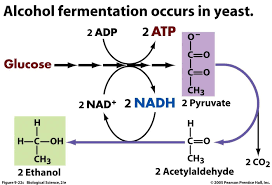
- Alcoholic Fermentation
- 1) Water is added to pyruvate and a CO2 is expelled which creates a 2 carbon compound (Acetaldehyde) 2) NADH loses its electrons and becomes NAD+ as it reduces acetaldehyde into ethanol
- Used in Brewing, Wine Making, and Baking
- Also used in making Soy Sauce, Chocolate, Saki, Vinegar, and Biofuel
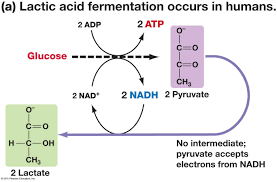
- Lactic Acid Fermentation
- 1) Pyruvate from glycolysis is reduced into lactic acid by NADH as it is oxidized into NAD+
- Accounts for Sore muscles, Rigor Mortis, Yogurt & Sauerkraut
- *remember that there are 2 pyruvates, so these rxns occur twice!
- Alcoholic Fermentation
- *The goal is to get the NAD+ back in order to keep performing glycolysis
- Aerobic CR = OXYGEN
- Organisms must have mitochondria in order to perform aerobic cellular respiration
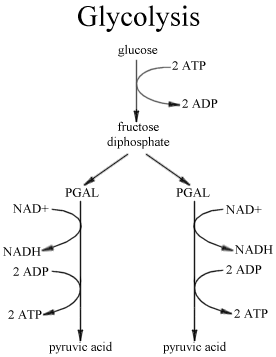
- Step 1: Glycolysis
- 1) A glucose molecule is split into 2 PGAL molecules by the oxidation of 2 ATP (Energy investment) 2) NAD+ and ADP are reuced into NADH and ATP as they take electrons from the PGAL and become Pyruvate *this happens twice so a total of 2 NADH are produced & 4 ATP (2 ADP per PGAL)
- *in cytoplasm
- Energy input & payoff
- Results in 2 ATP, 2NADH and 2 Pyruvates
- not very efficient
- - You only get 2 ATP from it
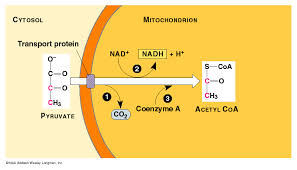
- Step 2: Pyruvate Oxidation
- 1) Pyruvate moves into the mitochondrial matrix and 1 carbon (CO2) is removed 2) NAD+ is reduced into NADH and an intermediate acetic acid is the result 3) Coenzyme A attaches to the acetic acid which forms Acetyl CoA
- *in the mitochondria
- Results in 2 NADH and 2 Acetyl CoA
- *Happens twice b/c there were 2 Pyruvates made in glycolysis
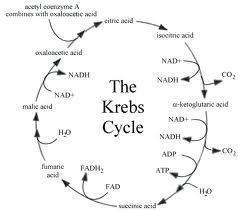
- Step 3: Kreb's Cycle
- *in the matrix
- *happens twice because 2 acetyl CoA's were made
- Results in 6 NADH, 2ATP and 2 FADH2 & releases 4 CO2
- Step 4: ETC & Chemiosmosis
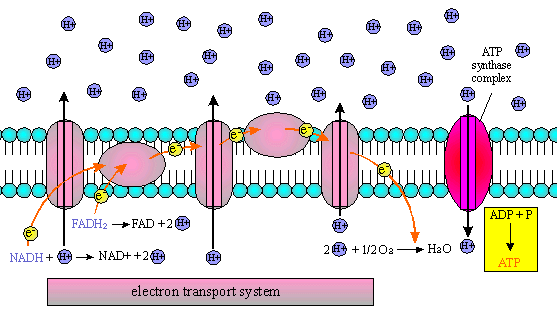
- 1) NADH and FADH2 enter the electron transport system in the inner mitochondrial membrane 2) They drop off their electrons & as they are transferred, an H+ is transported into the intermembrane space (this causes a very high concentration of protons) 3) The electrons are transpired to oxygen and join with a proton to produce water 4) The protons in the intermembrane space down their concentration gradient through ATP Synthase and facilitate the creation of ATP *The NADH that was made in glycolysis has to be converted into FADH2 in order for it to go through the mitochondrial membranes
- occurs in the mitochondria
- *where the most ATP is directly created
- NADH = 3e- --> 3 ATP FADH2 = 2e- --> 2 ATP
- Oxygen = terminal electron acceptor
- Results in 24ATP
- Electron carriers involved = NADH and FADH2
- NADH is oxidized into NAD+ FADH2 is oxidized into FAD+
- 36% Efficient
- Only 36% of the energy in glucose is converted into ATP - the rest is lost as heat (this is used by warm-blooded organisms to stay warm)
ATP is used for many things
- MOTION
- TRANSPORTING IONS & MOLECULES
- BUILDING MOLECULES
- CONTROLLING RXNS
- BIOLUMINESCENCE
Mitochondria are involved in anaerobic CR
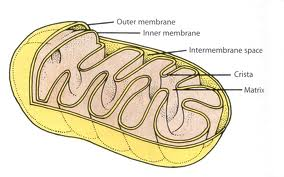
- -Double layered organelle that produces lots of ATP
- Mitochondrial Matrix: protein rich liquid filling the inside of the organelle
- *Pyruvate oxidation, the Kreb's Cycle, and Electron Transport and Chemiosmosis occur here
- Intermembrane Space: fluid filled space between inner & outer membranes
Poisons & Supplements
- Creatine Phosphate
- = source of phosphate *more phosphate = more ATP? = harder workout session
- Carbon Monoxide
- -Binds to RBCs to prevents O2 transport which means there is no terminal electron acceptor -CR stops = death
- Cyanide & Hydrogen Sulfide
- Prevent electron transfer in the ETS -body can't survive off of 2 ATP from glycolysis so you die
- Creatine Phosphate
Bilder und Dateien der Mindmap
Informationen
- Beschreibung
- Anaerobic and Aerobic Cellular Respiration
- Erstellt von
- courtneyhebert99
- Aufrufe
- 14
- Bewertung