
Mindmap
Hume Against Miracles
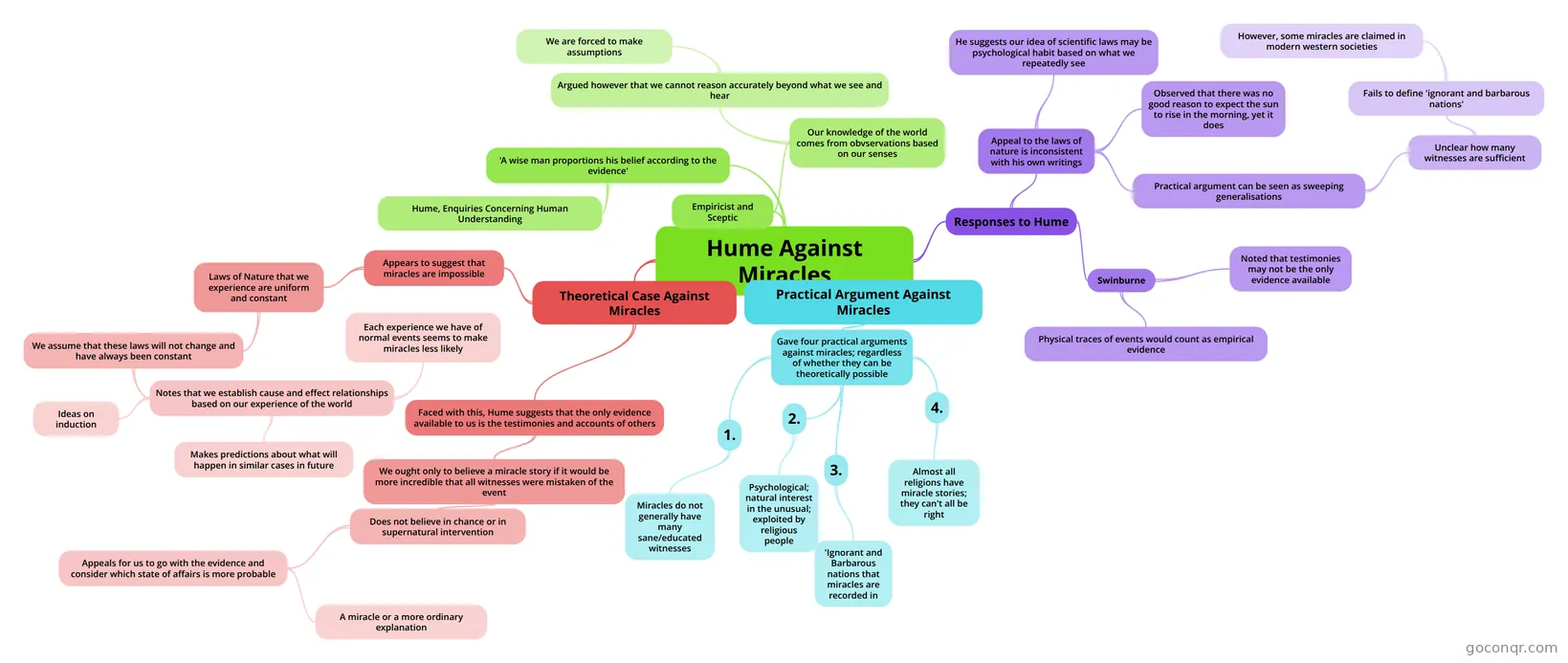
Mind map: Hume against miracles
Inhalt der Mindmap
Hume Against Miracles
'A wise man proportions his belief according to the evidence'
- Hume, Enquiries Concerning Human Understanding
Empiricist and Sceptic
- Our knowledge of the world comes from obvservations based on our senses
- Argued however that we cannot reason accurately beyond what we see and hear
- We are forced to make assumptions
- Argued however that we cannot reason accurately beyond what we see and hear
- Our knowledge of the world comes from obvservations based on our senses
Theoretical Case Against Miracles
- Appears to suggest that miracles are impossible
- Laws of Nature that we experience are uniform and constant
- We assume that these laws will not change and have always been constant
- Notes that we establish cause and effect relationships based on our experience of the world
- Ideas on induction
- Makes predictions about what will happen in similar cases in future
- Each experience we have of normal events seems to make miracles less likely
- Notes that we establish cause and effect relationships based on our experience of the world
- We assume that these laws will not change and have always been constant
- Laws of Nature that we experience are uniform and constant
- Faced with this, Hume suggests that the only evidence available to us is the testimonies and accounts of others
- We ought only to believe a miracle story if it would be more incredible that all witnesses were mistaken of the event
- Does not believe in chance or in supernatural intervention
- Appeals for us to go with the evidence and consider which state of affairs is more probable
- A miracle or a more ordinary explanation
- Appeals for us to go with the evidence and consider which state of affairs is more probable
- Does not believe in chance or in supernatural intervention
- We ought only to believe a miracle story if it would be more incredible that all witnesses were mistaken of the event
- Appears to suggest that miracles are impossible
Practical Argument Against Miracles
- Gave four practical arguments against miracles; regardless of whether they can be theoretically possible
- 1.
- Miracles do not generally have many sane/educated witnesses
- 2.
- Psychological; natural interest in the unusual; exploited by religious people
- 3.
- 'Ignorant and Barbarous nations that miracles are recorded in
- 4.
- Almost all religions have miracle stories; they can't all be right
- 1.
- Gave four practical arguments against miracles; regardless of whether they can be theoretically possible
Responses to Hume
- Appeal to the laws of nature is inconsistent with his own writings
- He suggests our idea of scientific laws may be psychological habit based on what we repeatedly see
- Observed that there was no good reason to expect the sun to rise in the morning, yet it does
- Practical argument can be seen as sweeping generalisations
- Unclear how many witnesses are sufficient
- Fails to define 'ignorant and barbarous nations'
- However, some miracles are claimed in modern western societies
- Fails to define 'ignorant and barbarous nations'
- Unclear how many witnesses are sufficient
- Swinburne
- Noted that testimonies may not be the only evidence available
- Physical traces of events would count as empirical evidence
- Appeal to the laws of nature is inconsistent with his own writings
Informationen
- Beschreibung
- Philosophy (Miracle) Mindmap am Hume Against Miracles, erstellt von joe_lamy am 14/04/2013.
- Erstellt von
- joe_lamy
- Aufrufe
- 115
- Tags
- Bewertung