
Mindmap
Developmental Biology
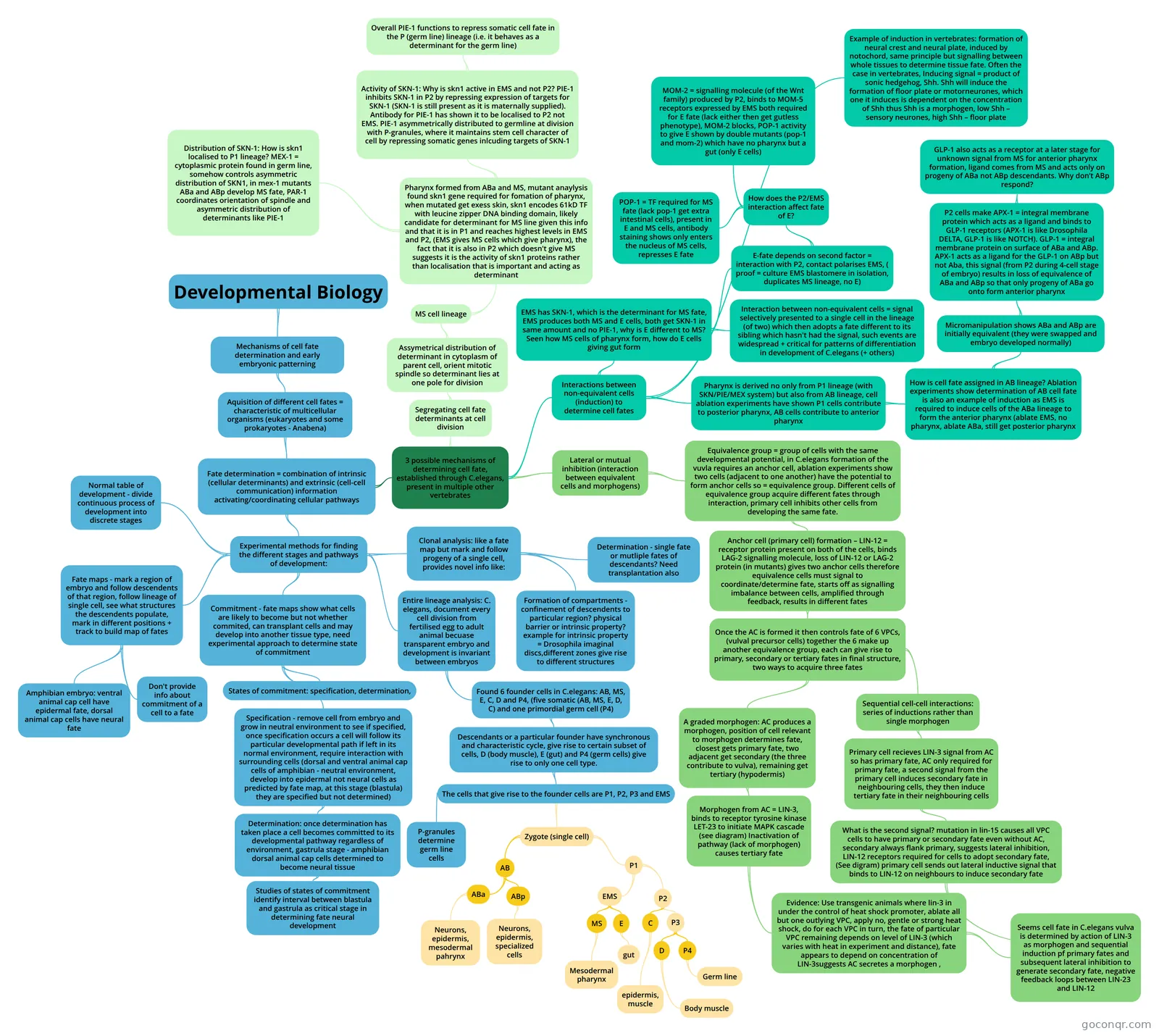
Mind map: Developmental biology
Inhalt der Mindmap
Developmental Biology
Mechanisms of cell fate determination and early embryonic patterning
- Aquisition of different cell fates = characteristic of multicellular organisms (eukaryotes and some prokaryotes - Anabena)
- Fate determination = combination of intrinsic (cellular determinants) and extrinsic (cell-cell communication) information activating/coordinating cellular pathways
- Experimental methods for finding the different stages and pathways of development:
- Normal table of development - divide continuous process of development into discrete stages
- Fate maps - mark a region of embryo and follow descendents of that region, follow lineage of single cell, see what structures the descendents populate, mark in different positions + track to build map of fates
- Amphibian embryo: ventral animal cap cell have epidermal fate, dorsal animal cap cells have neural fate
- Don't provide info about commitment of a cell to a fate
- Commitment - fate maps show what cells are likely to become but not whether commited, can transplant cells and may develop into another tissue type, need experimental approach to determine state of commitment
- Specification - remove cell from embryo and grow in neutral environment to see if specified, once specification occurs a cell will follow its particular developmental path if left in its normal environment, require interaction with surrounding cells (dorsal and ventral animal cap cells of amphibian - neutral environment, develop into epidermal not neural cells as predicted by fate map, at this stage (blastula) they are specified but not determined)
- Determination: once determination has taken place a cell becomes committed to its developmental pathway regardless of environment, gastrula stage - amphibian dorsal animal cap cells determined to become neural tissue
- Studies of states of commitment identify interval between blastula and gastrula as critical stage in determining fate neural development
- Determination: once determination has taken place a cell becomes committed to its developmental pathway regardless of environment, gastrula stage - amphibian dorsal animal cap cells determined to become neural tissue
- States of commitment: specification, determination,
- Specification - remove cell from embryo and grow in neutral environment to see if specified, once specification occurs a cell will follow its particular developmental path if left in its normal environment, require interaction with surrounding cells (dorsal and ventral animal cap cells of amphibian - neutral environment, develop into epidermal not neural cells as predicted by fate map, at this stage (blastula) they are specified but not determined)
- Clonal analysis: like a fate map but mark and follow progeny of a single cell, provides novel info like:
- Determination - single fate or mutliple fates of descendants? Need transplantation also
- Formation of compartments - confinement of descendents to particular region? physical barrier or intrinsic property? example for intrinsic property = Drosophila imaginal discs,different zones give rise to different structures
- Entire lineage analysis: C. elegans, document every cell division from fertilised egg to adult animal becuase transparent embryo and development is invariant between embryos
- Found 6 founder cells in C.elegans: AB, MS, E, C, D and P4, (five somatic (AB, MS, E, D, C) and one primordial germ cell (P4)
- Descendants or a particular founder have synchronous and characteristic cycle, give rise to certain subset of cells, D (body muscle), E (gut) and P4 (germ cells) give rise to only one cell type.
- The cells that give rise to the founder cells are P1, P2, P3 and EMS
- Zygote (single cell)
- AB
- ABa
- Neurons, epidermis, mesodermal pahrynx
- ABp
- Neurons, epidermis, specialized cells
- ABa
- P1
- EMS
- MS
- Mesodermal pharynx
- E
- gut
- MS
- P2
- C
- epidermis, muscle
- P3
- D
- Body muscle
- P4
- Germ line
- D
- C
- EMS
- AB
- P-granules determine germ line cells
- Zygote (single cell)
- The cells that give rise to the founder cells are P1, P2, P3 and EMS
- Descendants or a particular founder have synchronous and characteristic cycle, give rise to certain subset of cells, D (body muscle), E (gut) and P4 (germ cells) give rise to only one cell type.
- Found 6 founder cells in C.elegans: AB, MS, E, C, D and P4, (five somatic (AB, MS, E, D, C) and one primordial germ cell (P4)
- 3 possible mechanisms of determining cell fate, established through C.elegans, present in multiple other vertebrates
- Segregating cell fate determinants at cell division
- Assymetrical distribution of determinant in cytoplasm of parent cell, orient mitotic spindle so determinant lies at one pole for division
- MS cell lineage
- Pharynx formed from ABa and MS, mutant anaylysis found skn1 gene required for fomation of pharynx, when mutated get exess skin, skn1 encodes 61kD TF with leucine zipper DNA binding domain, likely candidate for determinant for MS line given this info and that it is in P1 and reaches highest levels in EMS and P2, (EMS gives MS cells which give pharynx), the fact that it is also in P2 which doesn't give MS suggests it is the activity of skn1 proteins rather than localisation that is important and acting as determinant
- Distribution of SKN-1: How is skn1 localised to P1 lineage? MEX-1 = cytoplasmic protein found in germ line, somehow controls asymmetric distribution of SKN1, in mex-1 mutants ABa and ABp develop MS fate, PAR-1 coordinates orientation of spindle and asymmetric distribution of determinants like PIE-1
- Activity of SKN-1: Why is skn1 active in EMS and not P2? PIE-1 inhibits SKN-1 in P2 by repressing expression of targets for SKN-1 (SKN-1 is still present as it is maternally supplied). Antibody for PIE-1 has shown it to be localised to P2 not EMS. PIE-1 asymmetrically distributed to germline at division with P-granules, where it maintains stem cell character of cell by repressing somatic genes inlcuding targets of SKN-1
- Overall PIE-1 functions to repress somatic cell fate in the P (germ line) lineage (i.e. it behaves as a determinant for the germ line)
- Pharynx formed from ABa and MS, mutant anaylysis found skn1 gene required for fomation of pharynx, when mutated get exess skin, skn1 encodes 61kD TF with leucine zipper DNA binding domain, likely candidate for determinant for MS line given this info and that it is in P1 and reaches highest levels in EMS and P2, (EMS gives MS cells which give pharynx), the fact that it is also in P2 which doesn't give MS suggests it is the activity of skn1 proteins rather than localisation that is important and acting as determinant
- MS cell lineage
- Assymetrical distribution of determinant in cytoplasm of parent cell, orient mitotic spindle so determinant lies at one pole for division
- Interactions between non-equivalent cells (induction) to determine cell fates
- EMS has SKN-1, which is the determinant for MS fate, EMS produces both MS and E cells, both get SKN-1 in same amount and no PIE-1, why is E different to MS? Seen how MS cells of pharynx form, how do E cells giving gut form
- E-fate depends on second factor = interaction with P2, contact polarises EMS, ( proof = culture EMS blastomere in isolation, duplicates MS lineage, no E)
- How does the P2/EMS interaction affect fate of E?
- POP-1 = TF required for MS fate (lack pop-1 get extra intestinal cells), present in E and MS cells, antibody staining shows only enters the nucleus of MS cells, represses E fate
- MOM-2 = signalling molecule (of the Wnt family) produced by P2, binds to MOM-5 receptors expressed by EMS both required for E fate (lack either then get gutless phenotype), MOM-2 blocks, POP-1 activity to give E shown by double mutants (pop-1 and mom-2) which have no pharynx but a gut (only E cells)
- How does the P2/EMS interaction affect fate of E?
- Interaction between non-equivalent cells = signal selectively presented to a single cell in the lineage (of two) which then adopts a fate different to its sibling which hasn't had the signal, such events are widespread + critical for patterns of differentiation in development of C.elegans (+ others)
- E-fate depends on second factor = interaction with P2, contact polarises EMS, ( proof = culture EMS blastomere in isolation, duplicates MS lineage, no E)
- Pharynx is derived no only from P1 lineage (with SKN/PIE/MEX system) but also from AB lineage, cell ablation experiments have shown P1 cells contribute to posterior pharynx, AB cells contribute to anterior pharynx
- How is cell fate assigned in AB lineage? Ablation experiments show determination of AB cell fate is also an example of induction as EMS is required to induce cells of the ABa lineage to form the anterior pharynx (ablate EMS, no pharynx, ablate ABa, still get posterior pharynx
- Micromanipulation shows ABa and ABp are initially equivalent (they were swapped and embryo developed normally)
- P2 cells make APX-1 = integral membrane protein which acts as a ligand and binds to GLP-1 receptors (APX-1 is like Drosophila DELTA, GLP-1 is like NOTCH). GLP-1 = integral membrane protein on surface of ABa and ABp. APX-1 acts as a ligand for the GLP-1 on ABp but not Aba, this signal (from P2 during 4-cell stage of embryo) results in loss of equivalence of ABa and ABp so that only progeny of ABa go onto form anterior pharynx
- GLP-1 also acts as a receptor at a later stage for unknown signal from MS for anterior pharynx formation, ligand comes from MS and acts only on progeny of ABa not ABp descendants. Why don’t ABp respond?
- P2 cells make APX-1 = integral membrane protein which acts as a ligand and binds to GLP-1 receptors (APX-1 is like Drosophila DELTA, GLP-1 is like NOTCH). GLP-1 = integral membrane protein on surface of ABa and ABp. APX-1 acts as a ligand for the GLP-1 on ABp but not Aba, this signal (from P2 during 4-cell stage of embryo) results in loss of equivalence of ABa and ABp so that only progeny of ABa go onto form anterior pharynx
- Micromanipulation shows ABa and ABp are initially equivalent (they were swapped and embryo developed normally)
- How is cell fate assigned in AB lineage? Ablation experiments show determination of AB cell fate is also an example of induction as EMS is required to induce cells of the ABa lineage to form the anterior pharynx (ablate EMS, no pharynx, ablate ABa, still get posterior pharynx
- Example of induction in vertebrates: formation of neural crest and neural plate, induced by notochord, same principle but signalling between whole tissues to determine tissue fate. Often the case in vertebrates, Inducing signal = product of sonic hedgehog, Shh. Shh will induce the formation of floor plate or motorneurones, which one it induces is dependent on the concentration of Shh thus Shh is a morphogen, low Shh – sensory neurones, high Shh – floor plate
- EMS has SKN-1, which is the determinant for MS fate, EMS produces both MS and E cells, both get SKN-1 in same amount and no PIE-1, why is E different to MS? Seen how MS cells of pharynx form, how do E cells giving gut form
- Lateral or mutual inhibition (interaction between equivalent cells and morphogens)
- Equivalence group = group of cells with the same developmental potential, in C.elegans formation of the vuvla requires an anchor cell, ablation experiments show two cells (adjacent to one another) have the potential to form anchor cells so = equivalence group. Different cells of equivalence group acquire different fates through interaction, primary cell inhibits other cells from developing the same fate.
- Anchor cell (primary cell) formation – LIN-12 = receptor protein present on both of the cells, binds LAG-2 signalling molecule, loss of LIN-12 or LAG-2 protein (in mutants) gives two anchor cells therefore equivalence cells must signal to coordinate/determine fate, starts off as signalling imbalance between cells, amplified through feedback, results in different fates
- Once the AC is formed it then controls fate of 6 VPCs, (vulval precursor cells) together the 6 make up another equivalence group, each can give rise to primary, secondary or tertiary fates in final structure, two ways to acquire three fates
- A graded morphogen: AC produces a morphogen, position of cell relevant to morphogen determines fate, closest gets primary fate, two adjacent get secondary (the three contribute to vulva), remaining get tertiary (hypodermis)
- Morphogen from AC = LIN-3, binds to receptor tyrosine kinase LET-23 to initiate MAPK cascade (see diagram) Inactivation of pathway (lack of morphogen) causes tertiary fate
- Evidence: Use transgenic animals where lin-3 in under the control of heat shock promoter, ablate all but one outlying VPC, apply no, gentle or strong heat shock, do for each VPC in turn, the fate of particular VPC remaining depends on level of LIN-3 (which varies with heat in experiment and distance), fate appears to depend on concentration of LIN-3suggests AC secretes a morphogen ,
- Seems cell fate in C.elegans vulva is determined by action of LIN-3 as morphogen and sequential induction pf primary fates and subsequent lateral inhibition to generate secondary fate, negative feedback loops between LIN-23 and LIN-12
- Evidence: Use transgenic animals where lin-3 in under the control of heat shock promoter, ablate all but one outlying VPC, apply no, gentle or strong heat shock, do for each VPC in turn, the fate of particular VPC remaining depends on level of LIN-3 (which varies with heat in experiment and distance), fate appears to depend on concentration of LIN-3suggests AC secretes a morphogen ,
- Morphogen from AC = LIN-3, binds to receptor tyrosine kinase LET-23 to initiate MAPK cascade (see diagram) Inactivation of pathway (lack of morphogen) causes tertiary fate
- Sequential cell-cell interactions: series of inductions rather than single morphogen
- Primary cell recieves LIN-3 signal from AC so has primary fate, AC only required for primary fate, a second signal from the primary cell induces secondary fate in neighbouring cells, they then induce tertiary fate in their neighbouring cells
- What is the second signal? mutation in lin-15 causes all VPC cells to have primary or secondary fate even without AC, secondary always flank primary, suggests lateral inhibition, LIN-12 receptors required for cells to adopt secondary fate, (See digram) primary cell sends out lateral inductive signal that binds to LIN-12 on neighbours to induce secondary fate
- What is the second signal? mutation in lin-15 causes all VPC cells to have primary or secondary fate even without AC, secondary always flank primary, suggests lateral inhibition, LIN-12 receptors required for cells to adopt secondary fate, (See digram) primary cell sends out lateral inductive signal that binds to LIN-12 on neighbours to induce secondary fate
- Primary cell recieves LIN-3 signal from AC so has primary fate, AC only required for primary fate, a second signal from the primary cell induces secondary fate in neighbouring cells, they then induce tertiary fate in their neighbouring cells
- A graded morphogen: AC produces a morphogen, position of cell relevant to morphogen determines fate, closest gets primary fate, two adjacent get secondary (the three contribute to vulva), remaining get tertiary (hypodermis)
- Once the AC is formed it then controls fate of 6 VPCs, (vulval precursor cells) together the 6 make up another equivalence group, each can give rise to primary, secondary or tertiary fates in final structure, two ways to acquire three fates
- Anchor cell (primary cell) formation – LIN-12 = receptor protein present on both of the cells, binds LAG-2 signalling molecule, loss of LIN-12 or LAG-2 protein (in mutants) gives two anchor cells therefore equivalence cells must signal to coordinate/determine fate, starts off as signalling imbalance between cells, amplified through feedback, results in different fates
- Equivalence group = group of cells with the same developmental potential, in C.elegans formation of the vuvla requires an anchor cell, ablation experiments show two cells (adjacent to one another) have the potential to form anchor cells so = equivalence group. Different cells of equivalence group acquire different fates through interaction, primary cell inhibits other cells from developing the same fate.
- Segregating cell fate determinants at cell division
- Experimental methods for finding the different stages and pathways of development:
- Fate determination = combination of intrinsic (cellular determinants) and extrinsic (cell-cell communication) information activating/coordinating cellular pathways
- Aquisition of different cell fates = characteristic of multicellular organisms (eukaryotes and some prokaryotes - Anabena)
Informationen
- Beschreibung
- 2 CDB Lent Mindmap am Developmental Biology, erstellt von Emily Lythgoe am 28/02/2016.
- Erstellt von
- Emily Lythgoe
- Aufrufe
- 1
- Bewertung