
Mindmap
organic chemistry

Inhalt der Mindmap
organic chemistry
combustion
- alcohol+O2->CO2+H2O
- biofuels(more photosynthesis)
- alkane
- complete(o2 not limited)
- alkane+O2->CO2+H2O
- O2 limited (incoplete )
- alkane+O2->CO2+CO+H2O
- complete(o2 not limited)
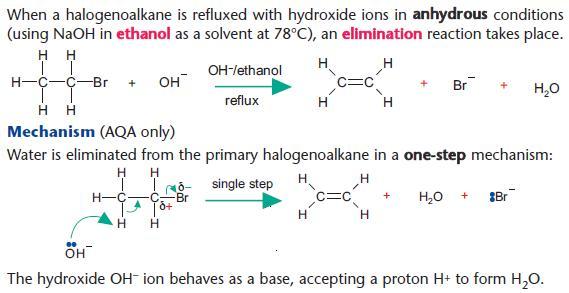
elimination
- a reaction in which a small molecule, such as H2O or HCl, is removed from an organic molecule
- of Halogenoalkanes
- removed molecule is HX
- ethanolic NaOH
- OHminus act as base
- The original 2-bromopropane molecule has lost an H atom and a Br atom. We can think of it as HBr being eliminated from the halogenoalkane. The ethanolic OH– ion acts as a base, accepting an H+ from the halogenoalkane to form water. The C Br bond breaks heterolytically, forming a Br– ion and leaving an alkene as the organic product
- OHminus act as base
- ethanolic NaOH
- removed molecule is HX
- dehydration of alchols
- H2O is removed
- alkene+water
- alcohol vapor
- Al2O3 or SiO2or H2SO4
- H2O is removed
substitution
- eaction that involves the replacement of one atom, or group of atoms, by another.
- ree-radical substitution the reaction in which halogen atoms substitute for hydrogen atoms in alkanes. The mechanism involves steps in which reactive free radicals are produced (initiation), regenerated (propagation) and consumed (termination)
- Alkanes(free radical substitution
- homolytic fission
- mechanism
- termination
- only free radicle react
- they form a molecule
- only free radicle react
- propagation
- free radicles are very reaxtive
- free radicles hits the normal molecule >CH3radicle
- free radicles are very reaxtive
- intiation
- energy is put in to break the bonds,
- only 2 free radicles formed
- energy is put in to break the bonds,
- termination
- mechanism
- homolytic fission
- halogenoalkane
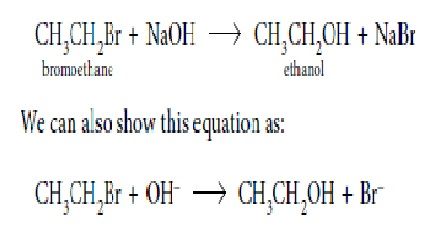
- with alkali(OHminus)Aq
- The halogen atom in the halogenoalkane is replaced by an OH, hydroxyl group, so the organic product formed is an alcohol
- gives alcohol
- wtih cyanide ion,CN- in ethanol
- heated in reflux with the halogenoalkane
- extra carbon atom is added
- CH3CH2Br + CN->CH3CH2CN + Br–
- heated in reflux with the halogenoalkane
- with NH3
- If a halogenoalkane is heated with an excess of ammonia dissolved in ethanol under pressure, an amine is formed.
- CH3CH2Br + NH3--> CH3CH2NH2 + HBr
- amine is formed
- CH3CH2Br + NH3--> CH3CH2NH2 + HBr
- If a halogenoalkane is heated with an excess of ammonia dissolved in ethanol under pressure, an amine is formed.
- with alkali(OHminus)Aq
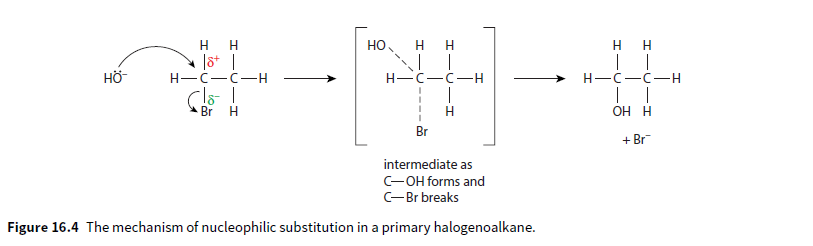
- Mechanism of nucleophilic substitution in halogenoalkanes
- nucleophiles are donors of an electron pair and are attracted to electron-deficient atoms
- primary SN2(heterolytic)
- when C is boned to X and one CH3(+2H)
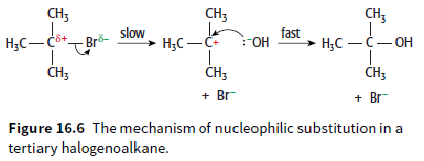
- SN1 Tertiary
- The Br– ion forms again, as in the SN2 mechanism, but in this mechanism a carbocation ion forms. This does not happen with primary halogenoalkanes. This is because tertiary carbocations are more stable than primary carbocations due to the inductive effect of the alkyl groups attached to the carbon atom bonded to the halogen. Alkyl groups tend to release electrons to atoms attached to them. So a tertiary carbocation has three alkyl groups donating electrons towards the positively charged carbon atom, reducing its charge density. This makes it more stable than a primary carbocation, which just has one alkyl group releasing electrons
- the C bonded to X is also bonded to 3C(s) or CH3(s)
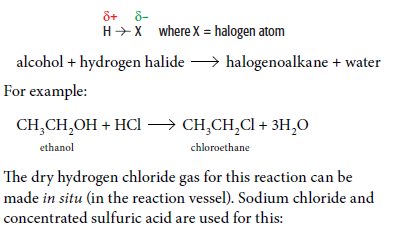
- of alcohols forms halogenoalkanes
hydrolysis
- the breakdown of a compound by water, which is often speeded up by reacting with acid or alkali.
- nucleophilic hydrolysis of halogenoalkane
- CH3CH2Br+H2O(IN AgNO3)-->CH3CH2OH+H-PLUS+Br MINUS
- reflux
oxidation
- crease in Oxidation nu# losss of e gain of oxygen loss of hydrogen
- alkene
- alkene converted to diol
- cold
- dilute acidified KMnO4
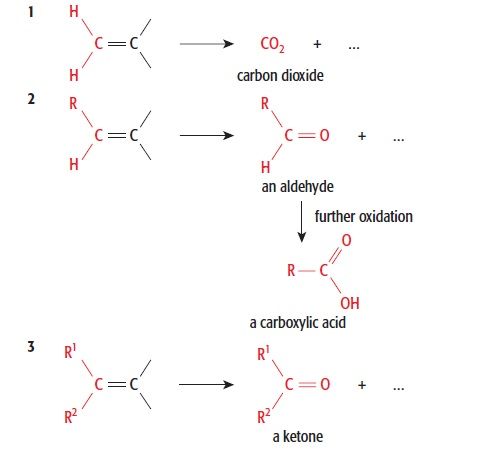
- CO2 or aldehyde.carboxylic and or keton
- hot
- conc. MNslo
- alkene converted to diol
reduction
- decrease in Oxidation nu# losss of e gain of oxygen loss of hydrogen
Addition
- an organic reaction in which two reactant molecules combine to give a single product molecule.
- c=c broken and eache carbon makes a new segma bond
- alkene[C=C is broken]
- H2->>alkane
- Ni(finely powdered catalyst
- 140 degree C
- steam->> alcohol
- gaseous alkene
- 6mega pa
- 330 degree C
- catalyst
- phosphoric
- tungestic
- dilute H2SO4
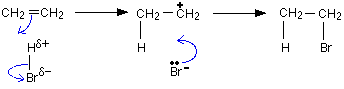
- mechanism of electrophilic
- HX->> halogenoalkane
- conc.sol. of HX(HF,HCl... ROOM TEP
- when not symetric ^ markovnikov alkene will decolorise
- When a compound HX is added to an unsymmetrical alkene, the hydrogen becomes attached to the carbon with the most hydrogens attached to it already.
- when not symetric ^ markovnikov alkene will decolorise
- conc.sol. of HX(HF,HCl... ROOM TEP
- electrophile can easily attact the c=c
- electrophile acceptor of e H+
- HX is polar due to electronegativity
- the only difference is in how fast the reactions happen with the different hydrogen halides. The rate of reaction increases as you go from HF to HCl to HBr to HI.
- The reason for this is that as the halogen atoms get bigger, the strength of the hydrogen-halogen bond falls. Bond strengths (measured in kilojoules per mole) are: H-F 568 H-Cl 432 H-Br 366 H-I 298
- the only difference is in how fast the reactions happen with the different hydrogen halides. The rate of reaction increases as you go from HF to HCl to HBr to HI.
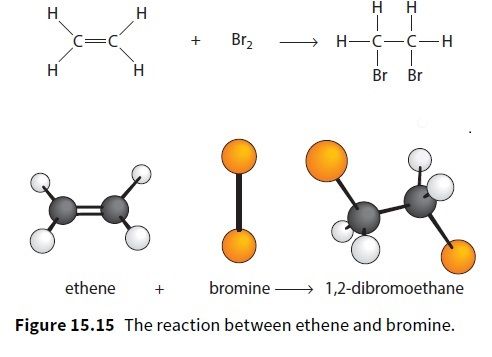
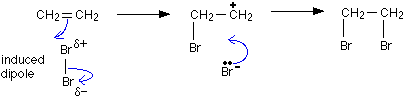
- c=c will polarize the nonpolar br-br
- Bromine as an electrophileThe bromine is a very "polarisable" molecule and the approaching pi bond in the ethene induces a dipole in the bromine molecule. If you draw this mechanism in an exam, write the words "induced dipole" next to the bromine molecule - to show that you understand what's going on.
- X2(halogens)
- yellow color of br is decolorised
- HX->> halogenoalkane
- H2->>alkane
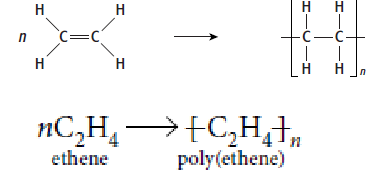
- polymerizzation
Bilder und Dateien der Mindmap
Informationen
- Beschreibung
- 9701 organic chemistry (includes the reactions and their mechanisms
- Erstellt von
- asdq dfjsk
- Aufrufe
- 380
- Tags
- Bewertung