
Mindmap
Lecture 3: Stress & Wellbeing
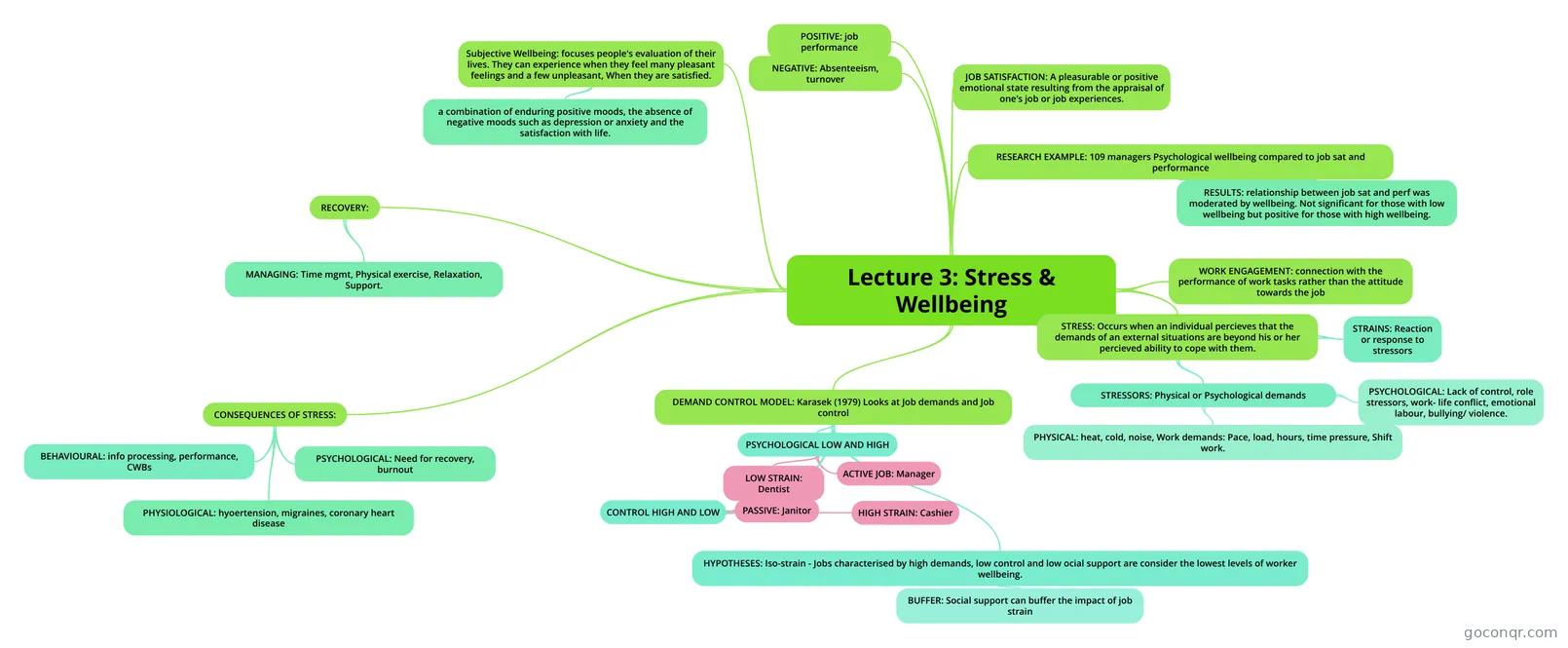
Mind map: stress and wellbeing
Inhalt der Mindmap
Lecture 3: Stress & Wellbeing
Subjective Wellbeing: focuses people's evaluation of their lives. They can experience when they feel many pleasant feelings and a few unpleasant, When they are satisfied.
- a combination of enduring positive moods, the absence of negative moods such as depression or anxiety and the satisfaction with life.
POSITIVE: job performance
NEGATIVE: Absenteeism, turnover
JOB SATISFACTION: A pleasurable or positive emotional state resulting from the appraisal of one's job or job experiences.
RESEARCH EXAMPLE: 109 managers Psychological wellbeing compared to job sat and performance
- RESULTS: relationship between job sat and perf was moderated by wellbeing. Not significant for those with low wellbeing but positive for those with high wellbeing.
WORK ENGAGEMENT: connection with the performance of work tasks rather than the attitude towards the job
STRESS: Occurs when an individual percieves that the demands of an external situations are beyond his or her percieved ability to cope with them.
- STRESSORS: Physical or Psychological demands
- PHYSICAL: heat, cold, noise, Work demands: Pace, load, hours, time pressure, Shift work.
- PSYCHOLOGICAL: Lack of control, role stressors, work- life conflict, emotional labour, bullying/ violence.
- STRAINS: Reaction or response to stressors
- STRESSORS: Physical or Psychological demands
DEMAND CONTROL MODEL: Karasek (1979) Looks at Job demands and Job control
- PSYCHOLOGICAL LOW AND HIGH
- LOW STRAIN: Dentist
- ACTIVE JOB: Manager
- CONTROL HIGH AND LOW
- PASSIVE: Janitor
- HIGH STRAIN: Cashier
- HYPOTHESES: Iso-strain - Jobs characterised by high demands, low control and low ocial support are consider the lowest levels of worker wellbeing.
- BUFFER: Social support can buffer the impact of job strain
- PSYCHOLOGICAL LOW AND HIGH
CONSEQUENCES OF STRESS:
- BEHAVIOURAL: info processing, performance, CWBs
- PSYCHOLOGICAL: Need for recovery, burnout
- PHYSIOLOGICAL: hyoertension, migraines, coronary heart disease
RECOVERY:
- MANAGING: Time mgmt, Physical exercise, Relaxation, Support.
Informationen
- Beschreibung
- University Human Resources 3345 Mindmap am Lecture 3: Stress & Wellbeing, erstellt von shannaebrydon am 28/01/2014.
- Erstellt von
- shannaebrydon
- Aufrufe
- 62
- Tags
- Bewertung