
Mindmap
Free Will
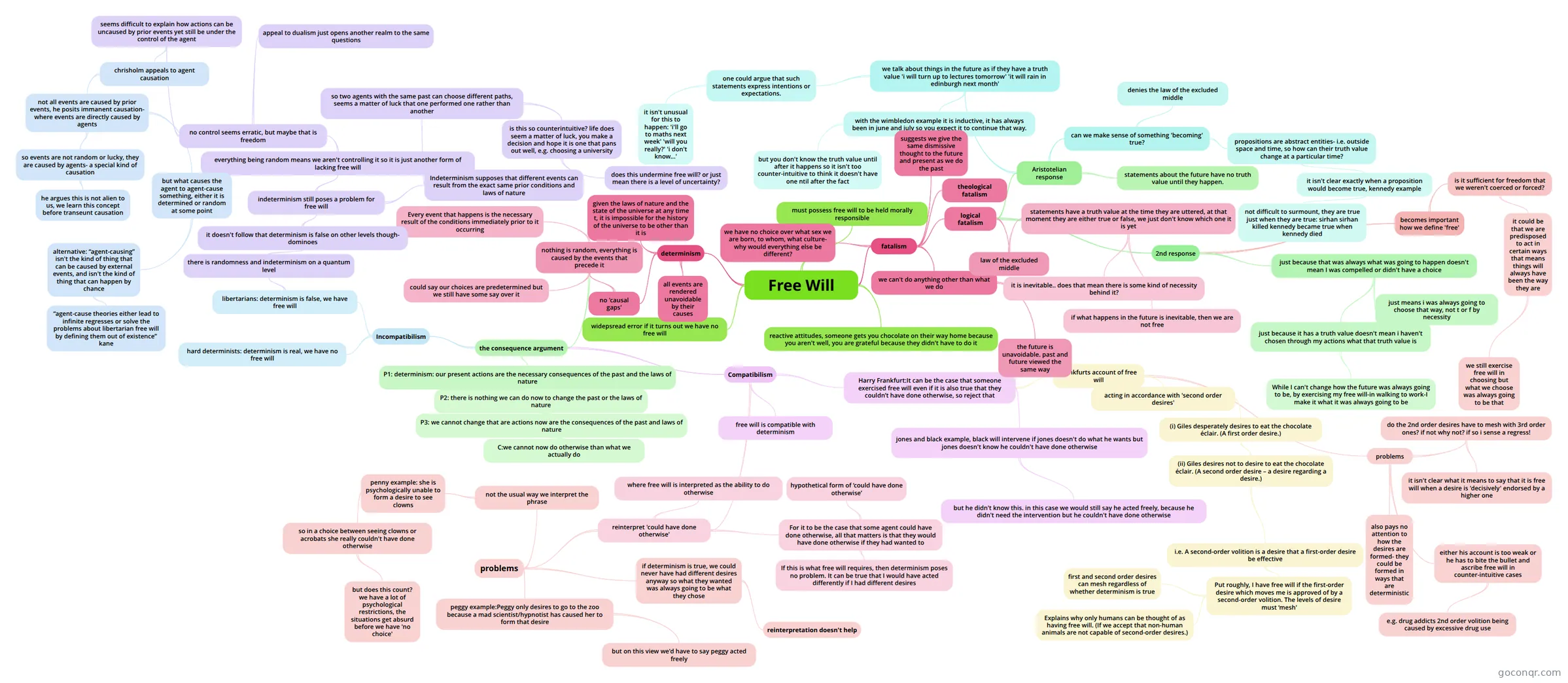
Mind map: Free will
Inhalt der Mindmap
Free Will
must possess free will to be held morally responsible
reactive attitudes, someone gets you chocolate on their way home because you aren't well, you are grateful because they didn't have to do it
widepsread error if it turns out we have no free will
fatalism
- we can't do anything other than what we do
- the future is unavoidable. past and future viewed the same way
- theological fatalism
- logical fatalism
- law of the excluded middle
- statements have a truth value at the time they are uttered, at that moment they are either true or false, we just don't know which one it is yet
- it is inevitable.. does that mean there is some kind of necessity behind it?
- if what happens in the future is inevitable, then we are not free
- statements have a truth value at the time they are uttered, at that moment they are either true or false, we just don't know which one it is yet
- Aristotelian response
- statements about the future have no truth value until they happen.
- can we make sense of something 'becoming' true?
- propositions are abstract entities- i.e. outside space and time, so how can their truth value change at a particular time?
- it isn't clear exactly when a proposition would become true, kennedy example
- not difficult to surmount, they are true just when they are true: sirhan sirhan killed kennedy became true when kennedy died
- it isn't clear exactly when a proposition would become true, kennedy example
- denies the law of the excluded middle
- propositions are abstract entities- i.e. outside space and time, so how can their truth value change at a particular time?
- we talk about things in the future as if they have a truth value 'i will turn up to lectures tomorrow' 'it will rain in edinburgh next month'
- one could argue that such statements express intentions or expectations.
- it isn't unusual for this to happen: 'i'll go to maths next week' 'will you really?' 'i don't know...'
- with the wimbledon example it is inductive, it has always been in june and july so you expect it to continue that way.
- but you don't know the truth value until after it happens so it isn't too counter-intuitive to think it doesn't have one ntil after the fact
- one could argue that such statements express intentions or expectations.
- 2nd response
- just because that was always what was going to happen doesn't mean I was compelled or didn't have a choice
- just means i was always going to choose that way, not t or f by necessity
- just because it has a truth value doesn't mean i haven't chosen through my actions what that truth value is
- While I can't change how the future was always going to be, by exercising my free will-in walking to work-I make it what it was always going to be
- becomes important how we define 'free'
- is it sufficient for freedom that we weren't coerced or forced?
- it could be that we are predisposed to act in certain ways that means things will always have been the way they are
- we still exercise free will in choosing but what we choose was always going to be that
- it could be that we are predisposed to act in certain ways that means things will always have been the way they are
- is it sufficient for freedom that we weren't coerced or forced?
- just because that was always what was going to happen doesn't mean I was compelled or didn't have a choice
- law of the excluded middle
- we have no choice over what sex we are born, to whom, what culture- why would everything else be different?
- suggests we give the same dismissive thought to the future and present as we do the past
- we can't do anything other than what we do
determinism
- given the laws of nature and the state of the universe at any time t, it is impossible for the history of the universe to be other than it is
- no 'causal gaps'
- nothing is random, everything is caused by the events that precede it
- could say our choices are predetermined but we still have some say over it
- Every event that happens is the necessary result of the conditions immediately prior to it occurring
- the consequence argument
- P1: determinism: our present actions are the necessary consequences of the past and the laws of nature
- P2: there is nothing we can do now to change the past or the laws of nature
- P3: we cannot change that are actions now are the consequences of the past and laws of nature
- C:we cannot now do otherwise than what we actually do
- P3: we cannot change that are actions now are the consequences of the past and laws of nature
- P2: there is nothing we can do now to change the past or the laws of nature
- Compatibilism
- free will is compatible with determinism
- reinterpret 'could have done otherwise'
- where free will is interpreted as the ability to do otherwise
- For it to be the case that some agent could have done otherwise, all that matters is that they would have done otherwise if they had wanted to
- hypothetical form of ‘could have done otherwise’
- If this is what free will requires, then determinism poses no problem. It can be true that I would have acted differently if I had different desires
- problems
- peggy example:Peggy only desires to go to the zoo because a mad scientist/hypnotist has caused her to form that desire
- but on this view we'd have to say peggy acted freely
- not the usual way we interpret the phrase
- penny example: she is psychologically unable to form a desire to see clowns
- so in a choice between seeing clowns or acrobats she really couldn't have done otherwise
- but does this count? we have a lot of psychological restrictions, the situations get absurd before we have 'no choice'
- so in a choice between seeing clowns or acrobats she really couldn't have done otherwise
- penny example: she is psychologically unable to form a desire to see clowns
- if determinism is true, we could never have had different desires anyway so what they wanted was always going to be what they chose
- reinterpretation doesn't help
- peggy example:Peggy only desires to go to the zoo because a mad scientist/hypnotist has caused her to form that desire
- Harry Frankfurt:It can be the case that someone exercised free will even if it is also true that they couldn’t have done otherwise, so reject that
- jones and black example, black will intervene if jones doesn't do what he wants but jones doesn't know he couldn't have done otherwise
- but he didn't know this. in this case we would still say he acted freely, because he didn't need the intervention but he couldn't have done otherwise
- frankfurts account of free will
- acting in accordance with 'second order desires'
- (i) Giles desperately desires to eat the chocolate éclair. (A first order desire.)
- (ii) Giles desires not to desire to eat the chocolate éclair. (A second order desire – a desire regarding a desire.)
- i.e. A second-order volition is a desire that a first-order desire be effective
- Put roughly, I have free will if the first-order desire which moves me is approved of by a second-order volition. The levels of desire must ‘mesh'
- first and second order desires can mesh regardless of whether determinism is true
- Explains why only humans can be thought of as having free will. (If we accept that non-human animals are not capable of second-order desires.)
- Put roughly, I have free will if the first-order desire which moves me is approved of by a second-order volition. The levels of desire must ‘mesh'
- i.e. A second-order volition is a desire that a first-order desire be effective
- (ii) Giles desires not to desire to eat the chocolate éclair. (A second order desire – a desire regarding a desire.)
- (i) Giles desperately desires to eat the chocolate éclair. (A first order desire.)
- problems
- do the 2nd order desires have to mesh with 3rd order ones? if not why not? if so i sense a regress!
- it isn't clear what it means to say that it is free will when a desire is 'decisively' endorsed by a higher one
- also pays no attention to how the desires are formed- they could be formed in ways that are deterministic
- either his account is too weak or he has to bite the bullet and ascribe free will in counter-intuitive cases
- e.g. drug addicts 2nd order volition being caused by excessive drug use
- do the 2nd order desires have to mesh with 3rd order ones? if not why not? if so i sense a regress!
- acting in accordance with 'second order desires'
- jones and black example, black will intervene if jones doesn't do what he wants but jones doesn't know he couldn't have done otherwise
- Incompatibilism
- libertarians: determinism is false, we have free will
- there is randomness and indeterminism on a quantum level
- it doesn't follow that determinism is false on other levels though- dominoes
- indeterminism still poses a problem for free will
- everything being random means we aren't controlling it so it is just another form of lacking free will
- no control seems erratic, but maybe that is freedom
- appeal to dualism just opens another realm to the same questions
- seems difficult to explain how actions can be uncaused by prior events yet still be under the control of the agent
- chrisholm appeals to agent causation
- not all events are caused by prior events, he posits immanent causation- where events are directly caused by agents
- so events are not random or lucky, they are caused by agents- a special kind of causation
- he argues this is not alien to us, we learn this concept before transeunt causation
- but what causes the agent to agent-cause something, either it is determined or random at some point
- alternative: “agent-causing” isn't the kind of thing that can be caused by external events, and isn't the kind of thing that can happen by chance
- “agent-cause theories either lead to infinite regresses or solve the problems about libertarian free will by defining them out of existence” kane
- alternative: “agent-causing” isn't the kind of thing that can be caused by external events, and isn't the kind of thing that can happen by chance
- so events are not random or lucky, they are caused by agents- a special kind of causation
- not all events are caused by prior events, he posits immanent causation- where events are directly caused by agents
- chrisholm appeals to agent causation
- no control seems erratic, but maybe that is freedom
- Indeterminism supposes that different events can result from the exact same prior conditions and laws of nature
- so two agents with the same past can choose different paths, seems a matter of luck that one performed one rather than another
- is this so counterintuitive? life does seem a matter of luck, you make a decision and hope it is one that pans out well, e.g. choosing a university
- does this undermine free will? or just mean there is a level of uncertainty?
- is this so counterintuitive? life does seem a matter of luck, you make a decision and hope it is one that pans out well, e.g. choosing a university
- so two agents with the same past can choose different paths, seems a matter of luck that one performed one rather than another
- everything being random means we aren't controlling it so it is just another form of lacking free will
- indeterminism still poses a problem for free will
- it doesn't follow that determinism is false on other levels though- dominoes
- there is randomness and indeterminism on a quantum level
- hard determinists: determinism is real, we have no free will
- libertarians: determinism is false, we have free will
- P1: determinism: our present actions are the necessary consequences of the past and the laws of nature
- nothing is random, everything is caused by the events that precede it
- all events are rendered unavoidable by their causes
Informationen
- Beschreibung
- Mindmap am Free Will, erstellt von Mikhia am 23/04/2013.
- Erstellt von
- Mikhia
- Aufrufe
- 35
- Bewertung
Mehr zu Free will and determinism