
Mindmap
Temperature Adaptation (1)
Inhalt der Mindmap
Temperature Adaptation (1)
Terminology used to describe microorganisms in relation to temperature
- Psychrophile
- Minimum: Below 0 oC
- Optimum: 10-15 oC
- Maximum: Below 20 oC
- Optimum: 10-15 oC
- Grows best at relatively low T
- Minimum: Below 0 oC
- Psychrotroph
- Minimum: 0 oC
- Optimum: 15-30 oC
- Maximum: Above 25 oC
- Optimum: 15-30 oC
- Able to grow at low T but prefer moderate T
- Minimum: 0 oC
- Mesophile
- Minimum: 10-15 oC
- Optimum: 30-40 oC
- Maximum: Below 45 oC
- Optimum: 30-40 oC
- Most bacteria esp. those living in association with warm-blooded animals
- Minimum: 10-15 oC
- Thermophile
- Minimum: 45 oC
- Optimum: 45-70 oC
- Maximum: Above 100 oC (boiling)
- Optimum: 45-70 oC
- Among all thermophiles is wide variation in optimum and maximum T
- Minimum: 45 oC
- Psychrophile
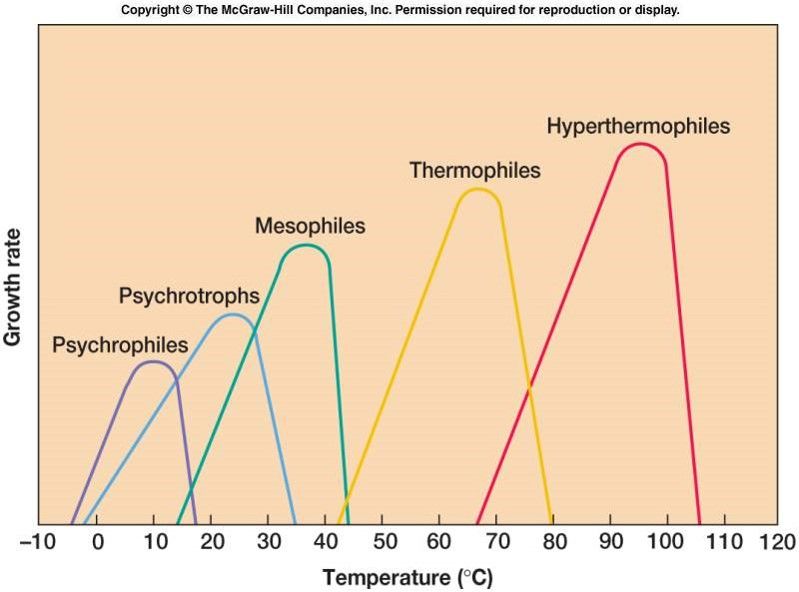
Growth rate versus temperature for different classes of bacteria
- Most bacteria will grow over a temperature range of about 30 oC. The curves exhibit 3 cardinal points: minimum, optimum and maximum temperatures for growth. There is a steady increase in growth rate between minimum and optimum temperatures, but slightly past the optimum a critical thermolabile cellular event occurs, and the growth rates plunge rapidly as the maximum T is approached.
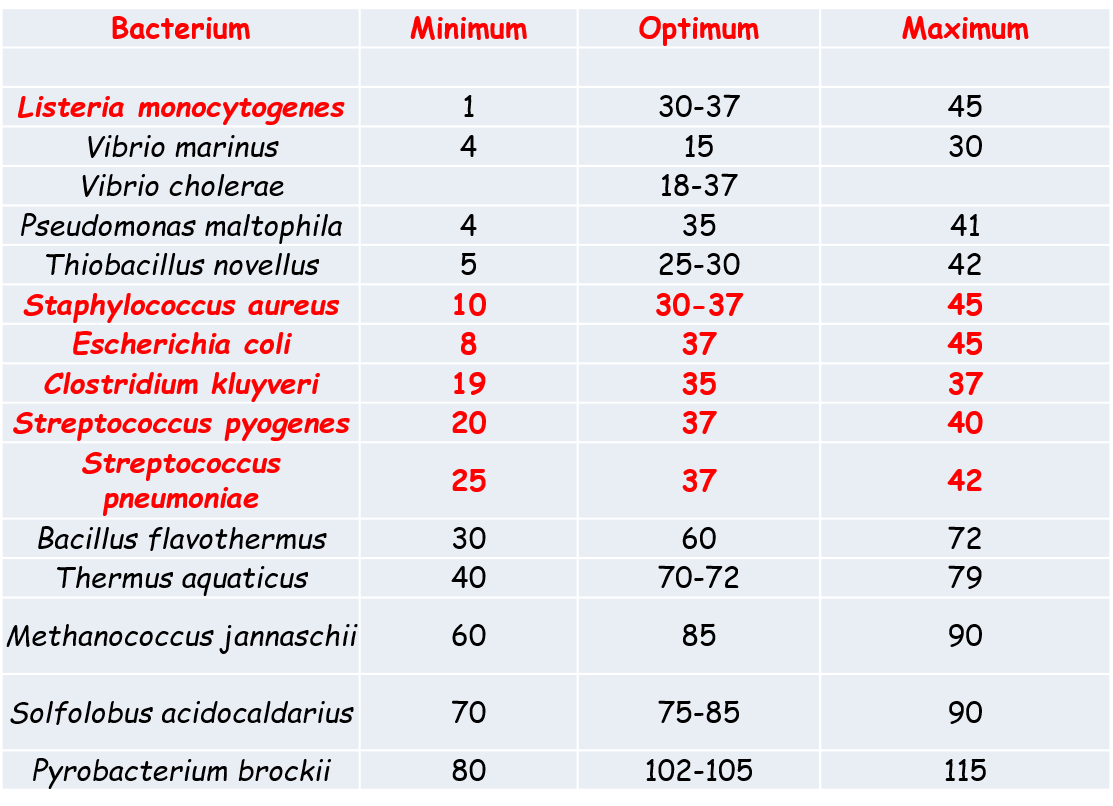
Minimum, maximum and optimum temperature for growth of certain bacteria and archaea
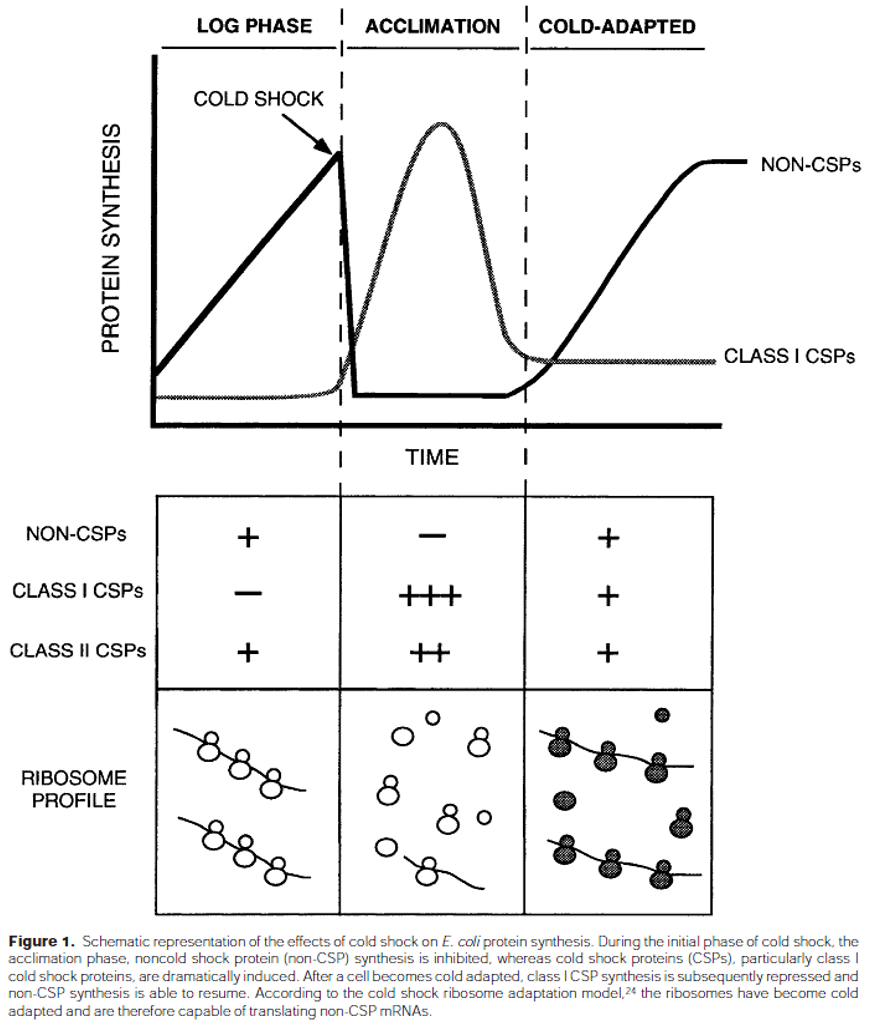
Cold shock and adaptation
- For example: E.coli
- A downshift in T causes transient inhibition of most protein synthesis- causes a growth lag known as acclimation phase during the acclimation phase a group of cold shock proteins (Csp) are dramatically induced.
- Some of these cold shock proteins are essential for the cell to resume growth at low T.
- E.coli
- Class II (<10-fold induction)
- RecA= Recombination factor
- GyrA= Subunit of topoisomerase DNA gyrase
- IF-2= Initiation factor
- H-NS= Nucleoid-associated DNA-binding protein
- Class I ( >10-fold induction)
- CspA family
- CspA= RNA chaperone
- CspB= RNA/ DNA chaperone(?)
- CspG= RNA/ DNA chaperone(?)
- CsdA= 70 kDa ribosome- associated protein (RNA unwinding activity)
- RbfA= 15- kDa 30s ribosomal binding factor
- NusA= Involved in termination and anti-termination
- RNP Ribonuclease
- CspA family
- Class II (<10-fold induction)
Listeria
- Non-spore forming Gram positive bacilli
- Listeriosis
- Infections are still quite rare and most healthy adults will not be affected. Pregnant women who have this infection later in their pregnancy can become ill and the baby may die or be born prematurely. Immunocompromised people may also become suddenly ill when infected.
- Widespread in the environment and is commonly found in vegetation, water, soil, wild or domestic animals, fish, birds as well as people.
- Capable of growth over a wide range of temperatures (4-40 oC)
- How is Listeria spread?
- Main method of infection is through eating contaminated foods that contain the bacteria. The infection can then be transferred to an unborn child during pregnancy if the mother is infected
- Listeria can grow and multiply at low temperatures
- Foodstuffs that have been implicated:
- Meats
- Unpasteurized milk
- Contaminated veg
- Seafood
- I.e. foods that require not further heat treatment or processing prior to being eaten and have longer shelf life
- Listeria virulence factors
- Involved in invasion of mammalian cells
- Internalin A and B
- Required for escape from a single membrane vacuole
- LLO (listeriolysin)- a pore forming cytotoxin
- PI-PLC (PlcA)- an enzyme that removes charged head groups from phospholipids
- Requires for movement through the cytoplasm
- ActA- interacts with host cell proteins to stimulate actin polymerisation
- Actin tail forms at one end of the cell, propels the bacterium through the cytoplasm
- Projections from the host cell surface caused by bacteria enter adjacent cells; bacteria inside double membrane vacuole
- Required for escape from double membrane vacuole
- PC-PLC (PlcB)- a phospholipase that cleaves the head group from many different kinds of lipids
- Regulation of virulence factors
- PrfA- positive regulation of virulence genes, may respond to temperature
- Involved in invasion of mammalian cells
Bilder und Dateien der Mindmap
Informationen
- Beschreibung
- University Infection- Microbial Pathogens Mindmap am Temperature Adaptation (1), erstellt von alex_antonia am 19/05/2016.
- Erstellt von
- alex_antonia
- Aufrufe
- 0
- Bewertung