
Mindmap
Advance Programming 1
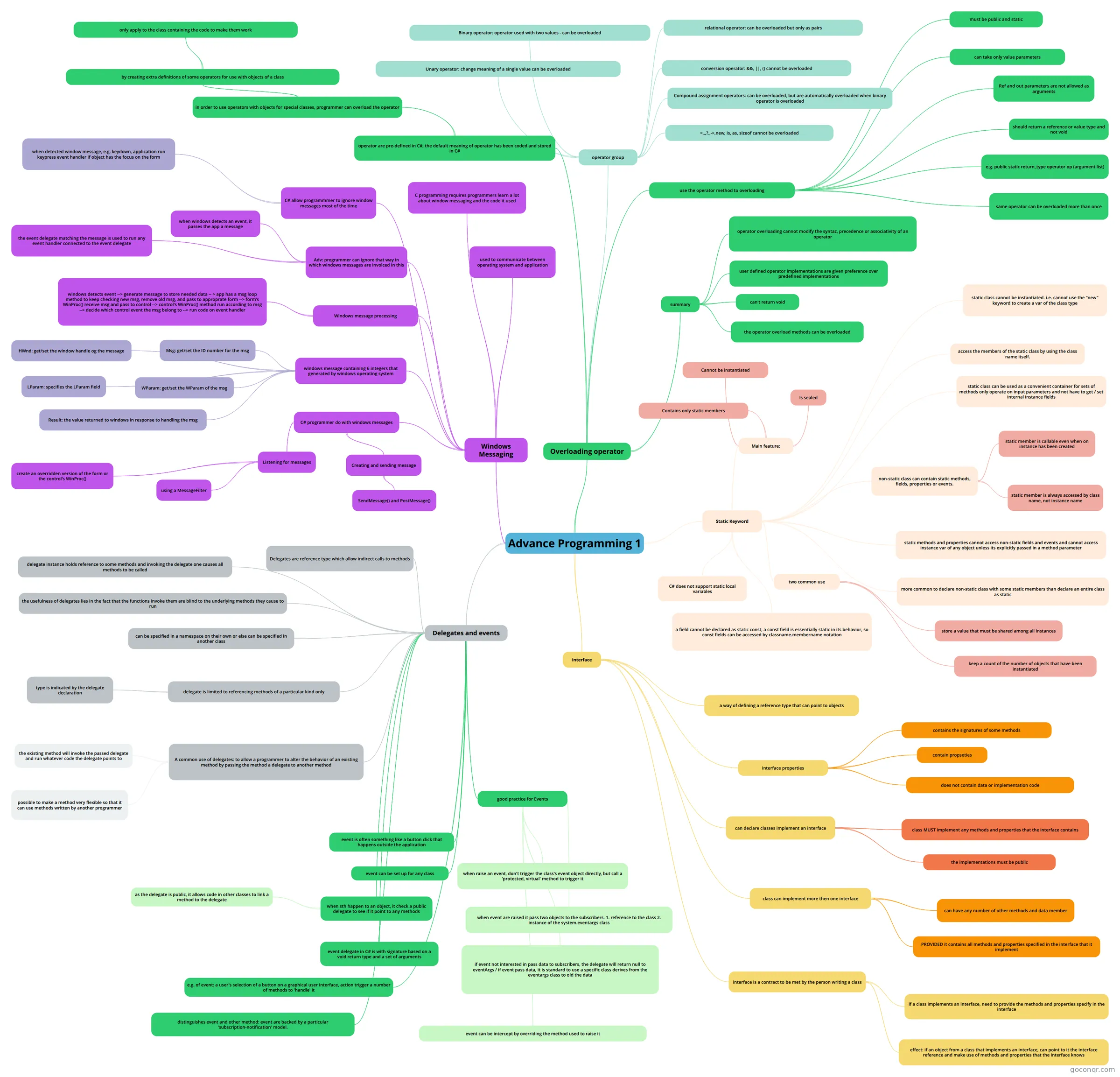
Mind map: Advance programming 1 C#
Inhalt der Mindmap
Advance Programming 1
Windows Messaging
- used to communicate between operating system and application
- C programming requires programmers learn a lot about window messaging and the code it used
- C# allow programmmer to ignore window messages most of the time
- when detected window message, e.g. keydown, application run keypress event handler if object has the focus on the form
- Adv: programmer can ignore that way in which windows messages are involced in this
- when windows detects an event, it passes the app a message
- the event delegate matching the message is used to run any event handler connected to the event delegate
- windows message containing 6 integers that generated by windows operating system
- HWnd: get/set the window handle og the message
- Msg: get/set the ID number for the msg
- LParam: specifies the LParam field
- WParam: get/set the WParam of the msg
- Result: the value returned to windows in response to handling the msg
- C# programmer do with windows messages
- Listening for messages
- create an overridden version of the form or the control's WinProc()
- using a MessageFilter
- Creating and sending message
- SendMessage() and PostMessage()
- Listening for messages
- Windows message processing
- windows detects event --> generate message to store needed data -- > app has a msg loop method to keep checking new msg, remove old msg, and pass to approprate form --> form's WinProc() receive msg and pass to control --> control's WinProc() method run according to msg --> decide which control event the msg belong to --> run code on event handler
Overloading operator
- operator are pre-defined in C#, the default meaning of operator has been coded and stored in C#
- in order to use operators with objects for special classes, programmer can overload the operator
- by creating extra definitions of some operators for use with objects of a class
- only apply to the class containing the code to make them work
- by creating extra definitions of some operators for use with objects of a class
- in order to use operators with objects for special classes, programmer can overload the operator
- operator group
- Unary operator: change meaning of a single value can be overloaded
- e.g "-1" +,-,|,~,++,--,true,false
- Binary operator: operator used with two values - can be overloaded
- e.g "1+2" +,-,*,/,%,&,|,<<,>>
- relational operator: can be overloaded but only as pairs
- ==,|=,<,>,<=,>=
- conversion operator: &&, ||, () cannot be overloaded
- Compound assignment operators: can be overloaded, but are automatically overloaded when binary operator is overloaded
- +=,-=,*=,/=,%=
- =,.,?.,->,new, is, as, sizeof cannot be overloaded
- Unary operator: change meaning of a single value can be overloaded
- use the operator method to overloading
- must be public and static
- can take only value parameters
- Ref and out parameters are not allowed as arguments
- e.g. public static return_type operator op (argument list)
- should return a reference or value type and not void
- same operator can be overloaded more than once
- summary
- operator overloading cannot modify the syntaz, precedence or associativity of an operator
- user defined operator implementations are given preference over predefined implementations
- can't return void
- the operator overload methods can be overloaded
- operator are pre-defined in C#, the default meaning of operator has been coded and stored in C#
Static Keyword
- static class cannot be instantiated. i.e. cannot use the "new" keyword to create a var of the class type
- access the members of the static class by using the class name itself.
- static class can be used as a convenient container for sets of methods only operate on input parameters and not have to get / set internal instance fields
- e.g. System.Math
- Main feature:
- Contains only static members
- Cannot be instantiated
- Is sealed
- non-static class can contain static methods, fields, properties or events.
- static member is always accessed by class name, not instance name
- static member is callable even when on instance has been created
- static methods and properties cannot access non-static fields and events and cannot access instance var of any object unless its explicitly passed in a method parameter
- more common to declare non-static class with some static members than declare an entire class as static
- two common use
- keep a count of the number of objects that have been instantiated
- store a value that must be shared among all instances
- a field cannot be declared as static const, a const field is essentially static in its behavior, so const fields can be accessed by classname.membername notation
- C# does not support static local variables
interface
- a way of defining a reference type that can point to objects
- interface properties
- contains the signatures of some methods
- contain propseties
- does not contain data or implementation code
- can declare classes implement an interface
- class MUST implement any methods and properties that the interface contains
- the implementations must be public
- class can implement more then one interface
- can have any number of other methods and data member
- PROVIDED it contains all methods and properties specified in the interface that it implement
- interface is a contract to be met by the person writing a class
- if a class implements an interface, need to provide the methods and properties specify in the interface
- effect: if an object from a class that implements an interface, can point to it the interface reference and make use of methods and properties that the interface knows
Delegates and events
- Delegates are reference type which allow indirect calls to methods
- delegate instance holds reference to some methods and invoking the delegate one causes all methods to be called
- the usefulness of delegates lies in the fact that the functions invoke them are blind to the underlying methods they cause to run
- can be specified in a namespace on their own or else can be specified in another class
- delegate is limited to referencing methods of a particular kind only
- type is indicated by the delegate declaration
- A common use of delegates: to allow a programmer to alter the behavior of an existing method by passing the method a delegate to another method
- the existing method will invoke the passed delegate and run whatever code the delegate points to
- possible to make a method very flexible so that it can use methods written by another programmer
- event is often something like a button click that happens outside the application
- event can be set up for any class
- when sth happen to an object, it check a public delegate to see if it point to any methods
- as the delegate is public, it allows code in other classes to link a method to the delegate
- event delegate in C# is with signature based on a void return type and a set of arguments
- e.g. of event: a user's selection of a button on a graphical user interface, action trigger a number of methods to 'handle' it
- distinguishes event and other method: event are backed by a particular 'subscription-notification' model.
- good practice for Events
- when raise an event, don't trigger the class's event object directly, but call a 'protected, virtual' method to trigger it
- when event are raised it pass two objects to the subscribers. 1. reference to the class 2. instance of the system.eventargs class
- if event not interested in pass data to subscribers, the delegate will return null to eventArgs / if event pass data, it is standard to use a specific class derives from the eventargs class to old the data
- event can be intercept by overriding the method used to raise it
Informationen
- Beschreibung
- Mindmap am Advance Programming 1, erstellt von hon sam Chan am 20/06/2016.
- Erstellt von
- hon sam Chan
- Aufrufe
- 0
- Bewertung