
Mindmap
Rationalism 2
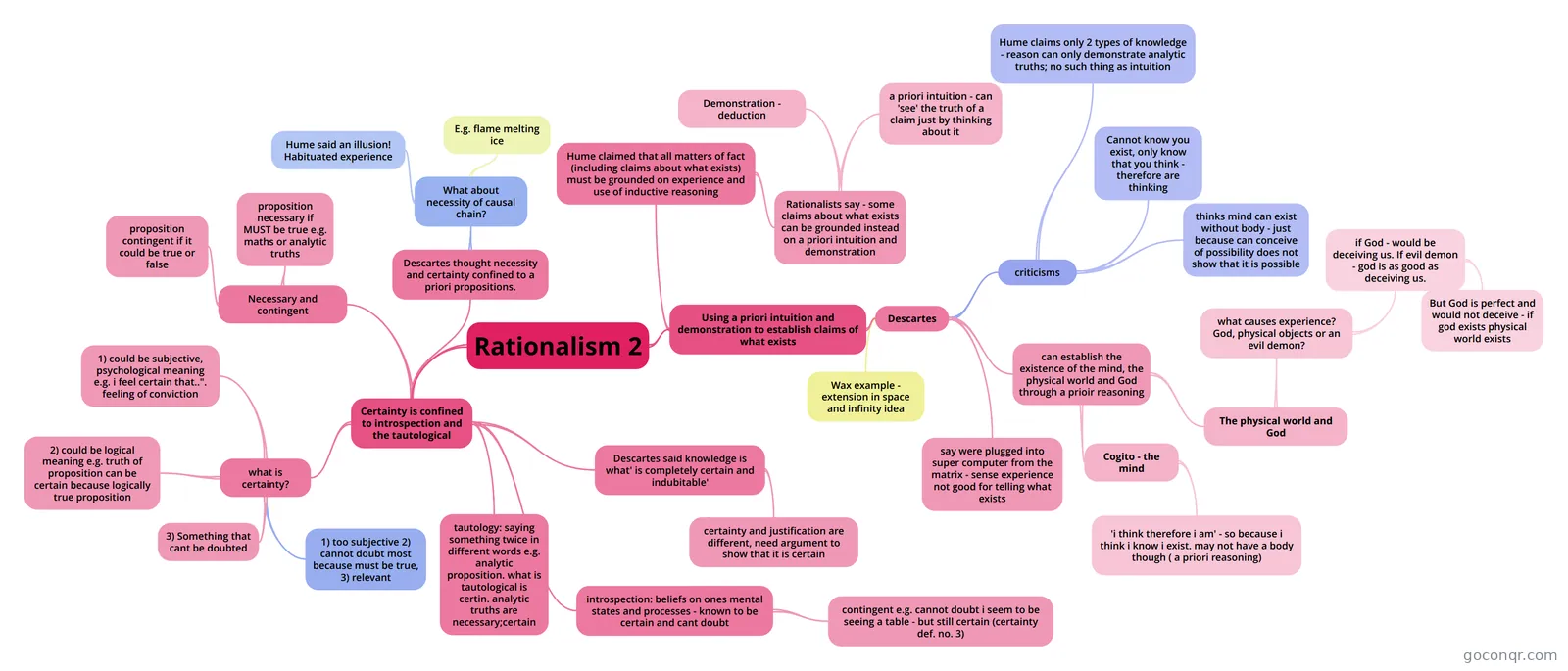
Mind map: Rationalism
Inhalt der Mindmap
Rationalism 2
Using a priori intuition and demonstration to establish claims of what exists
- Hume claimed that all matters of fact (including claims about what exists) must be grounded on experience and use of inductive reasoning
- Rationalists say - some claims about what exists can be grounded instead on a priori intuition and demonstration
- Demonstration - deduction
- a priori intuition - can 'see' the truth of a claim just by thinking about it
- Rationalists say - some claims about what exists can be grounded instead on a priori intuition and demonstration
- Descartes
- can establish the existence of the mind, the physical world and God through a prioir reasoning
- Cogito - the mind
- 'i think therefore i am' - so because i think i know i exist. may not have a body though ( a priori reasoning)
- The physical world and God
- what causes experience? God, physical objects or an evil demon?
- if God - would be deceiving us. If evil demon - god is as good as deceiving us.
- But God is perfect and would not deceive - if god exists physical world exists
- if God - would be deceiving us. If evil demon - god is as good as deceiving us.
- what causes experience? God, physical objects or an evil demon?
- Cogito - the mind
- say were plugged into super computer from the matrix - sense experience not good for telling what exists
- criticisms
- Cannot know you exist, only know that you think - therefore are thinking
- thinks mind can exist without body - just because can conceive of possibility does not show that it is possible
- Hume claims only 2 types of knowledge - reason can only demonstrate analytic truths; no such thing as intuition
- Wax example - extension in space and infinity idea
- can establish the existence of the mind, the physical world and God through a prioir reasoning
- Hume claimed that all matters of fact (including claims about what exists) must be grounded on experience and use of inductive reasoning
Certainty is confined to introspection and the tautological
- Descartes said knowledge is what' is completely certain and indubitable'
- certainty and justification are different, need argument to show that it is certain
- what is certainty?
- 1) could be subjective, psychological meaning e.g. i feel certain that..". feeling of conviction
- 2) could be logical meaning e.g. truth of proposition can be certain because logically true proposition
- 3) Something that cant be doubted
- 1) too subjective 2) cannot doubt most because must be true, 3) relevant
- Necessary and contingent
- proposition contingent if it could be true or false
- proposition necessary if MUST be true e.g. maths or analytic truths
- tautology: saying something twice in different words e.g. analytic proposition. what is tautological is certin. analytic truths are necessary;certain
- introspection: beliefs on ones mental states and processes - known to be certain and cant doubt
- contingent e.g. cannot doubt i seem to be seeing a table - but still certain (certainty def. no. 3)
- Descartes thought necessity and certainty confined to a priori propositions.
- What about necessity of causal chain?
- Hume said an illusion! Habituated experience
- E.g. flame melting ice
- What about necessity of causal chain?
- Descartes said knowledge is what' is completely certain and indubitable'
Informationen
- Beschreibung
- International Baccalaureate Philosophy (Reason and experience) Mindmap am Rationalism 2, erstellt von lauren_walji am 01/05/2013.
- Erstellt von
- lauren_walji
- Aufrufe
- 85
- Tags
- Bewertung