
Mindmap
Week 3 - organizational perspective
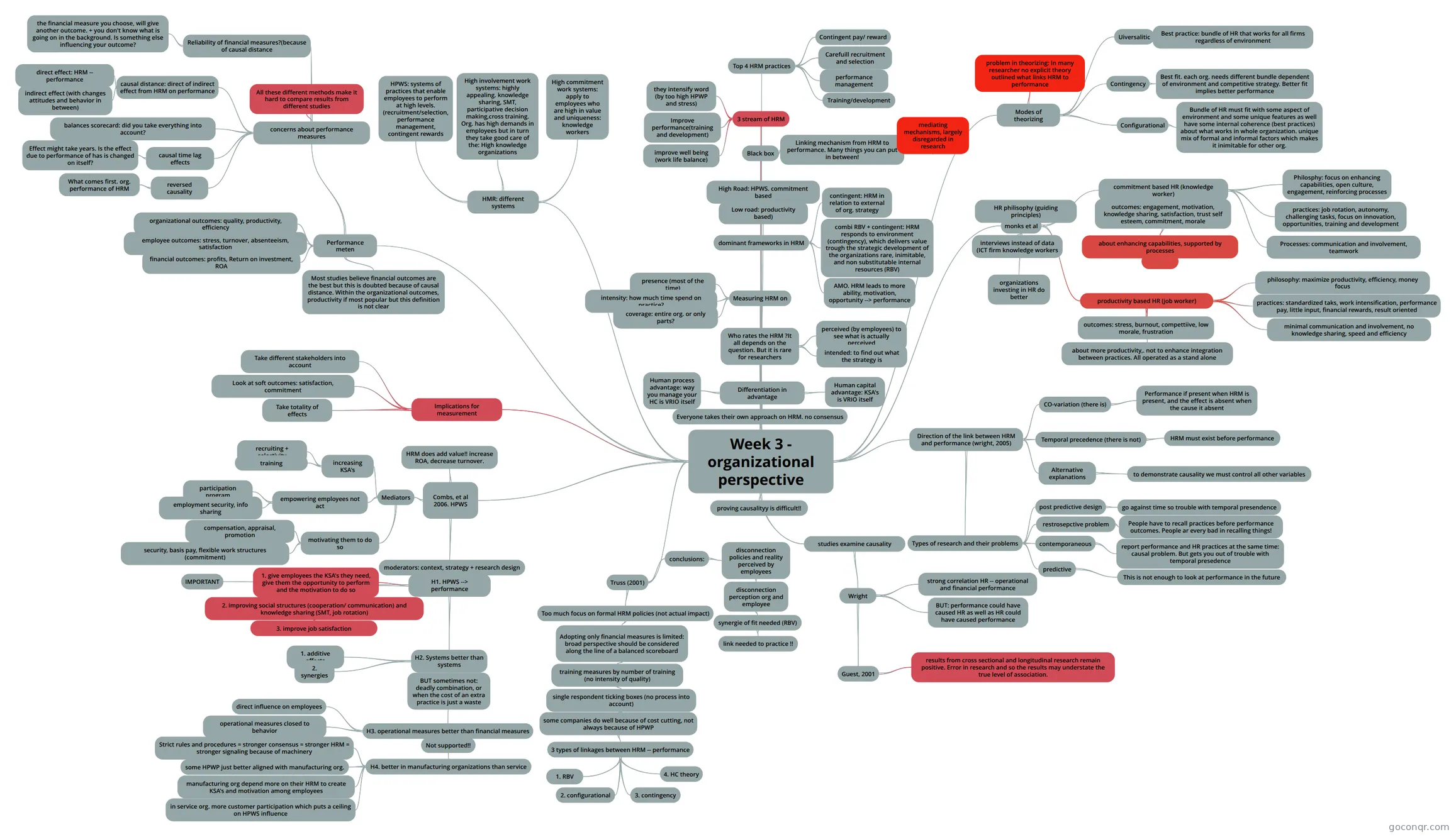
Mind map: HRM organizational perspective
Inhalt der Mindmap
Week 3 - organizational perspective
Top 4 HRM practices
- Training/development
- Contingent pay/ reward
- Carefuill recruitment and selection
- performance management
3 stream of HRM
- they intensify word (by too high HPWP and stress)
- Improve performance(training and development)
- improve well being (work life balance)
Everyone takes their own approach on HRM. no consensus
dominant frameworks in HRM
- contingent: HRM in relation to external of org. strategy
- combi RBV + contingent: HRM responds to environment (contingency), which delivers value trough the strategic development of the organizations rare, inimitable, and non substitutable internal resources (RBV)
- AMO. HRM leads to more ability, motivation, opportunity --> performance
Measuring HRM on
- presence (most of the time)
- intensity: how much time spend on practice?
- coverage: entire org. or only parts?
Who rates the HRM ?It all depends on the question. But it is rare for researchers
- perceived (by employees) to see what is actually perceived
- intended: to find out what the strategy is
High Road: HPWS. commitment based
- Low road: productivity based)
HMR: different systems
- HPWS: systems of practices that enable employees to perform at high levels. (recruitment/selection, performance management, contingent rewards
- High involvement work systems: highly appealing. knowledge sharing, SMT, participative decision making,cross training. Org. has high demands in employees but in turn they take good care of the: High knowledge organizations
- High commitment work systems: apply to employees who are high in value and uniqueness: knowledge workers
Performance meten
- organizational outcomes: quality, productivity, efficiency
- employee outcomes: stress, turnover, absenteeism, satisfaction
- financial outcomes: profits, Return on investment, ROA
- Most studies believe financial outcomes are the best but this is doubted because of causal distance. Within the organizational outcomes, productivity if most popular but this definition is not clear
- concerns about performance measures
- causal distance: direct of indirect effect from HRM on performance
- direct effect: HRM -- performance
- indirect effect (with changes attitudes and behavior in between)
- balances scorecard: did you take everything into account?
- causal time lag effects
- Effect might take years. Is the effect due to performance of has is changed on itself?
- reversed causality
- What comes first. org. performance of HRM
- Reliability of financial measures?(because of causal distance
- the financial measure you choose, will give another outcome. + you don't know what is going on in the background. Is something else influencing your outcome?
- All these different methods make it hard to compare results from different studies
- causal distance: direct of indirect effect from HRM on performance
Implications for measurement
- Take different stakeholders into account
- Look at soft outcomes: satisfaction, commitment
- Take totality of effects
Modes of theorizing
- Uiversalitic
- Best practice: bundle of HR that works for all firms regardless of environment
- Contingency
- Best fit. each org. needs different bundle dependent of environment and competitive strategy. Better fit implies better performance
- Configurational
- Bundle of HR must fit with some aspect of environment and some unique features as well have some internal coherence (best practices) about what works in whole organization. unique mix of formal and informal factors which makes it inimitable for other org.
- problem in theorizing: In many researcher no explicit theory outlined what links HRM to performance
- Uiversalitic
Black box
- Linking mechanism from HRM to performance. Many things you can put in between!
- mediating mechanisms, largely disregarded in research
- Linking mechanism from HRM to performance. Many things you can put in between!
Differentiation in advantage
- Human capital advantage: KSA's is VRIO itself
- Human process advantage: way you manage your HC is VRIO itself
Direction of the link between HRM and performance (wright, 2005)
- CO-variation (there is)
- Performance if present when HRM is present, and the effect is absent when the cause it absent
- Temporal precedence (there is not)
- HRM must exist before performance
- Alternative explanations
- to demonstrate causality we must control all other variables
- Types of research and their problems
- post predictive design
- go against time so trouble with temporal presendence
- restrosepctive problem
- People have to recall practices before performance outcomes. People ar every bad in recalling things!
- contemporaneous
- report performance and HR practices at the same time: causal problem. But gets you out of trouble with temporal presedence
- predictive
- This is not enough to look at performance in the future
- post predictive design
- CO-variation (there is)
studies examine causality
- Wright
- strong correlation HR -- operational and financial performance
- BUT: performance could have caused HR as well as HR could have caused performance
- Guest, 2001
- results from cross sectional and longitudinal research remain positive. Error in research and so the results may understate the true level of association.
- Wright
Combs, et al 2006. HPWS
- Mediators
- increasing KSA's
- recruiting + selectivity
- training
- empowering employees not act
- participation program
- employment security, info sharing
- motivating them to do so
- compensation, appraisal, promotion
- security, basis pay, flexible work structures (commitment)
- increasing KSA's
- H1. HPWS --> performance
- 1. give employees the KSA's they need, give them the opportunity to perform and the motivation to do so
- 2. improving social structures (cooperation/ communication) and knowledge sharing (SMT, job rotation)
- 3. improve job satisfaction
- 2. improving social structures (cooperation/ communication) and knowledge sharing (SMT, job rotation)
- H2. Systems better than systems
- 1. additive effects
- 2. synergies
- BUT sometimes not: deadly combination, or when the cost of an extra practice is just a waste
- H3. operational measures better than financial measures
- direct influence on employees
- operational measures closed to behavior
- H4. better in manufacturing organizations than service
- Strict rules and procedures = stronger consensus = stronger HRM = stronger signaling because of machinery
- some HPWP just better aligned with manufacturing org.
- manufacturing org depend more on their HRM to create KSA's and motivation among employees
- in service org. more customer participation which puts a ceiling on HPWS influence
- Not supported!!
- moderators: context, strategy + research design
- IMPORTANT
- 1. give employees the KSA's they need, give them the opportunity to perform and the motivation to do so
- HRM does add value!! increase ROA, decrease turnover.
- Mediators
proving causalityy is difficult!!
Truss (2001)
- Too much focus on formal HRM policies (not actual impact)
- Adopting only financial measures is limited: broad perspective should be considered along the line of a balanced scoreboard
- training measures by number of training (no intensity of quality)
- single respondent ticking boxes (no process into account)
- some companies do well because of cost cutting, not always because of HPWP
- 3 types of linkages between HRM -- performance
- 1. RBV
- 2. configurational
- 3. contingency
- 4. HC theory
- 3 types of linkages between HRM -- performance
- some companies do well because of cost cutting, not always because of HPWP
- single respondent ticking boxes (no process into account)
- training measures by number of training (no intensity of quality)
- Adopting only financial measures is limited: broad perspective should be considered along the line of a balanced scoreboard
- conclusions:
- disconnection policies and reality perceived by employees
- disconnection perception org and employee
- synergie of fit needed (RBV)
- link needed to practice !!
- synergie of fit needed (RBV)
- disconnection perception org and employee
- disconnection policies and reality perceived by employees
- Too much focus on formal HRM policies (not actual impact)
monks et al
- commitment based HR (knowledge worker)
- Philosphy: focus on enhancing capabilities, open culture, engagement, reinforcing processes
- practices: job rotation, autonomy, challenging tasks, focus on innovation, opportunities, training and development
- Processes: communication and involvement, teamwork
- outcomes: engagement, motivation, knowledge sharing, satisfaction, trust self esteem, commitment, morale
- about enhancing capabilities, supported by processes
- about enhancing capabilities, supported by processes
- productivity based HR (job worker)
- philosophy: maximize productivity, efficiency, money focus
- practices: standardized taks, work intensification, performance pay, little input, financial rewards, result oriented
- minimal communication and involvement, no knowledge sharing, speed and efficiency
- outcomes: stress, burnout, compettiive, low morale, frustration
- about more productivity,. not to enhance integration between practices. All operated as a stand alone
- HR philisophy (guiding principles)
- interviews instead of data (ICT firm knowledge workers
- organizations investing in HR do better
- commitment based HR (knowledge worker)
Informationen
- Beschreibung
- Managing people strategically Mindmap am Week 3 - organizational perspective, erstellt von Ella Hustinx am 19/12/2016.
- Erstellt von
- Ella Hustinx
- Aufrufe
- 1
- Bewertung