
Mindmap
Class Differences in Achievement - internal [2]
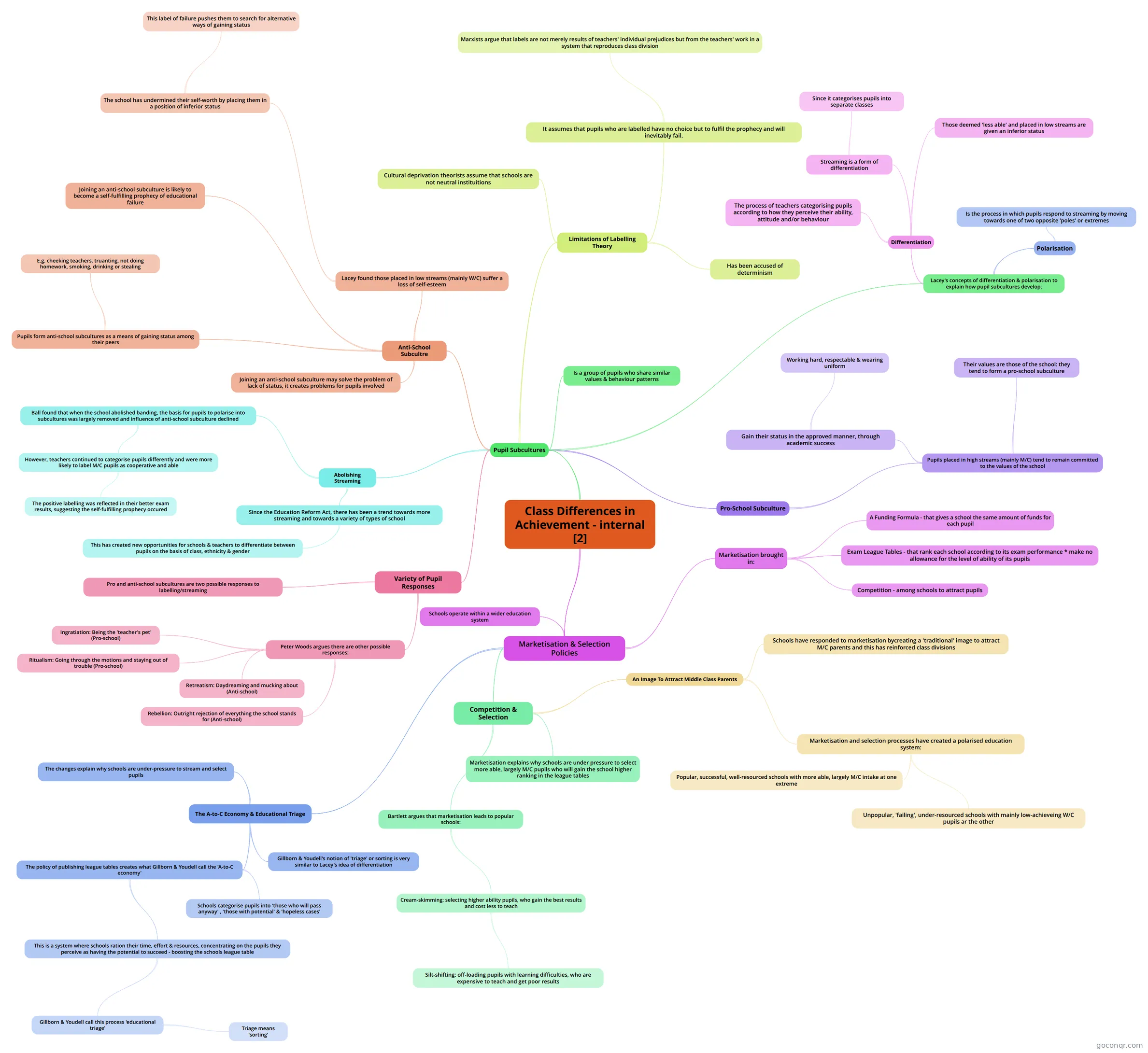
Mind map: class differences in achievement internal
Inhalt der Mindmap
Class Differences in Achievement - internal [2]
Pupil Subcultures
- Is a group of pupils who share similar values & behaviour patterns
- Lacey's concepts of differentiation & polarisation to explain how pupil subcultures develop:
- Differentiation
- The process of teachers categorising pupils according to how they perceive their ability, attitude and/or behaviour
- Streaming is a form of differentiation
- Since it categorises pupils into separate classes
- Those deemed 'less able' and placed in low streams are given an inferior status
- Polarisation
- Is the process in which pupils respond to streaming by moving towards one of two opposite 'poles' or extremes
- Differentiation
- Pro-School Subculture
- Pupils placed in high streams (mainly M/C) tend to remain committed to the values of the school
- Gain their status in the approved manner, through academic success
- Working hard, respectable & wearing uniform
- Their values are those of the school: they tend to form a pro-school subculture
- Gain their status in the approved manner, through academic success
- Pupils placed in high streams (mainly M/C) tend to remain committed to the values of the school
- Anti-School Subcultre
- Lacey found those placed in low streams (mainly W/C) suffer a loss of self-esteem
- The school has undermined their self-worth by placing them in a position of inferior status
- This label of failure pushes them to search for alternative ways of gaining status
- The school has undermined their self-worth by placing them in a position of inferior status
- Pupils form anti-school subcultures as a means of gaining status among their peers
- E.g. cheeking teachers, truanting, not doing homework, smoking, drinking or stealing
- Joining an anti-school subculture may solve the problem of lack of status, it creates problems for pupils involved
- Joining an anti-school subculture is likely to become a self-fulfilling prophecy of educational failure
- Lacey found those placed in low streams (mainly W/C) suffer a loss of self-esteem
- Abolishing Streaming
- Ball found that when the school abolished banding, the basis for pupils to polarise into subcultures was largely removed and influence of anti-school subculture declined
- However, teachers continued to categorise pupils differently and were more likely to label M/C pupils as cooperative and able
- The positive labelling was reflected in their better exam results, suggesting the self-fulfilling prophecy occured
- However, teachers continued to categorise pupils differently and were more likely to label M/C pupils as cooperative and able
- Since the Education Reform Act, there has been a trend towards more streaming and towards a variety of types of school
- This has created new opportunities for schools & teachers to differentiate between pupils on the basis of class, ethnicity & gender
- Ball found that when the school abolished banding, the basis for pupils to polarise into subcultures was largely removed and influence of anti-school subculture declined
- Variety of Pupil Responses
- Pro and anti-school subcultures are two possible responses to labelling/streaming
- Peter Woods argues there are other possible responses:
- Ingratiation: Being the 'teacher's pet' (Pro-school)
- Ritualism: Going through the motions and staying out of trouble (Pro-school)
- Retreatism: Daydreaming and mucking about (Anti-school)
- Rebellion: Outright rejection of everything the school stands for (Anti-school)
- Limitations of Labelling Theory
- Cultural deprivation theorists assume that schools are not neutral instituitions
- Has been accused of determinism
- It assumes that pupils who are labelled have no choice but to fulfil the prophecy and will inevitably fail.
- Marxists argue that labels are not merely results of teachers' individual prejudices but from the teachers' work in a system that reproduces class division
Marketisation & Selection Policies
- Schools operate within a wider education system
- Marketisation brought in:
- A Funding Formula - that gives a school the same amount of funds for each pupil
- Exam League Tables - that rank each school according to its exam performance * make no allowance for the level of ability of its pupils
- Competition - among schools to attract pupils
- The A-to-C Economy & Educational Triage
- The changes explain why schools are under-pressure to stream and select pupils
- The policy of publishing league tables creates what Gillborn & Youdell call the 'A-to-C economy'
- This is a system where schools ration their time, effort & resources, concentrating on the pupils they perceive as having the potential to succeed - boosting the schools league table
- Gillborn & Youdell call this process 'educational triage'
- Triage means 'sorting'
- Gillborn & Youdell call this process 'educational triage'
- Schools categorise pupils into 'those who will pass anyway' , 'those with potential' & 'hopeless cases'
- This is a system where schools ration their time, effort & resources, concentrating on the pupils they perceive as having the potential to succeed - boosting the schools league table
- Gillborn & Youdell's notion of 'triage' or sorting is very similar to Lacey's idea of differentiation
- Competition & Selection
- Bartlett argues that marketisation leads to popular schools:
- Cream-skimming: selecting higher ability pupils, who gain the best results and cost less to teach
- Silt-shifting: off-loading pupils with learning difficulties, who are expensive to teach and get poor results
- Cream-skimming: selecting higher ability pupils, who gain the best results and cost less to teach
- Marketisation explains why schools are under pressure to select more able, largely M/C pupils who will gain the school higher ranking in the league tables
- An Image To Attract Middle Class Parents
- Schools have responded to marketisation bycreating a 'traditional' image to attract M/C parents and this has reinforced class divisions
- Marketisation and selection processes have created a polarised education system:
- Popular, successful, well-resourced schools with more able, largely M/C intake at one extreme
- Unpopular, 'failing', under-resourced schools with mainly low-achieveing W/C pupils ar the other
- Bartlett argues that marketisation leads to popular schools:
Informationen
- Beschreibung
- A-Levels Sociology - Education Mindmap am Class Differences in Achievement - internal [2], erstellt von orlaghemmett am 07/05/2013.
- Erstellt von
- orlaghemmett
- Aufrufe
- 184
- Tags
- Bewertung