
Mindmap
Growing up (T.C.P)
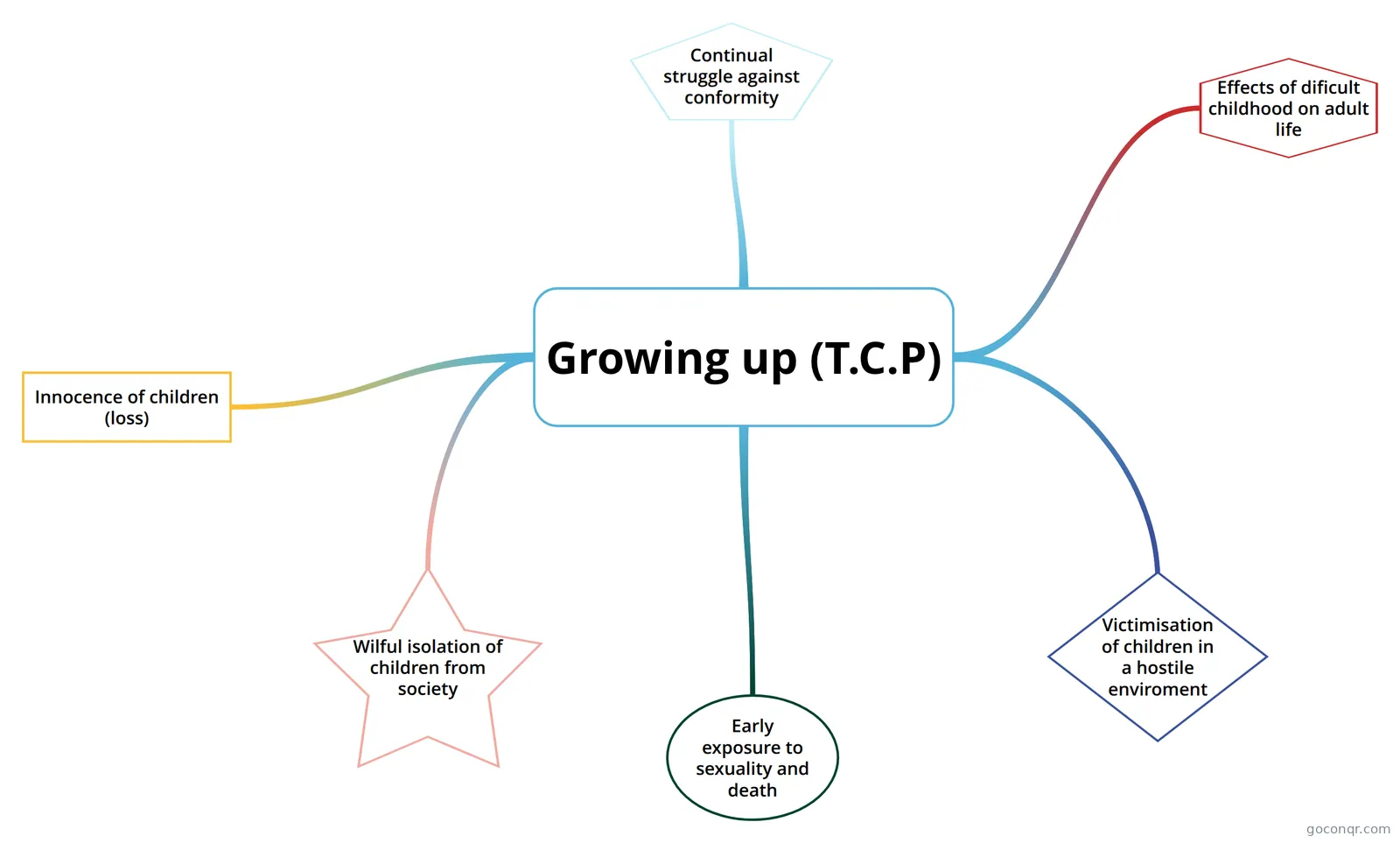
Mind map: Growing up (T.C.P)
Inhalt der Mindmap
Growing up (T.C.P)
Innocence of children (loss)
- (T.C.P)The loss of childhood innocence can be identified mainly in Celie's character. Right at the beginning of the novel, Celie losses her innocence through the act of rape by her stepfather. Her graphic descriptions of the assaults force the reader to confront the ugliness of child abuse and possible incest at the very beginning of the narrative, illustrating not only the central character’s vulnerability and isolation, but also the brutality of the act and its perpetrator. The callous removal of Celie’s children by ‘Pa’ and his decision to marry her off to a neighbour of his own age (Albert), as a ‘spoiled’ childminder and housekeeper, add to Celie’s dehumanisation. . Her graphic descriptions of the assaults force the reader to confront the ugliness of child abuse and possible incest at the very beginning of the narrative, illustrating not only the central character’s vulnerability and isolation, but also the brutality of the act and its perpetrator. The callous removal of Celie’s children by ‘Pa’ and his decision to marry her off to a neighbour of his own age (Albert), as a ‘spoiled’ childminder and housekeeper, add to Celie’s dehumanisation. "I am fourteen years old. I have always been a good girl."- p.g 3 "When that hurt, I cry. He start to choke me..." p.g 3
- (W.M.K)Maisie gradually losses her childhood innocene, as she begins to partake in the cunning adult games. She employs selective ignorance, purposeful silence, and an active and verbal quest for knowledge. James identifies Maisie’s loss of innocence as Maisie ceases to merely observe and extrapolate meaning from the situations around her, but evolves into an active participant in the manipulation thereby assuming a more adult role in her environment. Essentially, James illustrates how Maisie’s exposure to the crude adult world diminishes her childhood until it completely evaporates and forces her into pre-mature adolescence. By the end of the novel, Maisie asserts her independence and emerges as one capable of making her own decisions"Her parted lips locked themselves with the determination to be employed no longer." p.g 19"She spoiled their fun, but she practically added to her own." p.g 19 "....You've come out. Mrs Beale has come out. We each have our turn!" p.g 184
Victimisation of children in a hostile enviroment
- (T.C.P)Celie is married off to Albert by her father, which marks the end of one episode of abusive violence on the part of her stepfather, but the beginning of another at the hands of her new husband, a widower who abuses Celie verbally, sexually and physically in any way he wishes. She is expected to submit to frequent forced intercourse, which causes her to think of her body as something over which she has no control. Similarly she has no control over her physical environment, being expected to look after Albert’s uncooperative children and to work in the house and the fields. Celie has no value whatsoever as a woman - as females are considered inferior and worthless, men can and do treat them as they please. The beatings, domestic drudgery and brutish sex mean Celie retreats into an unfeeling emotional state, imagining that she is made of wood, like a tree. She cares for Albert’s children effectively but without feeling – patting Harpo’s back as though he was made of wood also. She ends up feeling that her life has no direction. Feminist Betty Friedan believes that life without purpose makes women lose the sense of who they are, as it is purpose in life that gives all human beings a reason to exist. Celie’s loss of self-esteem and sense of worth is signified from the first letter by crossing out the words ‘I am’, which signify self-belief – she can only look back to a pre-lapsarian state of ‘have been’. The present remains intensely painful until Celie meets Shug Avery, who enables Celie to regain her self-esteem and reclaim her life. "Fact is I got to get rid of her. She too old to be living here at home." p.g 10
- (W.M.K)Maisie too is terribly victimized by her parent's divorce that leaves her moving between houses and parents. She yearns to be loved and to belong to someone, which can explain her deep attachment to Sir Claude who shows her a little affection. "...the little girl disposed of in a manner worthy of the judgement-seat of Solomon. She was divided in two and the portions tossed impartially to the disputants." p.g 11"Poor little monkey! she a last exclaimed; and the words were an epitaph for the tomb of Maisie's childhood. She was abandoned to her fate." p.g 12 "She was in short introduced to life with a liberty in which the selfishness of others found it's account, and there was nothing to avert the sacrifice but the modesty of her youth." p.g 15 "She was the little feathered shuttlecock they could fiercely keep flying between them." p.g 18
Wilful isolation of children from society
Continual struggle against conformity
Effects of dificult childhood on adult life
Early exposure to sexuality and death
Informationen
- Beschreibung
- AS - Level Englilsh Literature (A2 Prose Themes) Mindmap am Growing up (T.C.P), erstellt von Rebecca Hunter am 01/03/2017.
- Erstellt von
- Rebecca Hunter
- Aufrufe
- 0
- Bewertung