
Mindmap
Developing Secure Software
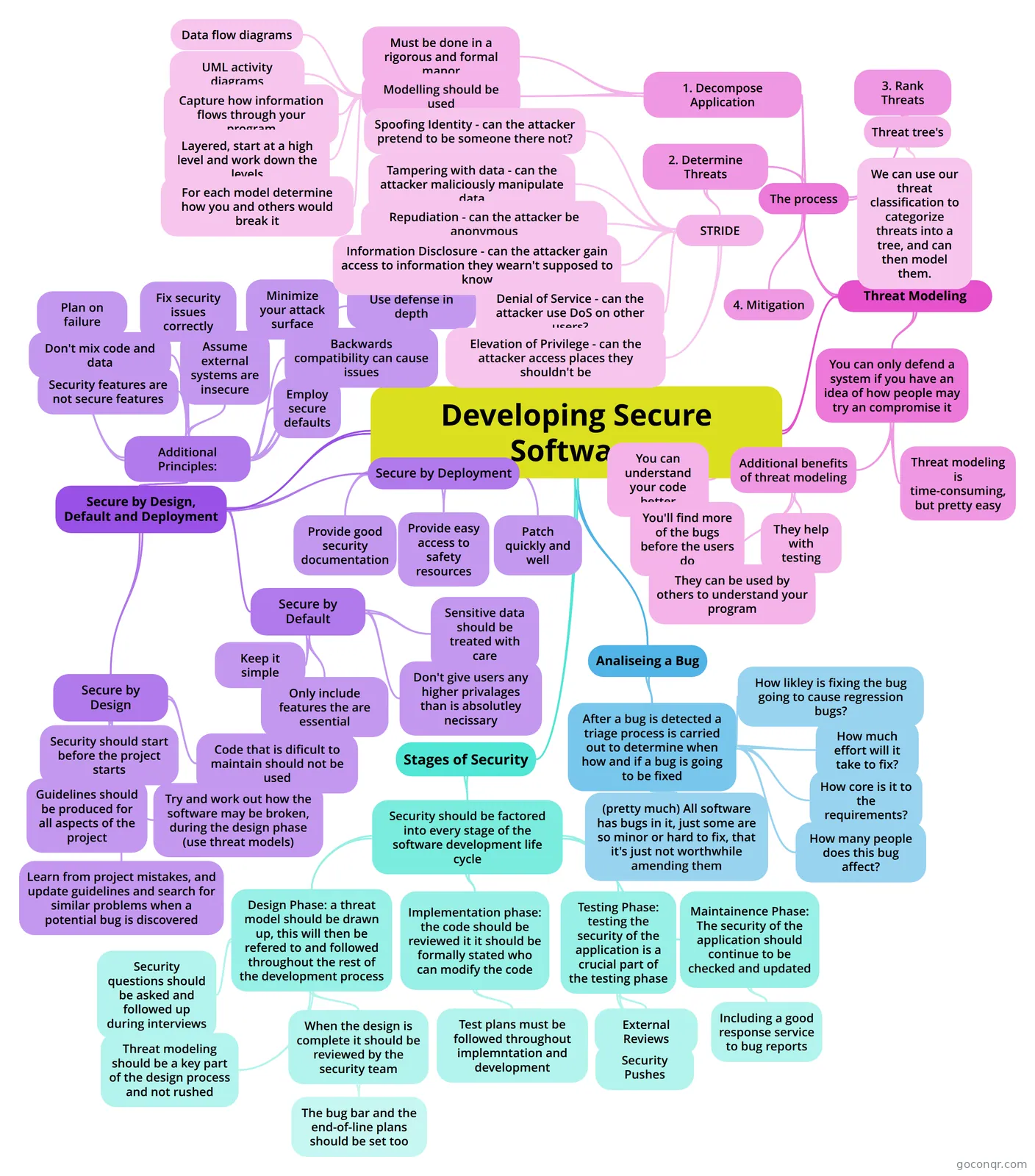
Mind map: developing secure software
Inhalt der Mindmap
Developing Secure Software
Stages of Security
- Security should be factored into every stage of the software development life cycle
- Design Phase: a threat model should be drawn up, this will then be refered to and followed throughout the rest of the development process
- Security questions should be asked and followed up during interviews
- Threat modeling should be a key part of the design process and not rushed
- When the design is complete it should be reviewed by the security team
- The bug bar and the end-of-line plans should be set too
- Implementation phase: the code should be reviewed it it should be formally stated who can modify the code
- Test plans must be followed throughout implemntation and development
- Testing Phase: testing the security of the application is a crucial part of the testing phase
- External Reviews
- Security Pushes
- Maintainence Phase: The security of the application should continue to be checked and updated
- Including a good response service to bug reports
- Design Phase: a threat model should be drawn up, this will then be refered to and followed throughout the rest of the development process
- Security should be factored into every stage of the software development life cycle
Analiseing a Bug
- After a bug is detected a triage process is carried out to determine when how and if a bug is going to be fixed
- How many people does this bug affect?
- How core is it to the requirements?
- How much effort will it take to fix?
- How likley is fixing the bug going to cause regression bugs?
- (pretty much) All software has bugs in it, just some are so minor or hard to fix, that it's just not worthwhile amending them
- After a bug is detected a triage process is carried out to determine when how and if a bug is going to be fixed
Secure by Design, Default and Deployment
- Secure by Design
- Security should start before the project starts
- Guidelines should be produced for all aspects of the project
- Learn from project mistakes, and update guidelines and search for similar problems when a potential bug is discovered
- Try and work out how the software may be broken, during the design phase (use threat models)
- Code that is dificult to maintain should not be used
- Secure by Default
- Don't give users any higher privalages than is absolutley necissary
- Keep it simple
- Only include features the are essential
- Sensitive data should be treated with care
- Secure by Deployment
- Provide good security documentation
- Patch quickly and well
- Provide easy access to safety resources
- Additional Principles:
- Minimize your attack surface
- Use defense in depth
- Backwards compatibility can cause issues
- Employ secure defaults
- Assume external systems are insecure
- Plan on failure
- Security features are not secure features
- Don't mix code and data
- Fix security issues correctly
- Secure by Design
Threat Modeling
- You can only defend a system if you have an idea of how people may try an compromise it
- Additional benefits of threat modeling
- You can understand your code better
- You'll find more of the bugs before the users do
- They can be used by others to understand your program
- They help with testing
- Threat modeling is time-consuming, but pretty easy
- Additional benefits of threat modeling
- The process
- 1. Decompose Application
- Must be done in a rigorous and formal manor
- Modelling should be used
- Data flow diagrams
- UML activity diagrams
- Capture how information flows through your program
- Layered, start at a high level and work down the levels
- For each model determine how you and others would break it
- 2. Determine Threats
- STRIDE
- Spoofing Identity - can the attacker pretend to be someone there not?
- Tampering with data - can the attacker maliciously manipulate data
- Repudiation - can the attacker be anonymous
- Information Disclosure - can the attacker gain access to information they wearn't supposed to know
- Denial of Service - can the attacker use DoS on other users?
- Elevation of Privilege - can the attacker access places they shouldn't be
- STRIDE
- 3. Rank Threats
- Threat tree's
- We can use our threat classification to categorize threats into a tree, and can then model them.
- Threat tree's
- 4. Mitigation
- 1. Decompose Application
- You can only defend a system if you have an idea of how people may try an compromise it
Informationen
- Beschreibung
- Mindmap am Developing Secure Software, erstellt von lissy93 am 28/04/2014.
- Erstellt von
- lissy93
- Aufrufe
- 15
- Bewertung