
Mindmap
education policy
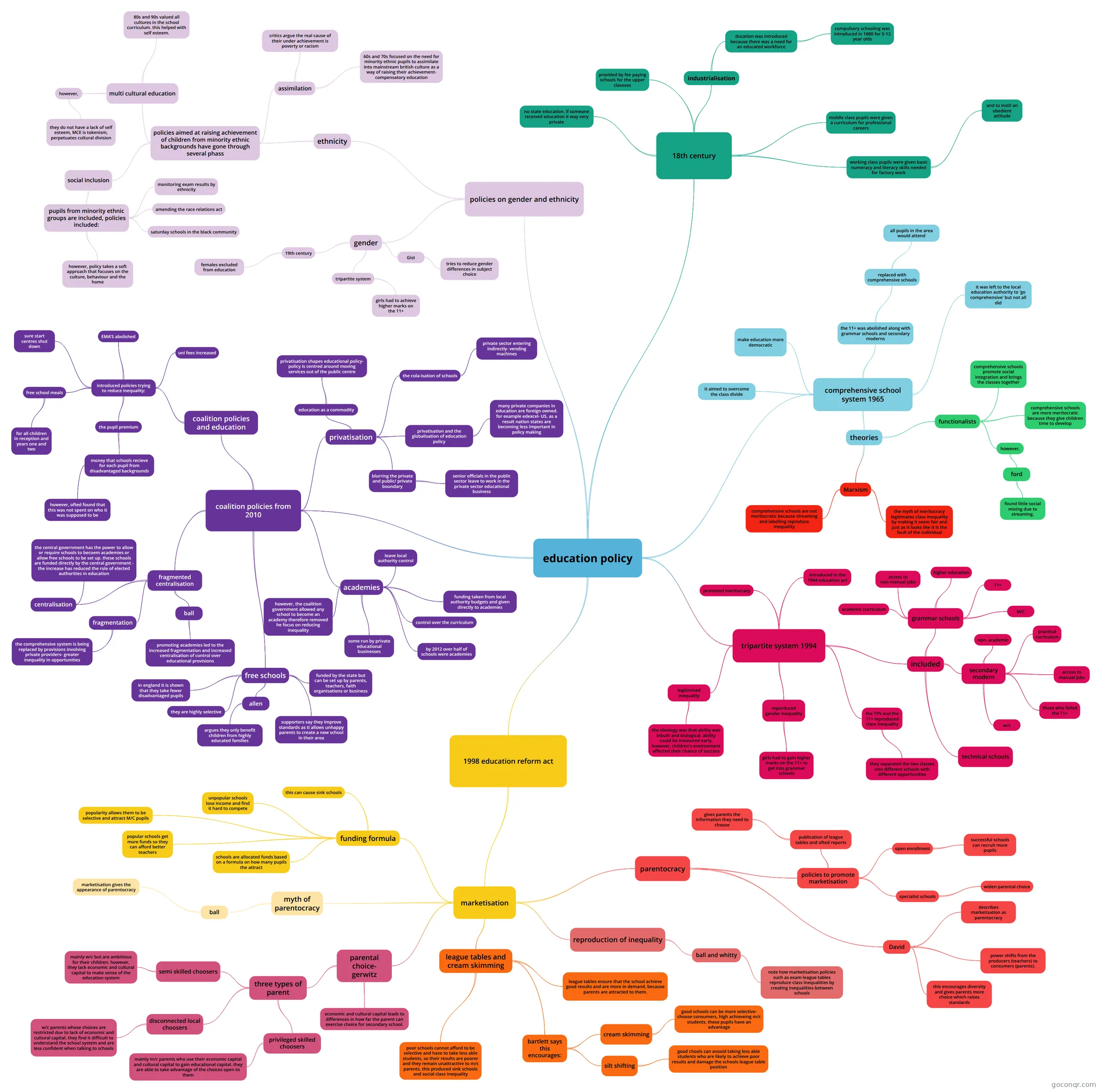
Mind map: education policy
Inhalt der Mindmap
education policy
18th century
- no state education. if someone received education it way very private
- provided by fee paying schools for the upper claseses
- industrialisation
- ducation was introduced because there was a need for an educated workforce
- compulsory schooling was introduced in 1880 for 5-13 year olds
- ducation was introduced because there was a need for an educated workforce
- middle class pupils were given a curriculum for professional careers
- working class pupils were given basic numeracy and literacy skills needed for factory work
- and to instil an obedient attitude
comprehensive school system 1965
- it aimed to overcome the class divide
- make education more democratic
- the 11+ was abolished along with grammar schools and secondary moderns
- replaced with comprehensive schools
- all pupils in the area would attend
- replaced with comprehensive schools
- it was left to the local education authority to 'go comprehensive' but not all did
- theories
- functionalists
- comprehensive schools promote social integration and brings the classes together
- however,
- ford
- found little social mixing due to streaming.
- ford
- comprehensive schools are more meritocratic because they give children time to develop
- Marxism
- comprehensive schools are not meritocratic because streaming and labelling reproduce inequality
- the myth of meritocracy legitimates class inequality by making it seem fair and just as it looks like it is the fault of the individual
- functionalists
tripartite system 1994
- promoted meritocracy
- introduced in the 1994 education act
- included
- grammar schools
- academic curriculum
- access to non-manual jobs
- higher education
- 11+
- M/C
- secondary modern
- non- academic
- practical curriculum
- access to manual jobs
- those who failed the 11+
- w/c
- technical schools
- grammar schools
- the TPS and the 11+ reproduced class inequality
- they separated the two classes into different schools with different opportunities
- reporduced gender inequality
- girls had to gain higher marks on the 11+ to get into grammar schools
- legitimised inequality
- the ideology was that ability was inbuilt and biological. ability could be measured early. however, children's environment affected their chance of success
1998 education reform act
- marketisation
- parentocracy
- policies to promote marketisation
- publication of league tables and ofted reports
- gives parents the information they need to choose
- open enrollment
- successful schools can recruit more pupils
- specialist schools
- widen parental choice
- publication of league tables and ofted reports
- David
- describes marketisation as parentocracy
- power shifts from the producers (teachers) to consumers (parents).
- this encourages diversity and gives parents more choice which raises standards
- policies to promote marketisation
- reproduction of inequality
- ball and whitty
- note how marketisation policies such as exam league tables reproduce class inequalities by creating inequalities between schools
- ball and whitty
- league tables and cream skimming
- league tables ensure that the school achieve good results and are more in demand, because parents are attracted to them.
- bartlett says this encourages:
- cream skimming
- good schools can be more selective- choose consumers, high achieveing m/c students. these pupils have an advantage
- silt shifting
- good chools can avooid taking less able students who are likely to achieve poor results and damage the schools league table position
- cream skimming
- poor schools cannot afford to be selective and have to take less able students, so their results are poorer and they remain unattractive to m/c parents. this produced sink schools and social class inequality
- parental choice- gerwitz
- economic and cultural capital leads to differences in how far the parent can exercise choice for secondary school.
- three types of parent
- privileged skilled choosers
- mainly m/c parents who use their economic capital and cultural capital to gain educational capital. they are able to take advantage of the choices open to them
- disconnected local choosers
- w/c parents whose choices are restricted due to lack of economic and cultural capital. they find it difficult to understand the school system and are less confident when talking to schools
- semi skilled choosers
- mainly w/c but are ambitious for their children. however, they lack economic and cultural capital to make sense of the education system
- privileged skilled choosers
- myth of parentocracy
- ball
- marketisation gives the appearance of parentocracy
- ball
- funding formula
- schools are allocated funds based on a formula on how many pupils the attract
- popular schools get more funds so they can afford better teachers
- popularity allows them to be selective and attract M/C pupils
- unpopular schools lose income and find it hard to compete
- this can cause sink schools
- parentocracy
- marketisation
coalition policies from 2010
- academies
- leave local authority control
- funding taken from local authority budgets and given directly to academies
- control over the curriculum
- by 2012 over half of schools were academies
- some run by private educational businesses
- however, the coalition government allowed any school to become an academy therefore removed he focus on reducing inequality
- free schools
- funded by the state but can be set up by parents, teachers, faith organisations or business
- supporters say they improve standards as ti allows unhappy parents to create a new school in their area
- allen
- argues they only benefit children from highly educated families
- they are highly selective
- in england it is shown that they take fewer disadvantaged pupils
- fragmented centralisation
- ball
- promoting academies led to the increased fragmentation and increased centralisation of control over educational provisions
- fragmentation
- the comprehensive system is being replaced by provisions involving private providers- greater inequality in opportunities
- centralisation
- the central government has the power to allow or require schools to becoem academies or allow free schools to be set up. these schools are funded directly by the central government - the increase has reduced the role of elected authorities in education
- ball
- coalition policies and education
- introduced policies trying to reduce inequality:
- free school meals
- for all children in reception and years one and two
- the pupil premium
- money that schools recieve for each pupil from disadvantaged backgrounds
- however, ofted found that this was not spent on who it was supposed to be
- money that schools recieve for each pupil from disadvantaged backgrounds
- sure start centres shut down
- EMA'S abolished
- uni fees increased
- free school meals
- introduced policies trying to reduce inequality:
- privatisation
- blurring the private and public/ private boundary
- senior officials in the public sector leave to work in the private sector educational business
- privatisation and the globalisation of education policy
- many private companies in education are foreign owned. for example edexcel- US. as a result nation states are becoming less important in policy making
- the cola-isation of schools
- private sector entering indirectly- vending machines
- education as a commodity
- privatisation shapes educational policy- policy is centred around moving services out of the public centre
- blurring the private and public/ private boundary
- academies
policies on gender and ethnicity
- gender
- 19th century
- females excluded from education
- tripartite system
- girls had to achieve higher marks on the 11+
- Gist
- tries to reduce gender differences in subject choice
- 19th century
- ethnicity
- policies aimed at raising achievement of children from minority ethnic backgrounds have gone through several phass
- assimilation
- 60s and 70s focused on the need for minority ethnic pupils to assimilate into mainstream british culture as a way of raising their achievement- compensatory education
- critics argue the real cause of their under achievement is poverty or racism
- multi cultural education
- 80s and 90s valued all cultures in the school curriculum. this helped with self esteem.
- however,
- they do not have a lack of self esteem, MCE is tokenism, perpetuates cultural division
- social inclusion
- pupils from minority ethnic groups are included, policies included:
- monitoring exam results by ethnicity
- amending the race relations act
- saturday schools in the black community
- however, policy takes a soft approach that focuses on the culture, behaviour and the home
- pupils from minority ethnic groups are included, policies included:
- assimilation
- policies aimed at raising achievement of children from minority ethnic backgrounds have gone through several phass
- gender
Informationen
- Beschreibung
- A2 Sociology A2 (Education) Mindmap am education policy, erstellt von Truely Costen am 20/03/2017.
- Erstellt von
- Truely Costen
- Aufrufe
- 0
- Bewertung