
Mindmap
166ISS Exam Plan
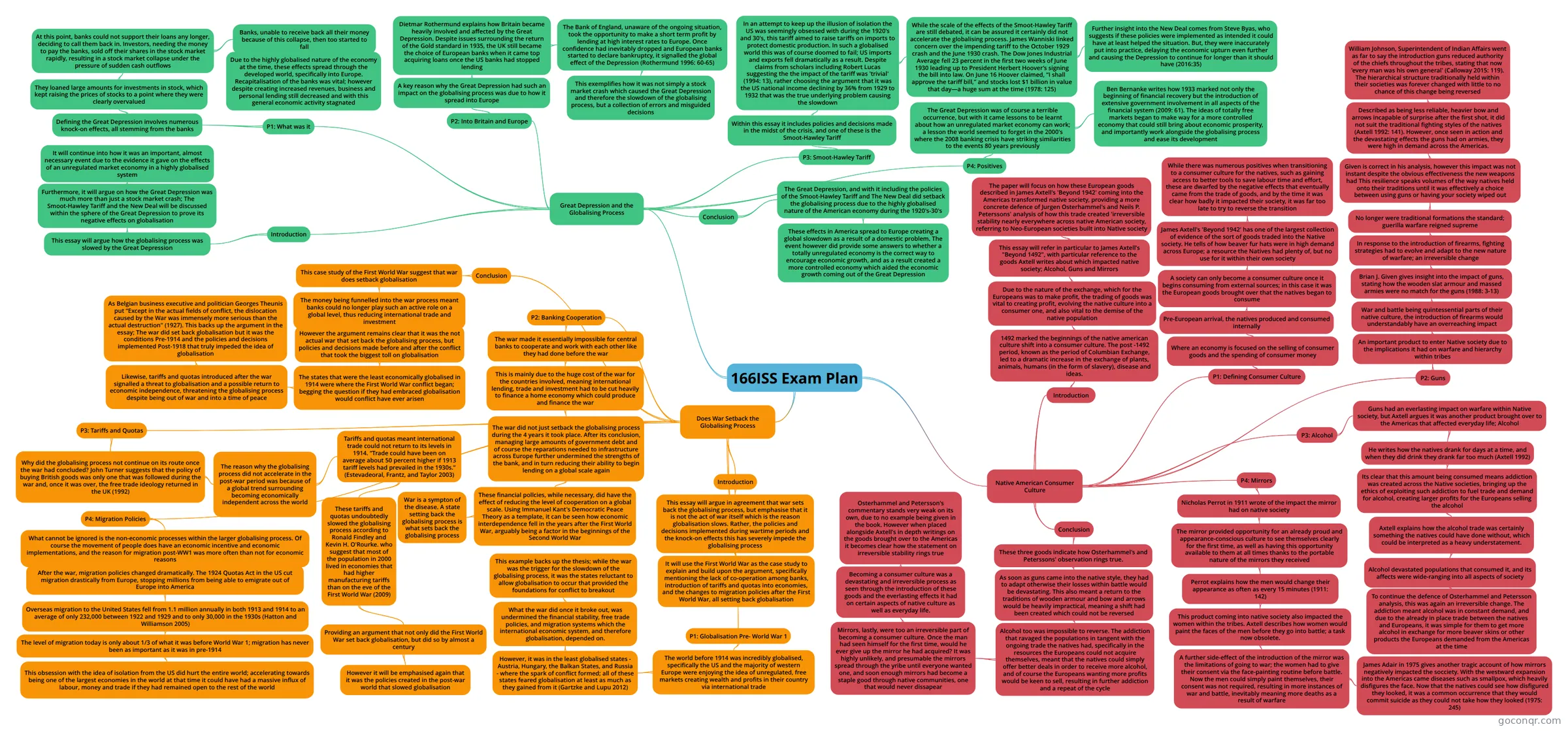
Mind map: 166ISS exam plan
Inhalt der Mindmap
166ISS Exam Plan
Native American Consumer Culture
- Introduction
- 1492 marked the beginnings of the native american culture shift into a consumer culture. The post -1492 period, known as the period of Columbian Exchange, led to a dramatic increase in the exchange of plants, animals, humans (in the form of slavery), disease and ideas.
- Due to the nature of the exchange, which for the Europeans was to make profit, the trading of goods was vital to creating profit, evolving the native culture into a consumer one, and also vital to the demise of the native population
- This essay will refer in particular to James Axtell's "Beyond 1492", with particular reference to the goods Axtell writes about which impacted native society; Alcohol, Guns and Mirrors
- The paper will focus on how these European goods described in James Axtell's 'Beyond 1942' coming into the Americas transformed native society, providing a more concrete defence of Jurgen Osterhammel's and Neils P. Peterssons' analysis of how this trade created 'irreversible stability nearly everywhere across native American society, referring to Neo-European societies built into Native society
- This essay will refer in particular to James Axtell's "Beyond 1492", with particular reference to the goods Axtell writes about which impacted native society; Alcohol, Guns and Mirrors
- Due to the nature of the exchange, which for the Europeans was to make profit, the trading of goods was vital to creating profit, evolving the native culture into a consumer one, and also vital to the demise of the native population
- 1492 marked the beginnings of the native american culture shift into a consumer culture. The post -1492 period, known as the period of Columbian Exchange, led to a dramatic increase in the exchange of plants, animals, humans (in the form of slavery), disease and ideas.
- P1: Defining Consumer Culture
- Where an economy is focused on the selling of consumer goods and the spending of consumer money
- Pre-European arrival, the natives produced and consumed internally
- A society can only become a consumer culture once it begins consuming from external sources; in this case it was the European goods brought over that the natives began to consume
- James Axtell's 'Beyond 1942' has one of the largest collection of evidence of the sort of goods traded into the Native society. He tells of how beaver fur hats were in high demand across Europe; a resource the Natives had plenty of, but no use for it within their own society
- While there was numerous positives when transitioning to a consumer culture for the natives, such as gaining access to better tools to save labour time and effort, these are dwarfed by the negative effects that eventually came from the trade of goods, and by the time it was clear how badly it impacted their society, it was far too late to try to reverse the transition
- James Axtell's 'Beyond 1942' has one of the largest collection of evidence of the sort of goods traded into the Native society. He tells of how beaver fur hats were in high demand across Europe; a resource the Natives had plenty of, but no use for it within their own society
- A society can only become a consumer culture once it begins consuming from external sources; in this case it was the European goods brought over that the natives began to consume
- Pre-European arrival, the natives produced and consumed internally
- Where an economy is focused on the selling of consumer goods and the spending of consumer money
- P2: Guns
- An important product to enter Native society due to the implications it had on warfare and hierarchy within tribes
- War and battle being quintessential parts of their native culture, the introduction of firearms would understandably have an overreaching impact
- Brian J. Given gives insight into the impact of guns, stating how the wooden slat armour and massed armies were no match for the guns (1988: 3-13)
- In response to the introduction of firearms, fighting strategies had to evolve and adapt to the new nature of warfare; an irreversible change
- No longer were traditional formations the standard; guerilla warfare reigned supreme
- Given is correct in his analysis, however this impact was not instant despite the obvious effectiveness the new weapons had This resilience speaks volumes of the way natives held onto their traditions until it was effectively a choice between using guns or having your society wiped out
- Described as being less reliable, heavier bow and arrows incapable of surprise after the first shot, it did not suit the traditional fighting styles of the natives (Axtell 1992: 141). However, once seen in action and the devastating effects the guns had on armies, they were high in demand across the Americas.
- William Johnson, Superintendent of Indian Affairs went as far to say the introduction guns reduced authority of the chiefs throughout the tribes, stating that now 'every man was his own general' (Calloway 2015: 119). The hierarchical structure traditionally held within their societies was forever changed with little to no chance of this change being reversed
- Described as being less reliable, heavier bow and arrows incapable of surprise after the first shot, it did not suit the traditional fighting styles of the natives (Axtell 1992: 141). However, once seen in action and the devastating effects the guns had on armies, they were high in demand across the Americas.
- Given is correct in his analysis, however this impact was not instant despite the obvious effectiveness the new weapons had This resilience speaks volumes of the way natives held onto their traditions until it was effectively a choice between using guns or having your society wiped out
- No longer were traditional formations the standard; guerilla warfare reigned supreme
- In response to the introduction of firearms, fighting strategies had to evolve and adapt to the new nature of warfare; an irreversible change
- Brian J. Given gives insight into the impact of guns, stating how the wooden slat armour and massed armies were no match for the guns (1988: 3-13)
- War and battle being quintessential parts of their native culture, the introduction of firearms would understandably have an overreaching impact
- An important product to enter Native society due to the implications it had on warfare and hierarchy within tribes
- P3: Alcohol
- Guns had an everlasting impact on warfare within Native society, but Axtell argues it was another product brought over to the Americas that affected everyday life; Alcohol
- He writes how the natives drank for days at a time, and when they did drink they drank far too much (Axtell 1992)
- Its clear that this amount being consumed means addiction was created across the Native societies, bringing up the ethics of exploiting such addiction to fuel trade and demand for alcohol, creating larger profits for the Europeans selling the alcohol
- Axtell explains how the alcohol trade was certainly something the natives could have done without, which could be interpreted as a heavy understatement.
- Alcohol devastated populations that consumed it, and its affects were wide-ranging into all aspects of society
- To continue the defence of Osterhammel and Petersson analysis, this was again an irreversible change. The addiction meant alcohol was in constant demand, and due to the already in place trade between the natives and Europeans, it was simple for them to get more alcohol in exchange for more beaver skins or other products the Europeans demanded from the Americas at the time
- Alcohol devastated populations that consumed it, and its affects were wide-ranging into all aspects of society
- Axtell explains how the alcohol trade was certainly something the natives could have done without, which could be interpreted as a heavy understatement.
- Its clear that this amount being consumed means addiction was created across the Native societies, bringing up the ethics of exploiting such addiction to fuel trade and demand for alcohol, creating larger profits for the Europeans selling the alcohol
- He writes how the natives drank for days at a time, and when they did drink they drank far too much (Axtell 1992)
- Guns had an everlasting impact on warfare within Native society, but Axtell argues it was another product brought over to the Americas that affected everyday life; Alcohol
- P4: Mirrors
- Nicholas Perrot in 1911 wrote of the impact the mirror had on native society
- The mirror provided opportunity for an already proud and appearance-conscious culture to see themselves clearly for the first time, as well as having this opportunity available to them at all times thanks to the portable nature of the mirrors they received
- Perrot explains how the men would change their appearance as often as every 15 minutes (1911: 142)
- This product coming into native society also impacted the women within the tribes. Axtell describes how women would paint the faces of the men before they go into battle; a task now obsolete.
- A further side-effect of the introduction of the mirror was the limitations of going to war; the women had to give their consent via the face-painting routine before battle. Now the men could simply paint themselves, their consent was not required, resulting in more instances of war and battle, inevitably meaning more deaths as a result of warfare
- James Adair in 1975 gives another tragic account of how mirrors negatively impacted the socciety. With the westward expansion into the Americas came diseases such as smallpox, which heavily disfigures the face. Now that the natives could see how disfigured they looked, it was a common occurrence that they would commit suicide as they could not take how they looked (1975: 245)
- A further side-effect of the introduction of the mirror was the limitations of going to war; the women had to give their consent via the face-painting routine before battle. Now the men could simply paint themselves, their consent was not required, resulting in more instances of war and battle, inevitably meaning more deaths as a result of warfare
- This product coming into native society also impacted the women within the tribes. Axtell describes how women would paint the faces of the men before they go into battle; a task now obsolete.
- Perrot explains how the men would change their appearance as often as every 15 minutes (1911: 142)
- The mirror provided opportunity for an already proud and appearance-conscious culture to see themselves clearly for the first time, as well as having this opportunity available to them at all times thanks to the portable nature of the mirrors they received
- Nicholas Perrot in 1911 wrote of the impact the mirror had on native society
- Conclusion
- These three goods indicate how Osterhammel's and Peterssons' observation rings true.
- As soon as guns came into the native style, they had to adapt otherwise their losses within battle would be devastating. This also meant a return to the traditions of wooden armour and bow and arrows would be heavily impractical, meaning a shift had been created which could not be reversed
- Alcohol too was impossible to reverse. The addiction that ravaged the populations in tangent with the ongoing trade the natives had, specifically in the resources the Europeans could not acquire themselves, meant that the natives could simply offer better deals in order to receive more alcohol, and of course the Europeans wanting more profits would be keen to sell, resulting in further addiction and a repeat of the cycle
- Mirrors, lastly, were too an irreversible part of becoming a consumer culture. Once the man had seen himself for the first time, would he ever give up the mirror he had acquired? It was highly unlikely, and presumable the mirrors spread through the yribe until everyone wanted one, and soon enough mirrors had become a staple good through native communities, one that would never dissapear
- Becoming a consumer culture was a devastating and irreversible process as seen through the introduction of these goods and the everlasting effects it had on certain aspects of native culture as well as everyday life.
- Osterhammel and Petersson's commentary stands very weak on its own, due to no example being given in the book. However when placed alongside Axtell's in depth writings on the goods brought over to the Americas it becomes clear how the statement on irreversible stability rings true
- Becoming a consumer culture was a devastating and irreversible process as seen through the introduction of these goods and the everlasting effects it had on certain aspects of native culture as well as everyday life.
- Mirrors, lastly, were too an irreversible part of becoming a consumer culture. Once the man had seen himself for the first time, would he ever give up the mirror he had acquired? It was highly unlikely, and presumable the mirrors spread through the yribe until everyone wanted one, and soon enough mirrors had become a staple good through native communities, one that would never dissapear
- Alcohol too was impossible to reverse. The addiction that ravaged the populations in tangent with the ongoing trade the natives had, specifically in the resources the Europeans could not acquire themselves, meant that the natives could simply offer better deals in order to receive more alcohol, and of course the Europeans wanting more profits would be keen to sell, resulting in further addiction and a repeat of the cycle
- As soon as guns came into the native style, they had to adapt otherwise their losses within battle would be devastating. This also meant a return to the traditions of wooden armour and bow and arrows would be heavily impractical, meaning a shift had been created which could not be reversed
- These three goods indicate how Osterhammel's and Peterssons' observation rings true.
- Introduction
Great Depression and the Globalising Process
- Introduction
- This essay will argue how the globalising process was slowed by the Great Depression
- Furthermore, it will argue on how the Great Depression was much more than just a stock market crash; The Smoot-Hawley Tariff and the New Deal will be discussed within the sphere of the Great Depression to prove its negative effects on globalisation
- It will continue into how it was an important, almost necessary event due to the evidence it gave on the effects of an unregulated market economy in a highly globalised system
- Furthermore, it will argue on how the Great Depression was much more than just a stock market crash; The Smoot-Hawley Tariff and the New Deal will be discussed within the sphere of the Great Depression to prove its negative effects on globalisation
- This essay will argue how the globalising process was slowed by the Great Depression
- P1: What was it
- Defining the Great Depression involves numerous knock-on effects, all stemming from the banks
- They loaned large amounts for investments in stock, which kept raising the prices of stocks to a point where they were clearly overvalued
- At this point, banks could not support their loans any longer, deciding to call them back in. Investors, needing the money to pay the banks, sold off their shares in the stock market rapidly, resulting in a stock market collapse under the pressure of sudden cash outflows
- Banks, unable to receive back all their money because of this collapse, then too started to fall
- Due to the highly globalised nature of the economy at the time, these effects spread through the developed world, specifically into Europe. Recapitalisation of the banks was vital; however despite creating increased revenues, business and personal lending still decreased and with this general economic activity stagnated
- Banks, unable to receive back all their money because of this collapse, then too started to fall
- At this point, banks could not support their loans any longer, deciding to call them back in. Investors, needing the money to pay the banks, sold off their shares in the stock market rapidly, resulting in a stock market collapse under the pressure of sudden cash outflows
- They loaned large amounts for investments in stock, which kept raising the prices of stocks to a point where they were clearly overvalued
- Defining the Great Depression involves numerous knock-on effects, all stemming from the banks
- P2: Into Britain and Europe
- A key reason why the Great Depression had such an impact on the globalising process was due to how it spread into Europe
- Dietmar Rothermund explains how Britain became heavily involved and affected by the Great Depression. Despite issues surrounding the return of the Gold standard in 1935, the UK still became the choice of European banks when it came top acquiring loans once the US banks had stopped lending
- The Bank of England, unaware of the ongoing situation, took the opportunity to make a short term profit by lending at high interest rates to Europe. Once confidence had inevitably dropped and European banks started to declare bankruptcy, it signalled the global effect of the Depression (Rothermund 1996: 60-65)
- This exemplifies how it was not simply a stock market crash which caused the Great Depression and therefore the slowdown of the globalising process, but a collection of errors and misguided decisions
- The Bank of England, unaware of the ongoing situation, took the opportunity to make a short term profit by lending at high interest rates to Europe. Once confidence had inevitably dropped and European banks started to declare bankruptcy, it signalled the global effect of the Depression (Rothermund 1996: 60-65)
- Dietmar Rothermund explains how Britain became heavily involved and affected by the Great Depression. Despite issues surrounding the return of the Gold standard in 1935, the UK still became the choice of European banks when it came top acquiring loans once the US banks had stopped lending
- A key reason why the Great Depression had such an impact on the globalising process was due to how it spread into Europe
- P3: Smoot-Hawley Tariff
- Within this essay it includes policies and decisions made in the midst of the crisis, and one of these is the Smoot-Hawley Tariff
- In an attempt to keep up the illusion of isolation the US was seemingly obsessed with during the 1920's and 30's, this tariff aimed to raise tariffs on imports to protect domestic production. In such a globalised world this was of course doomed to fail; US imports and exports fell dramatically as a result. Despite claims from scholars including Robert Lucas suggesting the the impact of the tariff was 'trivial' (1994: 13), rather choosing the argument that it was the US national income declining by 36% from 1929 to 1932 that was the true underlying problem causing the slowdown
- While the scale of the effects of the Smoot-Hawley Tariff are still debated, it can be assured it certainly did not accelerate the globalising process. James Wanniski linked concern over the impending tariff to the October 1929 crash and the June 1930 crash. The Dow Jones Industrial Average fell 23 percent in the first two weeks of June 1930 leading up to President Herbert Hoover’s signing the bill into law. On June 16 Hoover claimed, “I shall approve the tariff bill,” and stocks lost $1 billion in value that day—a huge sum at the time (1978: 125)
- Further insight into the New Deal comes from Steve Byas, who suggests if these policies were implemented as intended it could have at least helped the situation. But, they were inaccurately put into practice, delaying the economic upturn even further and causing the Depression to continue for longer than it should have (2016:35)
- While the scale of the effects of the Smoot-Hawley Tariff are still debated, it can be assured it certainly did not accelerate the globalising process. James Wanniski linked concern over the impending tariff to the October 1929 crash and the June 1930 crash. The Dow Jones Industrial Average fell 23 percent in the first two weeks of June 1930 leading up to President Herbert Hoover’s signing the bill into law. On June 16 Hoover claimed, “I shall approve the tariff bill,” and stocks lost $1 billion in value that day—a huge sum at the time (1978: 125)
- In an attempt to keep up the illusion of isolation the US was seemingly obsessed with during the 1920's and 30's, this tariff aimed to raise tariffs on imports to protect domestic production. In such a globalised world this was of course doomed to fail; US imports and exports fell dramatically as a result. Despite claims from scholars including Robert Lucas suggesting the the impact of the tariff was 'trivial' (1994: 13), rather choosing the argument that it was the US national income declining by 36% from 1929 to 1932 that was the true underlying problem causing the slowdown
- Within this essay it includes policies and decisions made in the midst of the crisis, and one of these is the Smoot-Hawley Tariff
- P4: Positives
- The Great Depression was of course a terrible occurrence, but with it came lessons to be learnt about how an unregulated market economy can work; a lesson the world seemed to forget in the 2000's where the 2008 banking crisis have striking similarities to the events 80 years previously
- Ben Bernanke writes how 1933 marked not only the beginning of financial recovery but the introduction of extensive government involvement in all aspects of the financial system (2009: 61). The ideas of totally free markets began to make way for a more controlled economy that could still bring about economic prosperity, and importantly work alongside the globalising process and ease its development
- The Great Depression was of course a terrible occurrence, but with it came lessons to be learnt about how an unregulated market economy can work; a lesson the world seemed to forget in the 2000's where the 2008 banking crisis have striking similarities to the events 80 years previously
- Conclusion
- The Great Depression, and with it including the policies of the Smoot-Hawley Tariff and The New Deal did setback the globalising process due to the highly globalised nature of the American economy during the 1920's-30's
- These effects in America spread to Europe creating a global slowdown as a result of a domestic problem. The event however did provide some answers to whether a totally unregulated economy is the correct way to encourage economic growth, and as a result created a more controlled economy which aided the economic growth coming out of the Great Depression
- The Great Depression, and with it including the policies of the Smoot-Hawley Tariff and The New Deal did setback the globalising process due to the highly globalised nature of the American economy during the 1920's-30's
- Introduction
Does War Setback the Globalising Process
- Introduction
- This essay will argue in agreement that war sets back the globalising process, but emphasise that it is not the act of war itself which is the reason globalisation slows. Rather, the policies and decisions implemented during wartime periods and the knock-on effects this has severely impede the globalising process
- It will use the First World War as the case study to explain and build upon the argument, specifically mentioning the lack of co-operation among banks, introduction of tariffs and quotas into economies, and the changes to migration policies after the First World War, all setting back globalisation
- This essay will argue in agreement that war sets back the globalising process, but emphasise that it is not the act of war itself which is the reason globalisation slows. Rather, the policies and decisions implemented during wartime periods and the knock-on effects this has severely impede the globalising process
- P1: Globalisation Pre- World War 1
- The world before 1914 was incredibly globalised, specifically the US and the majority of western Europe were enjoying the idea of unregulated, free markets creating wealth and profits in their country via international trade
- However, it was in the least globalised states - Austria, Hungary, the Balkan States, and Russia - where the spark of conflict formed; all of these states feared globalisation at least as much as they gained from it (Gartzke and Lupu 2012)
- What the war did once it broke out, was undermined the financial stability, free trade policies, and migration systems which the international economic system, and therefore globalisation, depended on.
- This example backs up the thesis; while the war was the trigger for the slowdown of the globalising process, it was the states reluctant to allow globalisation to occur that provided the foundations for conflict to breakout
- What the war did once it broke out, was undermined the financial stability, free trade policies, and migration systems which the international economic system, and therefore globalisation, depended on.
- However, it was in the least globalised states - Austria, Hungary, the Balkan States, and Russia - where the spark of conflict formed; all of these states feared globalisation at least as much as they gained from it (Gartzke and Lupu 2012)
- The world before 1914 was incredibly globalised, specifically the US and the majority of western Europe were enjoying the idea of unregulated, free markets creating wealth and profits in their country via international trade
- P2: Banking Cooperation
- The war made it essentially impossible for central banks to cooperate and work with each other like they had done before the war
- This is mainly due to the huge cost of the war for the countries involved, meaning international lending, trade and investment had to be cut heavily to finance a home economy which could produce and finance the war
- The war did not just setback the globalising process during the 4 years it took place. After its conclusion, managing large amounts of government debt and of course the reparations needed to infrastructure across Europe further undermined the strengths of the bank, and in turn reducing their ability to begin lending on a global scale again
- These financial pollcies, while necessary, did have the effect of reducing the level of cooperation on a global scale. Using Immanuel Kant's Democratic Peace Theory as a template, it can be seen how economic interdependence fell in the years after the First World War, arguably being a factor in the beginnings of the Second World War
- War is a sympton of the disease. A state setting back the globalising process is what sets back the globalising process
- These financial pollcies, while necessary, did have the effect of reducing the level of cooperation on a global scale. Using Immanuel Kant's Democratic Peace Theory as a template, it can be seen how economic interdependence fell in the years after the First World War, arguably being a factor in the beginnings of the Second World War
- The war did not just setback the globalising process during the 4 years it took place. After its conclusion, managing large amounts of government debt and of course the reparations needed to infrastructure across Europe further undermined the strengths of the bank, and in turn reducing their ability to begin lending on a global scale again
- This is mainly due to the huge cost of the war for the countries involved, meaning international lending, trade and investment had to be cut heavily to finance a home economy which could produce and finance the war
- The war made it essentially impossible for central banks to cooperate and work with each other like they had done before the war
- P3: Tariffs and Quotas
- Why did the globalising process not continue on its route once the war had concluded? John Turner suggests that the policy of buying British goods was only one that was followed during the war and, once it was over, the free trade ideology returned in the UK (1992)
- The reason why the globalising process did not accelerate in the post-war period was because of a global trend surrounding becoming economically independent across the world
- Tariffs and quotas meant international trade could not return to its levels in 1914. “Trade could have been on average about 50 percent higher if 1913 tariff levels had prevailed in the 1930s.” (Estevadeoral, Frantz, and Taylor 2003)
- These tariffs and quotas undoubtedly slowed the globalising process according to Ronald Findley and Kevin H. O'Rourke. who suggest that most of the population in 2000 lived in economies that had higher manufacturing tariffs than on the eve of the First World War (2009)
- Providing an argument that not only did the First World War set back globalisation, but did so by almost a century
- However it will be emphasised again that it was the policies created in the post-war world that slowed globalisation
- Providing an argument that not only did the First World War set back globalisation, but did so by almost a century
- These tariffs and quotas undoubtedly slowed the globalising process according to Ronald Findley and Kevin H. O'Rourke. who suggest that most of the population in 2000 lived in economies that had higher manufacturing tariffs than on the eve of the First World War (2009)
- Tariffs and quotas meant international trade could not return to its levels in 1914. “Trade could have been on average about 50 percent higher if 1913 tariff levels had prevailed in the 1930s.” (Estevadeoral, Frantz, and Taylor 2003)
- The reason why the globalising process did not accelerate in the post-war period was because of a global trend surrounding becoming economically independent across the world
- Why did the globalising process not continue on its route once the war had concluded? John Turner suggests that the policy of buying British goods was only one that was followed during the war and, once it was over, the free trade ideology returned in the UK (1992)
- P4: Migration Policies
- What cannot be ignored is the non-economic processes within the larger globalising process. Of course the movement of people does have an economic incentive and economic implementations, and the reason for migration post-WW1 was more often than not for economic reasons
- After the war, migration policies changed dramatically. The 1924 Quotas Act in the US cut migration drastically from Europe, stopping millions from being able to emigrate out of Europe into America
- Overseas migration to the United States fell from 1.1 million annually in both 1913 and 1914 to an average of only 232,000 between 1922 and 1929 and to only 30,000 in the 1930s (Hatton and Williamson 2005)
- The level of migration today is only about 1/3 of what it was before World War 1; migration has never been as important as it was in pre-1914
- This obsession with the idea of isolation from the US did hurt the entire world; accelerating towards being one of the largest economies in the world at that time it could have had a massive influx of labour, money and trade if they had remained open to the rest of the world
- The level of migration today is only about 1/3 of what it was before World War 1; migration has never been as important as it was in pre-1914
- Overseas migration to the United States fell from 1.1 million annually in both 1913 and 1914 to an average of only 232,000 between 1922 and 1929 and to only 30,000 in the 1930s (Hatton and Williamson 2005)
- After the war, migration policies changed dramatically. The 1924 Quotas Act in the US cut migration drastically from Europe, stopping millions from being able to emigrate out of Europe into America
- What cannot be ignored is the non-economic processes within the larger globalising process. Of course the movement of people does have an economic incentive and economic implementations, and the reason for migration post-WW1 was more often than not for economic reasons
- Conclusion
- This case study of the First World War suggest that war does setback globalisation
- The money being funnelled into the war process meant banks could no longer play such an active role on a global level, thus reducing international trade and investment
- However the argument remains clear that it was the not actual war that set back the globalising process, but policies and decisions made before and after the conflict that took the biggest toll on globalisation
- The states that were the least economically globalised in 1914 were where the First World War conflict began; begging the question if they had embraced globalisation would conflict have ever arisen
- Likewise, tariffs and quotas introduced after the war signalled a threat to globalisation and a possible return to economic independence, threatening the globalising process despite being out of war and into a time of peace
- As Belgian business executive and politician Georges Theunis put “Except in the actual fields of conflict, the dislocation caused by the War was immensely more serious than the actual destruction" (1927). This backs up the argument in the essay; The war did set back globalisation but it was the conditions Pre-1914 and the policies and decisions implemented Post-1918 that truly impeded the idea of globalisation
- Likewise, tariffs and quotas introduced after the war signalled a threat to globalisation and a possible return to economic independence, threatening the globalising process despite being out of war and into a time of peace
- The states that were the least economically globalised in 1914 were where the First World War conflict began; begging the question if they had embraced globalisation would conflict have ever arisen
- However the argument remains clear that it was the not actual war that set back the globalising process, but policies and decisions made before and after the conflict that took the biggest toll on globalisation
- The money being funnelled into the war process meant banks could no longer play such an active role on a global level, thus reducing international trade and investment
- This case study of the First World War suggest that war does setback globalisation
- Introduction
Informationen
- Beschreibung
- Mindmap am 166ISS Exam Plan, erstellt von Luigi Botrugno am 19/04/2017.
- Erstellt von
- Luigi Botrugno
- Aufrufe
- 5
- Bewertung