
Mindmap
Paul Cezanne (Post Impressionism)
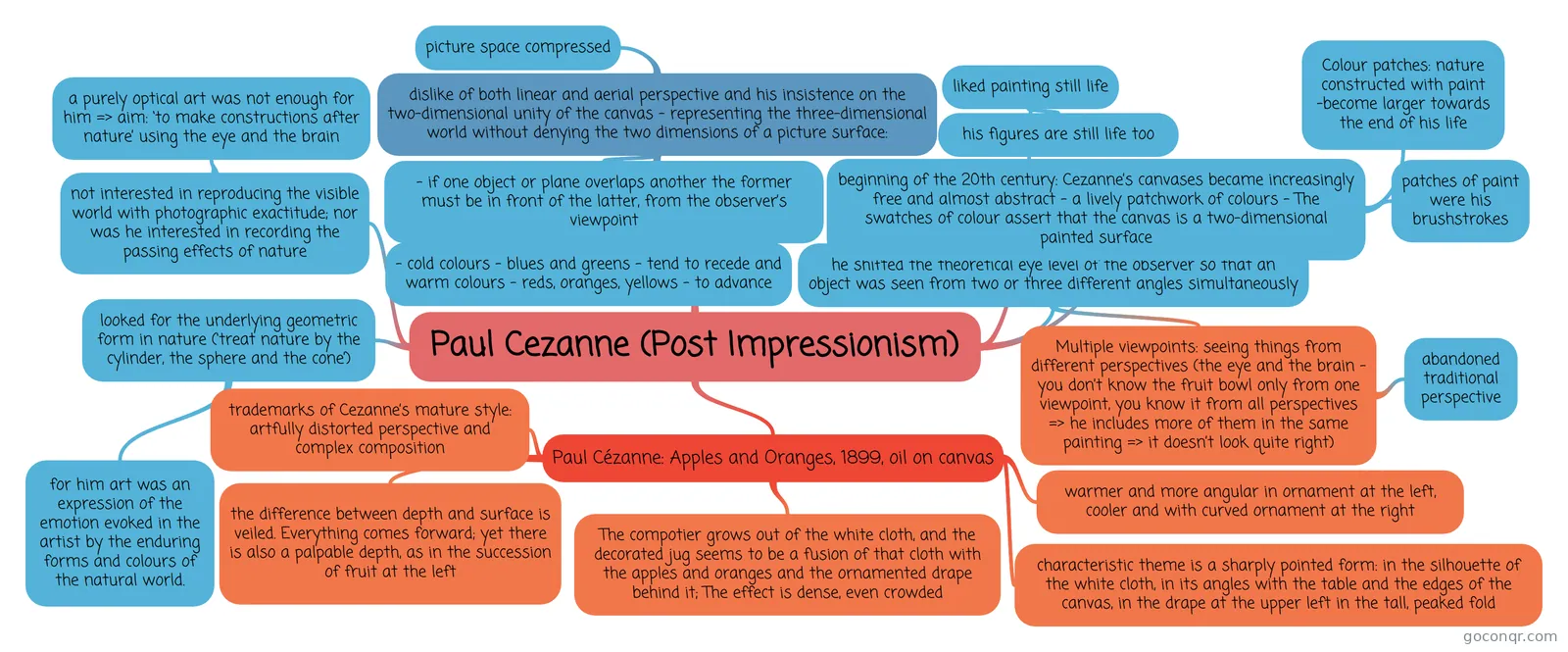
Mind map: Paul Cézanne and Post-Impressionism
Inhalt der Mindmap
Paul Cezanne (Post Impressionism)
looked for the underlying geometric form in nature (‘treat nature by the cylinder, the sphere and the cone’)
- for him art was an expression of the emotion evoked in the artist by the enduring forms and colours of the natural world.
not interested in reproducing the visible world with photographic exactitude; nor was he interested in recording the passing effects of nature
- a purely optical art was not enough for him => aim: ‘to make constructions after nature’ using the eye and the brain
dislike of both linear and aerial perspective and his insistence on the two-dimensional unity of the canvas - representing the three-dimensional world without denying the two dimensions of a picture surface:
- - if one object or plane overlaps another the former must be in front of the latter, from the observer’s viewpoint
- - cold colours – blues and greens – tend to recede and warm colours – reds, oranges, yellows – to advance
- picture space compressed
he shifted the theoretical eye level of the observer so that an object was seen from two or three different angles simultaneously
- Multiple viewpoints: seeing things from different perspectives (the eye and the brain – you don’t know the fruit bowl only from one viewpoint, you know it from all perspectives => he includes more of them in the same painting => it doesn’t look quite right)
- abandoned traditional perspective
- Multiple viewpoints: seeing things from different perspectives (the eye and the brain – you don’t know the fruit bowl only from one viewpoint, you know it from all perspectives => he includes more of them in the same painting => it doesn’t look quite right)
beginning of the 20th century: Cezanne’s canvases became increasingly free and almost abstract – a lively patchwork of colours - The swatches of colour assert that the canvas is a two-dimensional painted surface
- patches of paint were his brushstrokes
- Colour patches: nature constructed with paint -become larger towards the end of his life
liked painting still life
- his figures are still life too
Paul Cézanne: Apples and Oranges, 1899, oil on canvas
- trademarks of Cezanne’s mature style: artfully distorted perspective and complex composition
- the difference between depth and surface is veiled. Everything comes forward; yet there is also a palpable depth, as in the succession of fruit at the left
- The compotier grows out of the white cloth, and the decorated jug seems to be a fusion of that cloth with the apples and oranges and the ornamented drape behind it; The effect is dense, even crowded
- warmer and more angular in ornament at the left, cooler and with curved ornament at the right
- characteristic theme is a sharply pointed form: in the silhouette of the white cloth, in its angles with the table and the edges of the canvas, in the drape at the upper left in the tall, peaked fold
Informationen
- Beschreibung
- Mindmap am Paul Cezanne (Post Impressionism), erstellt von Sandra Porenta am 27/04/2017.
- Erstellt von
- Sandra Porenta
- Aufrufe
- 2
- Bewertung