
Mindmap
Human Endocrine System
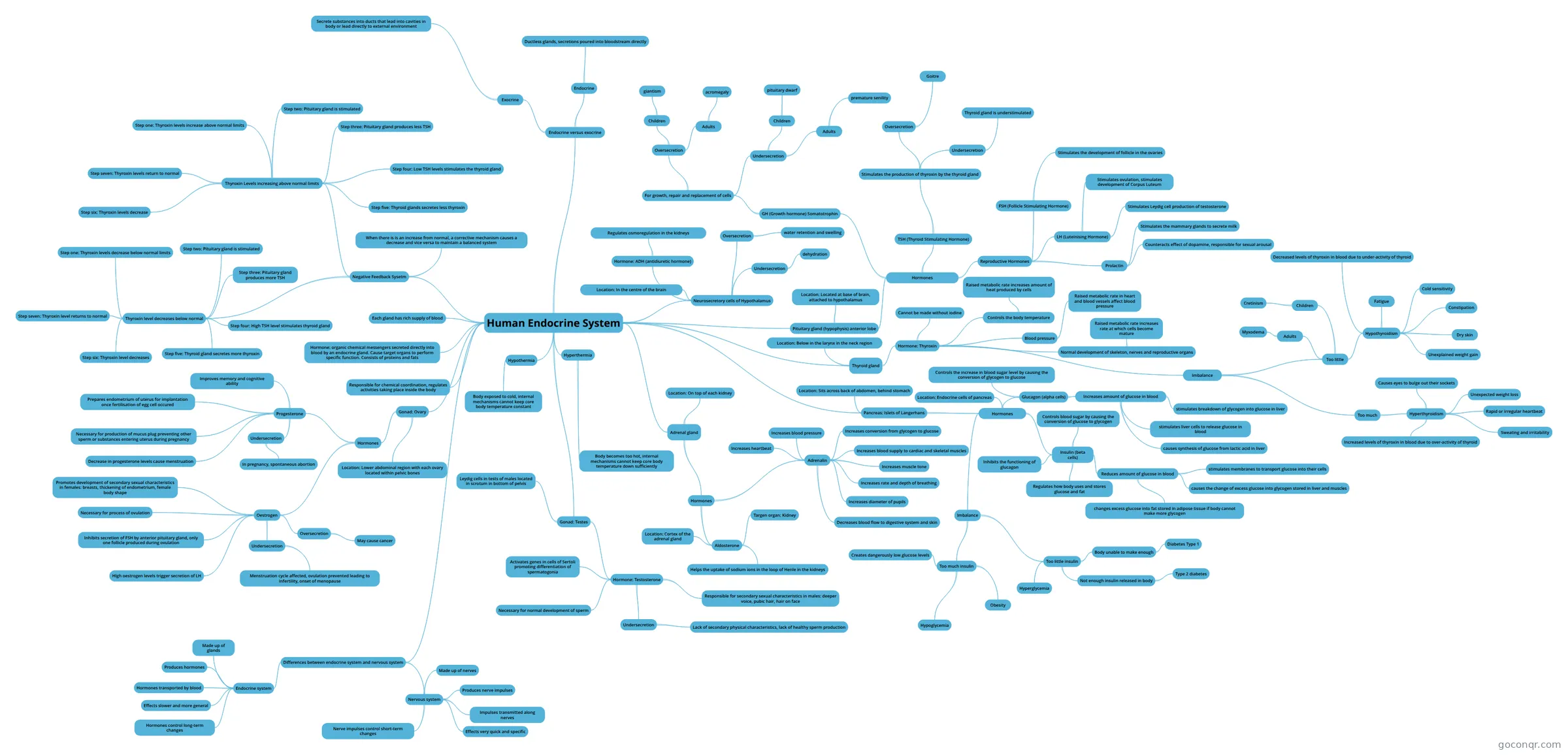
Mind map: Human Endocrine System
Inhalt der Mindmap
Human Endocrine System
Responsible for chemical coordination, regulates activities taking place inside the body
Each gland has rich supply of blood
Neurosecretory cells of Hypothalamus
- Location: In the centre of the brain
- Hormone: ADH (antidiuretic hormone)
- Regulates osmoregulation in the kidneys
- Oversecretion
- water retention and swelling
- Undersecretion
- dehydration
Pituitary gland (hypophysis) anterior lobe
- Location: Located at base of brain, attached to hypothalamus
- Hormones
- GH (Growth hormone) Somatotrophin
- For growth, repair and replacement of cells
- Oversecretion
- Children
- giantism
- Adults
- acromegaly
- Children
- Undersecretion
- Children
- pituitary dwarf
- Adults
- premature senility
- Children
- Oversecretion
- For growth, repair and replacement of cells
- TSH (Thyroid Stimulating Hormone)
- Stimulates the production of thyroxin by the thyroid gland
- Oversecretion
- Goitre
- Undersecretion
- Thyroid gland is understimulated
- Oversecretion
- Stimulates the production of thyroxin by the thyroid gland
- Reproductive Hormones
- FSH (Follicle Stimulating Hormone)
- Stimulates the development of follicle in the ovaries
- LH (Luteinising Hormone)
- Stimulates ovulation, stimulates development of Corpus Luteum
- Stimulates Leydig cell production of testosterone
- Prolactin
- Stimulates the mammary glands to secrete milk
- Counteracts effect of dopamine, responsible for sexual arousal
- FSH (Follicle Stimulating Hormone)
- GH (Growth hormone) Somatotrophin
Thyroid gland
- Location: Below in the larynx in the neck region
- Hormone: Thyroxin
- Controls the body temperature
- Raised metabolic rate increases amount of heat produced by cells
- Blood pressure
- Raised metabolic rate in heart and blood vessels affect blood pressure
- Normal development of skeleton, nerves and reproductive organs
- Raised metabolic rate increases rate at which cells become mature
- Cannot be made without iodine
- Imbalance
- Too little
- Hypothyroidism
- Fatigue
- Cold sensitivity
- Constipation
- Dry skin
- Unexplained weight gain
- Decreased levels of thyroxin in blood due to under-activity of thyroid
- Children
- Cretinism
- Adults
- Myxodema
- Hypothyroidism
- Too much
- Hyperthyroidism
- Causes eyes to bulge out their sockets
- Unexpected weight loss
- Rapid or irregular heartbeat
- Sweating and irritability
- Increased levels of thyroxin in blood due to over-activity of thyroid
- Hyperthyroidism
- Too little
- Controls the body temperature
Pancreas: Islets of Langerhans
- Location: Sits across back of abdomen, behind stomach
- Hormones
- Glucagon (alpha cells)
- Increases amount of glucose in blood
- stimulates breakdown of glycogen into glucose in liver
- stimulates liver cells to release glucose in blood
- causes synthesis of glucose from lactic acid in liver
- Controls the increase in blood sugar level by causing the conversion of glycogen to glucose
- Increases amount of glucose in blood
- Insulin (beta cells)
- Reduces amount of glucose in blood
- stimulates membranes to transport glucose into their cells
- causes the change of excess glucose into glycogen stored in liver and muscles
- changes excess glucose into fat stored in adipose tissue if body cannot make more glycogen
- Regulates how body uses and stores glucose and fat
- Controls blood sugar by causing the conversion of glucose to glycogen
- Inhibits the functioning of glucagon
- Reduces amount of glucose in blood
- Imbalance
- Too much insulin
- Creates dangerously low glucose levels
- Hypoglycemia
- Obesity
- Too little insulin
- Body unable to make enough
- Diabetes Type 1
- Not enough insulin released in body
- Type 2 diabetes
- Hyperglycemia
- Body unable to make enough
- Too much insulin
- Location: Endocrine cells of pancreas
- Glucagon (alpha cells)
Adrenal gland
- Location: On top of each kidney
- Hormones
- Adrenalin
- Increases heartbeat
- Increases blood pressure
- Increases conversion from glycogen to glucose
- Increases blood supply to cardiac and skeletal muscles
- Increases muscle tone
- Increases rate and depth of breathing
- Increases diameter of pupils
- Decreases blood flow to digestive system and skin
- Aldosterone
- Targen organ: Kidney
- Helps the uptake of sodium ions in the loop of Henle in the kidneys
- Location: Cortex of the adrenal gland
- Adrenalin
Gonad: Ovary
- Location: Lower abdominal region with each ovary located within pelvic bones
- Hormones
- Oestrogen
- Promotes development of secondary sexual characteristics in females: breasts, thickening of endometrium, female body shape
- Necessary for process of ovulation
- Inhibits secretion of FSH by anterior pituitary gland, only one follicle produced during ovulation
- HIgh oestrogen levels trigger secretion of LH
- Oversecretion
- May cause cancer
- Undersecretion
- Menstruation cycle affected, ovulation prevented leading to infertility, onset of menopause
- Progesterone
- Prepares endometrium of uterus for implantation once fertilisation of egg cell occured
- Necessary for production of mucus plug preventing other sperm or substances entering uterus during pregnancy
- Decrease in progesterone levels cause menstruation
- Improves memory and cognitive ability
- Undersecretion
- In pregnancy, spontaneous abortion
- Oestrogen
Gonad: Testes
- Hormone: Testosterone
- Responsible for secondary sexual characteristics in males: deeper voice, pubic hair, hair on face
- Necessary for normal development of sperm
- Activates genes in cells of Sertoli promoting differentiation of spermatogonia
- Undersecretion
- Lack of secondary physical characteristics, lack of healthy sperm production
- Leydig cells in tests of males located in scrotum in bottom of pelvis
- Hormone: Testosterone
Negative Feedback Sysetm
- Thyroxin Levels increasing above normal limits
- Step one: Thyroxin levels increase above normal limits
- Step two: Pituitary gland is stimulated
- Step three: Pituitary gland produces less TSH
- Step four: Low TSH levels stimulates the thyroid gland
- Step five: Thyroid glands secretes less thyroxin
- Step six: Thyroxin levels decrease
- Step seven: Thyroxin levels return to normal
- Thyroxin level decreases below normal
- Step one: Thyroxin levels decrease below normal limits
- Step two: Pituitary gland is stimulated
- Step three: Pituitary gland produces more TSH
- Step four: High TSH level stimulates thyroid gland
- Step five: Thyroid gland secretes more thyroxin
- Step six: Thyroxin level decreases
- Step seven: Thyroxin level returns to normal
- When there is is an increase from normal, a corrective mechanism causes a decrease and vice versa to maintain a balanced system
- Thyroxin Levels increasing above normal limits
Endocrine versus exocrine
- Exocrine
- Secrete substances into ducts that lead into cavities in body or lead directly to external environment
- Endocrine
- Ductless glands, secretions poured into bloodstream directly
- Exocrine
Hormone: organic chemical messengers secreted directly into blood by an endocrine gland. Cause target organs to perform specific function. Consists of proteins and fats
Differences between endocrine system and nervous system
- Nervous system
- Made up of nerves
- Produces nerve impulses
- Impulses transmitted along nerves
- Effects very quick and specific
- Nerve impulses control short-term changes
- Endocrine system
- Made up of glands
- Produces hormones
- Hormones transported by blood
- Effects slower and more general
- Hormones control long-term changes
- Nervous system
Hypothermia
- Body exposed to cold, internal mechanisms cannot keep core body temperature constant
Hyperthermia
- Body becomes too hot, internal mechanisms cannot keep core body temperature down sufficiently
Informationen
- Beschreibung
- Life Sciences Mindmap am Human Endocrine System, erstellt von Sharni Knight am 23/08/2017.
- Erstellt von
- Sharni Knight
- Aufrufe
- 1
- Bewertung