
Mindmap
Aromatic Compounds - Mindmap
Inhalt der Mindmap
Aromatic Compounds - Mindmap
August Kekule
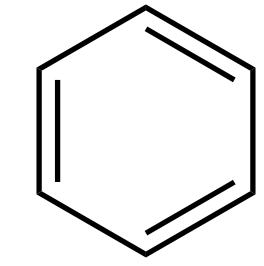
- For
- Benzene can be hydrogenated with 3 hydrogens to form cyclohexene. This would suggest there are 3 double bonds.
- Against
- Enthalpy of hydrogenation would be expected to be -320 kJ/mol. However benzene has an enthalpy of hydrogenation of -208 kJ/mol. This means benzene is more stable than the Kekule Model.
- Kekule suggested that benzene has alternating double and single bonds meaning the bonds have different lengths. However all the bonds in benzene have been found to have a length of 0.139 nm; this length is between a single and double bond.
- Benzene doesn't decolourise bromine water. Since Kekule's structure included double bonds you would expect this.
- Doesn't undergo electrophilic addition.
- For
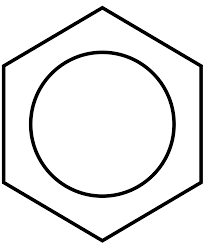
Delocalised Pi System
- This is the proposed structure of benzene. It is a cloud in the middle of a benzene molecule. It forms due to the sideways overlap of the pi bonds. This creates a region of high electron density due to there being delocalised electrons inside. This is split into two regions, one above and below the carbon ring.
Nitration
- Requires: Concentrated sulphuric acid, nitric acid and a temperature of 50 degrees celsius.
- Electrophilic substitution.
- HNO3 is not the electrophile. This is created from the reaction between concentrated sulphuric acid and nitric acid. A nitronium ion is created which is the electrophile.
- Halogenation follows the same process as the halogen isn't the electrophile. Instead a halogen carrier is required, such as AlCl3 which can be formed just by mixing aluminium with chlorine. This produces a Cl+ ion which can react with benzene.
Acylation
- This is the addition of a -RCOCl group. This too requires a halogen carrier.
- Adding acyl chloride forms an aromatic ketone.
- Called Friedl-crafts acylation
Alkylation
- Substitution of a hydrogen atom with an alkyl group. This alkyl group must have a halogen attached to it (haloalkane) and a halogen carrier such as AlCl3 is required to generate the electrophile.
- Called Friedl-crafts alkylation.
Electrophilic Substitution
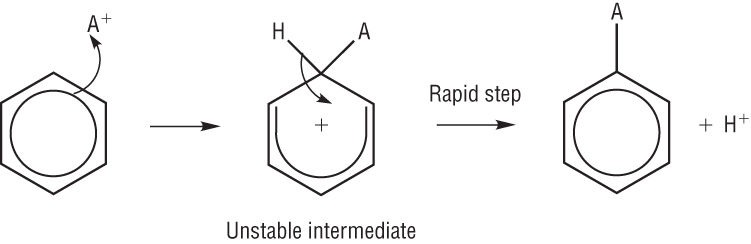
- Two steps: addition and substitution.
- Addition: An electrophile is attracted to the electron cloud. The curly arrow points to the electrophile from the circle. This forms a coordinate bond. An unstable intermediate is formed.
- Substitution: The c-h bond breaks. Its pair of electrons restore the stable delocalised structure. A hydrogen ion is eliminated. The curly arrow points from the C-H bond to the electron cloud.
Activating
- The activating group forces the additional groups to the second and fourth carbons.
- An activator donates electrons to the Pi system.
Deactivating
- The deactivating group forces the additional groups to the third and fifth carbons.
- A deactivator accepts electrons.
Bilder und Dateien der Mindmap
Informationen
- Beschreibung
- Der Nutzer hat seine Fachbereichs-Information gelöscht. Mindmap am Aromatic Compounds - Mindmap, erstellt von Gelöschter Nutzer am 25/09/2017.
- Erstellt von
- Gelöschter Nutzer
- Aufrufe
- 19
- Verlauf
-
- Erstellt von Chloe Drewery · 25 Sep 2017
- Kopiert von Chloe Drewery · 25 Sep 2017
- Bewertung