
Mindmap
Indigenous perspectives
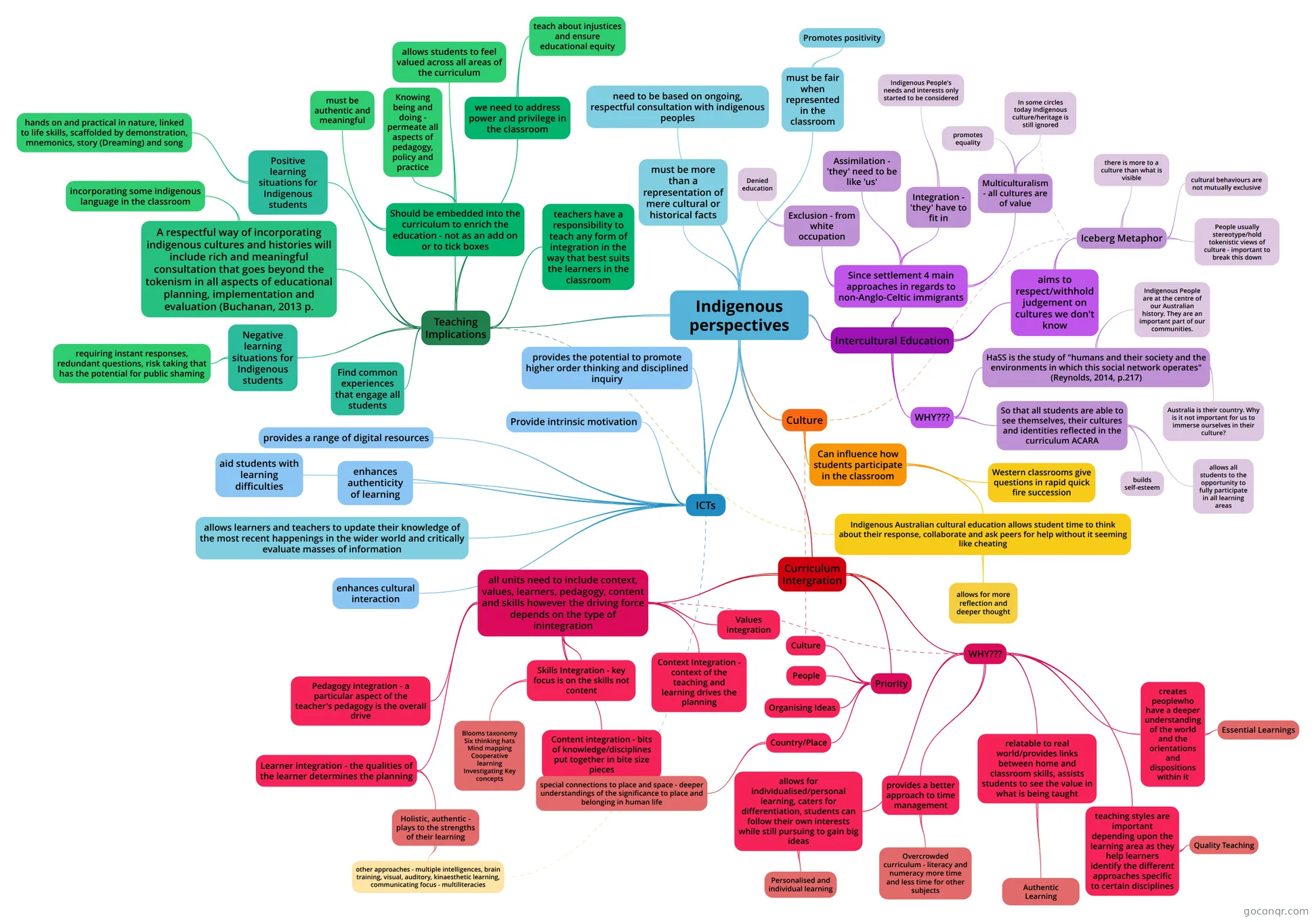
Mind map: Indigenous perspectives
Inhalt der Mindmap
Indigenous perspectives
Intercultural Education
- Since settlement 4 main approaches in regards to non-Anglo-Celtic immigrants
- Exclusion - from white occupation
- Denied education
- Assimilation - 'they' need to be like 'us'
- Integration - 'they' have to fit in
- Indigenous People's needs and interests only started to be considered
- Multiculturalism - all cultures are of value
- In some circles today Indigenous culture/heritage is still ignored
- promotes equality
- Exclusion - from white occupation
- aims to respect/withhold judgement on cultures we don't know
- Iceberg Metaphor
- there is more to a culture than what is visible
- cultural behaviours are not mutually exclusive
- People usually stereotype/hold tokenistic views of culture - important to break this down
- Iceberg Metaphor
- WHY???
- HaSS is the study of "humans and their society and the environments in which this social network operates" (Reynolds, 2014, p.217)
- Indigenous People are at the centre of our Australian history. They are an important part of our communities.
- Australia is their country. Why is it not important for us to immerse ourselves in their culture?
- So that all students are able to see themselves, their cultures and identities reflected in the curriculum ACARA
- builds self-esteem
- allows all students to the opportunity to fully participate in all learning areas
- HaSS is the study of "humans and their society and the environments in which this social network operates" (Reynolds, 2014, p.217)
- Since settlement 4 main approaches in regards to non-Anglo-Celtic immigrants
Curriculum Intergration
- WHY???
- provides a better approach to time management
- Overcrowded curriculum - literacy and numeracy more time and less time for other subjects
- creates peoplewho have a deeper understanding of the world and the orientations and dispositions within it
- Essential Learnings
- relatable to real world/provides links between home and classroom skills, assists students to see the value in what is being taught
- Authentic Learning
- teaching styles are important depending upon the learning area as they help learners identify the different approaches specific to certain disciplines
- Quality Teaching
- allows for individualised/personal learning, caters for differentiation, students can follow their own interests while still pursuing to gain big ideas
- Personalised and individual learning
- provides a better approach to time management
- all units need to include context, values, learners, pedagogy, content and skills however the driving force depends on the type of inintegration
- Content integration - bits of knowledge/disciplines put together in bite size pieces
- Skills Integration - key focus is on the skills not content
- Blooms taxonomy Six thinking hats Mind mapping Cooperative learning Investigating Key concepts
- Learner integration - the qualities of the learner determines the planning
- Holistic, authentic - plays to the strengths of their learning
- other approaches - multiple intelligences, brain training, visual, auditory, kinaesthetic learning, communicating focus - multiliteracies
- Holistic, authentic - plays to the strengths of their learning
- Context Integration - context of the teaching and learning drives the planning
- Pedagogy integration - a particular aspect of the teacher's pedagogy is the overall drive
- Values integration
- Priority
- Country/Place
- special connections to place and space - deeper understandings of the significance to place and belonging in human life
- Culture
- People
- Organising Ideas
- Country/Place
- WHY???
Teaching Implications
- we need to address power and privilege in the classroom
- teach about injustices and ensure educational equity
- Should be embedded into the curriculum to enrich the education - not as an add on or to tick boxes
- allows students to feel valued across all areas of the curriculum
- must be authentic and meaningful
- Knowing being and doing - permeate all aspects of pedagogy, policy and practice
- teachers have a responsibility to teach any form of integration in the way that best suits the learners in the classroom
- A respectful way of incorporating indigenous cultures and histories will include rich and meaningful consultation that goes beyond the tokenism in all aspects of educational planning, implementation and evaluation (Buchanan, 2013 p.
- incorporating some indigenous language in the classroom
- Positive learning situations for Indigenous students
- hands on and practical in nature, linked to life skills, scaffolded by demonstration, mnemonics, story (Dreaming) and song
- Negative learning situations for Indigenous students
- requiring instant responses, redundant questions, risk taking that has the potential for public shaming
- Find common experiences that engage all students
- we need to address power and privilege in the classroom
must be fair when represented in the classroom
- Promotes positivity
must be more than a representation of mere cultural or historical facts
ICTs
- enhances cultural interaction
- provides the potential to promote higher order thinking and disciplined inquiry
- Provide intrinsic motivation
- aid students with learning difficulties
- provides a range of digital resources
- enhances authenticity of learning
- allows learners and teachers to update their knowledge of the most recent happenings in the wider world and critically evaluate masses of information
need to be based on ongoing, respectful consultation with indigenous peoples
Culture
- Can influence how students participate in the classroom
- Indigenous Australian cultural education allows student time to think about their response, collaborate and ask peers for help without it seeming like cheating
- allows for more reflection and deeper thought
- Western classrooms give questions in rapid quick fire succession
- Indigenous Australian cultural education allows student time to think about their response, collaborate and ask peers for help without it seeming like cheating
- Can influence how students participate in the classroom
Informationen
- Beschreibung
- Education Mindmap am Indigenous perspectives, erstellt von Esther Keddie am 05/10/2017.
- Erstellt von
- Esther Keddie
- Aufrufe
- 3
- Bewertung