
Mindmap
Blockchain

Inhalt der Mindmap
Blockchain
A Blockchain is a constantly growing ledger that keeps a permanent record of all the transaction that have taken place, in a secure, chronological and immutable way.
- Ledger
- Constantly Growing
- Keeps track of all transactions
- Permanent
- Secure
- Chronological
- Immutable
- Chronological
- Secure
- Permanent
- Keeps track of all transactions
- Constantly Growing
- What Are the Applications and Use Cases of Blockchains?
- Blockchain technology is a revolution in systems of record.
- As a system of record
- Digital identity
- Cryptographic keys in the hands of individuals allow for new ownership rights and a basis to form interesting digital relationships.
- Tokenization
- For the purposes of authenticating a unique physical item, the items are paired with a corresponding digital token
- Digital identity
- For governments
- Governments have an interest in all three aspects components of blockchain technology. Firstly, there's the ownership rights surrounding cryptographic key possession, revocation, generation, replacement, or loss. They also have an interest in who can act as part of a blockchain network.
- For audit trails
- Using the client-server infrastructure, banks and other large institutions that help individuals form digital relationships over the internet are forced to secure the account information they hold on users against hackers.
- As a platform
- For smart contracting
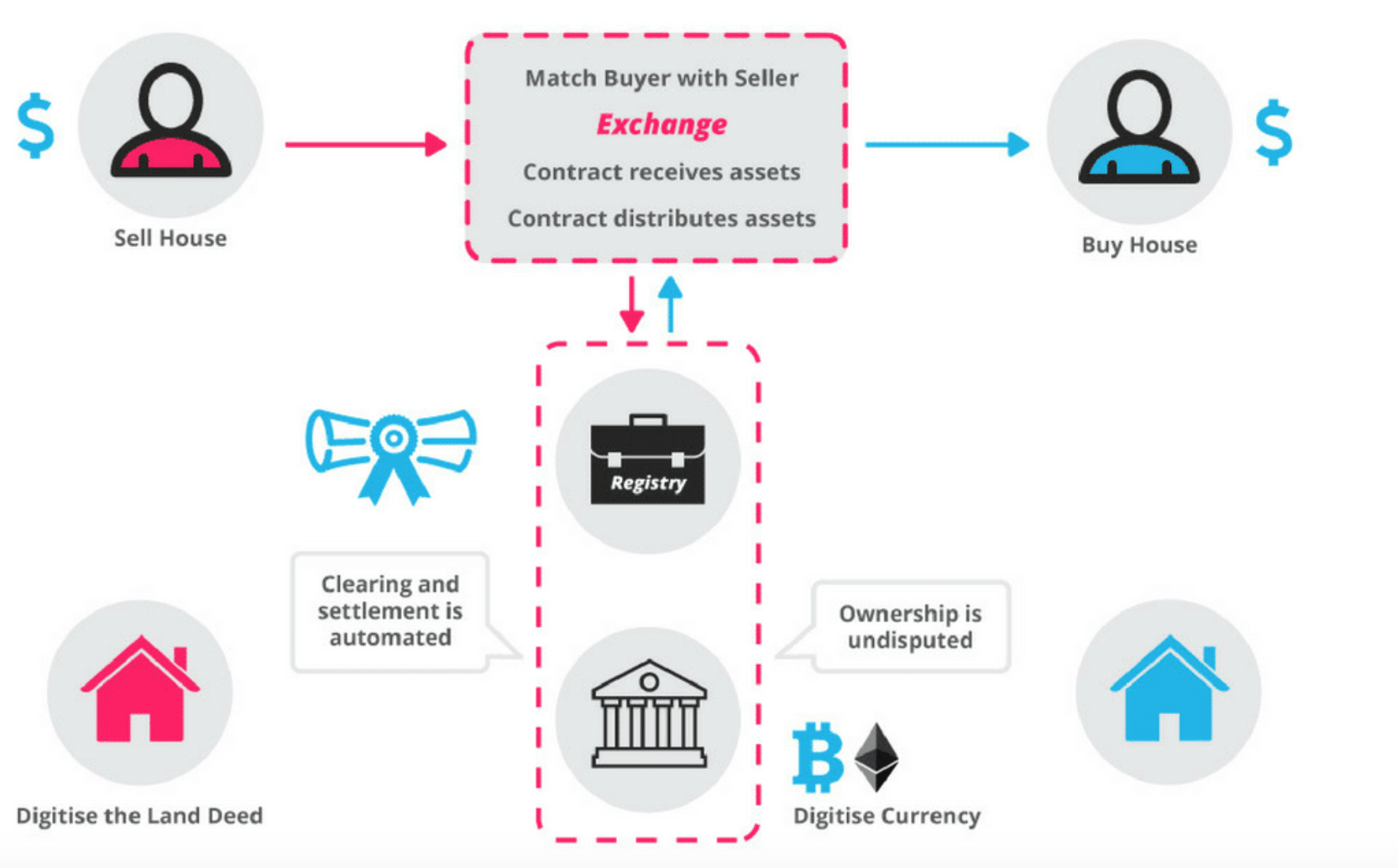
- In short, this version of smart contracts seeks to use information and documents stored in blockchains to support complex legal agreements.
- The best way to describe smart contracts is to compare the technology to a vending machine. Ordinarily, you would go to a lawyer or a notary, pay them, and wait while you get the document. With smart contracts, you simply drop a bitcoin into the vending machine (i.e. ledger), and your escrow, driver’s license, or whatever drops into your account. More so, smart contracts not only define the rules and penalties around an agreement in the same way that a traditional contract does, but also automatically enforce those obligations.
- Here’s what smart contracts give you:
- Autonomy
- You’re the one making the agreement; there’s no need to rely on a broker, lawyer or other intermediaries to confirm. Incidentally, this also knocks out the danger of manipulation by a third party, since execution is managed automatically by the network, rather than by one or more, possibly biased, individuals who may err.
- Trust
- Your documents are encrypted on a shared ledger. There’s no way that someone can say they lost it.
- Backup
- Imagine if your bank lost your savings account. On the blockchain, each and every one of your friends has your back. Your documents are duplicated many times over.
- Safety
- Cryptography, the encryption of websites, keeps your documents safe. There is no hacking. In fact, it would take an abnormally smart hacker to crack the code and infiltrate.
- Speed
- You’d ordinarily have to spend chunks of time and paperwork to manually process documents. Smart contracts use software code to automate tasks, thereby shaving hours off a range of business processes.
- Savings
- Smart contracts save you money since they knock out the presence of an intermediary. You would, for instance, have to pay a notary to witness your transaction.
- Accuracy
- Automated contracts are not only faster and cheaper but also avoid the errors that come from manually filling out heaps of forms.
- Autonomy
- Programming Languages for Smart Contracts
- Just use Solidity
- To write smart contracts there are a few different languages: Solidity, which is like JavaScript and has .sol as a file extension, Serpent, Python-like with extension .se, and a 3rd, LLL, based on Lisp. Serpent was popular a while back but Solidity is the most popular right now and more robust, so just use Solidity. You prefer Python? Use Solidity.
- solc Compiler
- After writing a contract in Solidity, use solc to compile it. It’s from the C++ libraries
- web3.js API
- Once a Solidity contract is compiled with solc and sent to the network, you can call it using the Ethereum web3.js JavaScript API and build web apps that interact with contracts.
- Just use Solidity
- For automated governance
- Bitcoin itself is an example of automated governance, or a DAO (decentralized autonomous organization). It, and other projects, remain experiments in governance, and much research is missing on this subject.
- For markets
- This simply means establishing a digitally unique identity for keys to control code that can express particular ownership rights (eg it can be owned or can own other things).
- For smart contracting
- Internet of Things(IoT)
- Internet of Things is communication among a certain type of electronic devices, for instance switching on the air conditioners 10 minutes before you reach home.
- Crowd Funding
- Blockchains can potentially create crowdsourced venture capital funds. There are a couple of websites built on the technology and their popularity suggests that people want to have a direct say in product development.
- Supply Chain Auditing
- The concept of distributed general ledgers will certify the genuineness of products. This transparency is possible due to timestamping of the transaction on a particular product number.
- Prediction Markets
- We have already seen how prediction markets have evolved that pay according to the outcome of an event. In near future, the blockchain will be “wisdom of the crowd” and develop newer applications in this domain.
- The Best Blockchain Developer Tools List
- https://blockchain.info/es/api https://blockgeeks.com/blockchain-developer-tools/
- Blockchain Testnet
- If you are blockchain developer, whether you want to create a new dapp using Ethereum or another chain, you should use the related testnet or a system that works as a substitute for the real blockchain that you will want to use for the real dapp.
- BaaS: blockchain as a service by Microsoft
- BaaS was created with the main goal of enabling the backend the capabilities needed by blockchain solutions, so you can launch the blockchain with just a few clicks, rather than setting up your own on Azure.
- Mist
- For Ethereum developer, you can use Mist not only to store Ether or send transactions but also to deploy smart contracts.
- Coinbase’s API
- Coinbase’s APIs allow blockchain developers to easily build new bitcoin apps and integrate bitcoin into already existing applications. This system enables a wide range of capabilities from gathering read-only data to building something really new. Also, Coinbase’s APIs provides a system to create bitcoin wallets and addresses, buy, sell, send and receive bitcoins worldwide, and they offer several client libraries and mobile SDKs that are quite useful for a developer.
- Tierion
- It enables to create a verifiable database of any data or process on the bitcoin blockchain by offering developer tools & API to add data to the distributed ledger.
- Embark
- Embark enables you to create new smart contracts and make them available in the JS code. Also, it watches for changes, and if you update the contract, Embark will automatically modify the contracts and its related dapp.
- Ether Scripter
- This is a tool that helps you writing the script (or code) of your smart contract. It is an user-friendly platform created back in 2014. At the moment, it can only be used with the Serpent programming language.
- Solc
- Solc is the Solidity Compiler (Solidity is the programming language to write code on the Ethereum chain). A good number of Ethereum nodes natively includes a solc implementation, but it is also packaged as a standalone module for an offline compiling. So, you can decide to use web3.eth.compile.solidity to compile your Solidity files using your node, or you can start using a solc.compile that doesn’t rely on any external node.
- Ledger
Bilder und Dateien der Mindmap
Informationen
- Beschreibung
- Mindmap am Blockchain, erstellt von Hiram Castro am 07/11/2017.
- Erstellt von
- Hiram Castro
- Aufrufe
- 52
- Bewertung