
Mindmap
Cakes and icings
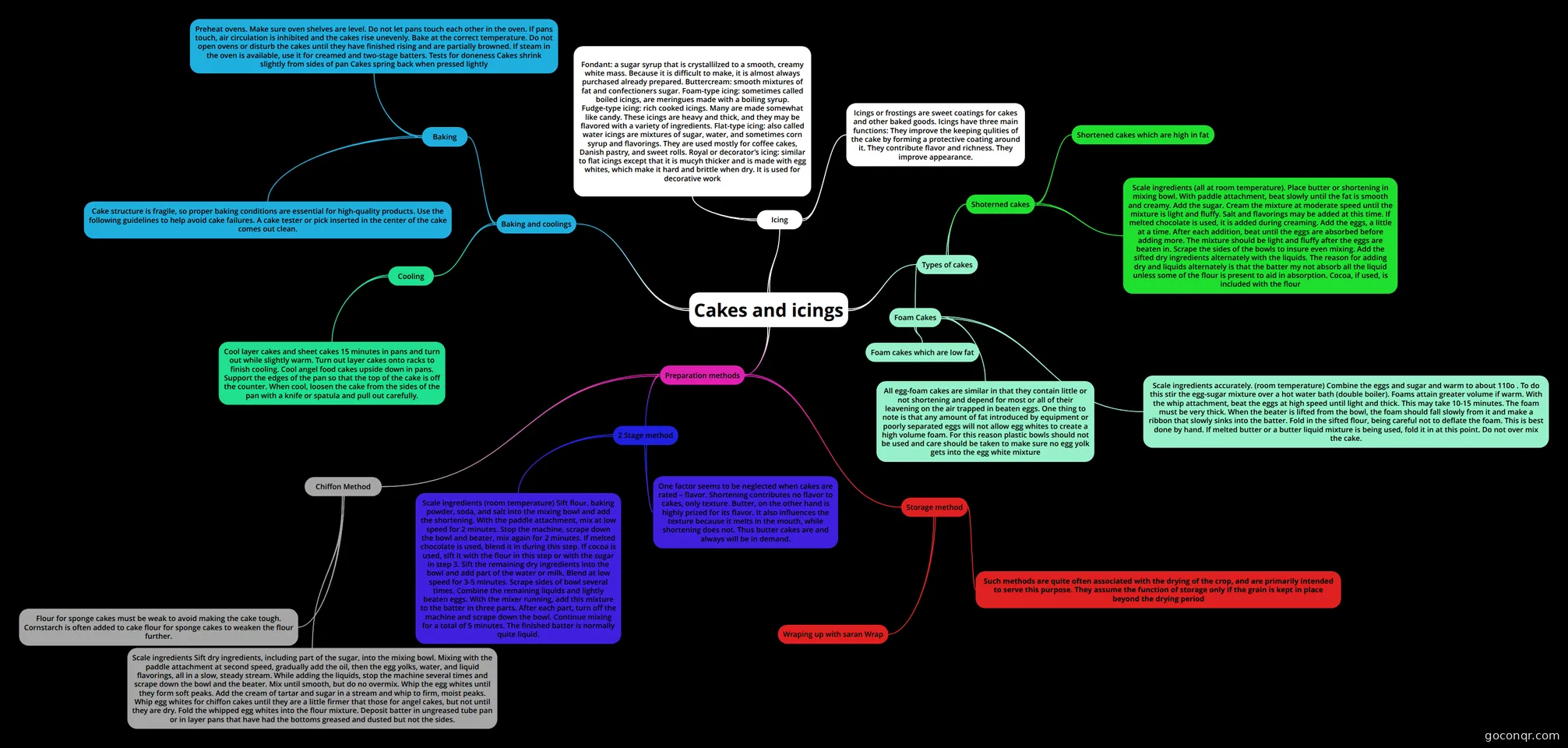
Mind map: Cakes and icings
Inhalt der Mindmap
Cakes and icings
Types of cakes
- Shoterned cakes
- Shortened cakes which are high in fat
- Scale ingredients (all at room temperature). Place butter or shortening in mixing bowl. With paddle attachment, beat slowly until the fat is smooth and creamy. Add the sugar. Cream the mixture at moderate speed until the mixture is light and fluffy. Salt and flavorings may be added at this time. If melted chocolate is used, it is added during creaming. Add the eggs, a little at a time. After each addition, beat until the eggs are absorbed before adding more. The mixture should be light and fluffy after the eggs are beaten in. Scrape the sides of the bowls to insure even mixing. Add the sifted dry ingredients alternately with the liquids. The reason for adding dry and liquids alternately is that the batter my not absorb all the liquid unless some of the flour is present to aid in absorption. Cocoa, if used, is included with the flour
- Foam Cakes
- Foam cakes which are low fat
- All egg-foam cakes are similar in that they contain little or not shortening and depend for most or all of their leavening on the air trapped in beaten eggs. One thing to note is that any amount of fat introduced by equipment or poorly separated eggs will not allow egg whites to create a high volume foam. For this reason plastic bowls should not be used and care should be taken to make sure no egg yolk gets into the egg white mixture
- Scale ingredients accurately. (room temperature) Combine the eggs and sugar and warm to about 110o . To do this stir the egg-sugar mixture over a hot water bath (double boiler). Foams attain greater volume if warm. With the whip attachment, beat the eggs at high speed until light and thick. This may take 10-15 minutes. The foam must be very thick. When the beater is lifted from the bowl, the foam should fall slowly from it and make a ribbon that slowly sinks into the batter. Fold in the sifted flour, being careful not to deflate the foam. This is best done by hand. If melted butter or a butter liquid mixture is being used, fold it in at this point. Do not over mix the cake.
- Shoterned cakes
Baking and coolings
- Cooling
- Cool layer cakes and sheet cakes 15 minutes in pans and turn out while slightly warm. Turn out layer cakes onto racks to finish cooling. Cool angel food cakes upside down in pans. Support the edges of the pan so that the top of the cake is off the counter. When cool, loosen the cake from the sides of the pan with a knife or spatula and pull out carefully.
- Baking
- Cake structure is fragile, so proper baking conditions are essential for high-quality products. Use the following guidelines to help avoid cake failures. A cake tester or pick inserted in the center of the cake comes out clean.
- Preheat ovens. Make sure oven shelves are level. Do not let pans touch each other in the oven. If pans touch, air circulation is inhibited and the cakes rise unevenly. Bake at the correct temperature. Do not open ovens or disturb the cakes until they have finished rising and are partially browned. If steam in the oven is available, use it for creamed and two-stage batters. Tests for doneness Cakes shrink slightly from sides of pan Cakes spring back when pressed lightly
- Cooling
Preparation methods
- Chiffon Method
- Scale ingredients Sift dry ingredients, including part of the sugar, into the mixing bowl. Mixing with the paddle attachment at second speed, gradually add the oil, then the egg yolks, water, and liquid flavorings, all in a slow, steady stream. While adding the liquids, stop the machine several times and scrape down the bowl and the beater. Mix until smooth, but do no overmix. Whip the egg whites until they form soft peaks. Add the cream of tartar and sugar in a stream and whip to firm, moist peaks. Whip egg whites for chiffon cakes until they are a little firmer that those for angel cakes, but not until they are dry. Fold the whipped egg whites into the flour mixture. Deposit batter in ungreased tube pan or in layer pans that have had the bottoms greased and dusted but not the sides.
- Flour for sponge cakes must be weak to avoid making the cake tough. Cornstarch is often added to cake flour for sponge cakes to weaken the flour further.
- 2 Stage method
- Scale ingredients (room temperature) Sift flour, baking powder, soda, and salt into the mixing bowl and add the shortening. With the paddle attachment, mix at low speed for 2 minutes. Stop the machine, scrape down the bowl and beater, mix again for 2 minutes. If melted chocolate is used, blend it in during this step. If cocoa is used, sift it with the flour in this step or with the sugar in step 3. Sift the remaining dry ingredients into the bowl and add part of the water or milk. Blend at low speed for 3-5 minutes. Scrape sides of bowl several times. Combine the remaining liquids and lightly beaten eggs. With the mixer running, add this mixture to the batter in three parts. After each part, turn off the machine and scrape down the bowl. Continue mixing for a total of 5 minutes. The finished batter is normally quite liquid.
- One factor seems to be neglected when cakes are rated – flavor. Shortening contributes no flavor to cakes, only texture. Butter, on the other hand is highly prized for its flavor. It also influences the texture because it melts in the mouth, while shortening does not. Thus butter cakes are and always will be in demand.
- Storage method
- Wraping up with saran Wrap
- Such methods are quite often associated with the drying of the crop, and are primarily intended to serve this purpose. They assume the function of storage only if the grain is kept in place beyond the drying period
- Chiffon Method
Icing
- Icings or frostings are sweet coatings for cakes and other baked goods. Icings have three main functions: They improve the keeping qulities of the cake by forming a protective coating around it. They contribute flavor and richness. They improve appearance.
- Fondant: a sugar syrup that is crystallilzed to a smooth, creamy white mass. Because it is difficult to make, it is almost always purchased already prepared. Buttercream: smooth mixtures of fat and confectioners sugar. Foam-type icing: sometimes called boiled icings, are meringues made with a boiling syrup. Fudge-type icing: rich cooked icings. Many are made somewhat like candy. These icings are heavy and thick, and they may be flavored with a variety of ingredients. Flat-type icing: also called water icings are mixtures of sugar, water, and sometimes corn syrup and flavorings. They are used mostly for coffee cakes, Danish pastry, and sweet rolls. Royal or decorator’s icing: similar to flat icings except that it is mucyh thicker and is made with egg whites, which make it hard and brittle when dry. It is used for decorative work
Informationen
- Beschreibung
- Mindmap am Cakes and icings, erstellt von Johnathan Brown am 06/02/2018.
- Erstellt von
- Johnathan Brown
- Aufrufe
- 2
- Bewertung