
Mindmap
Practitioner’s Section Patent License Negotiation: Best Practices
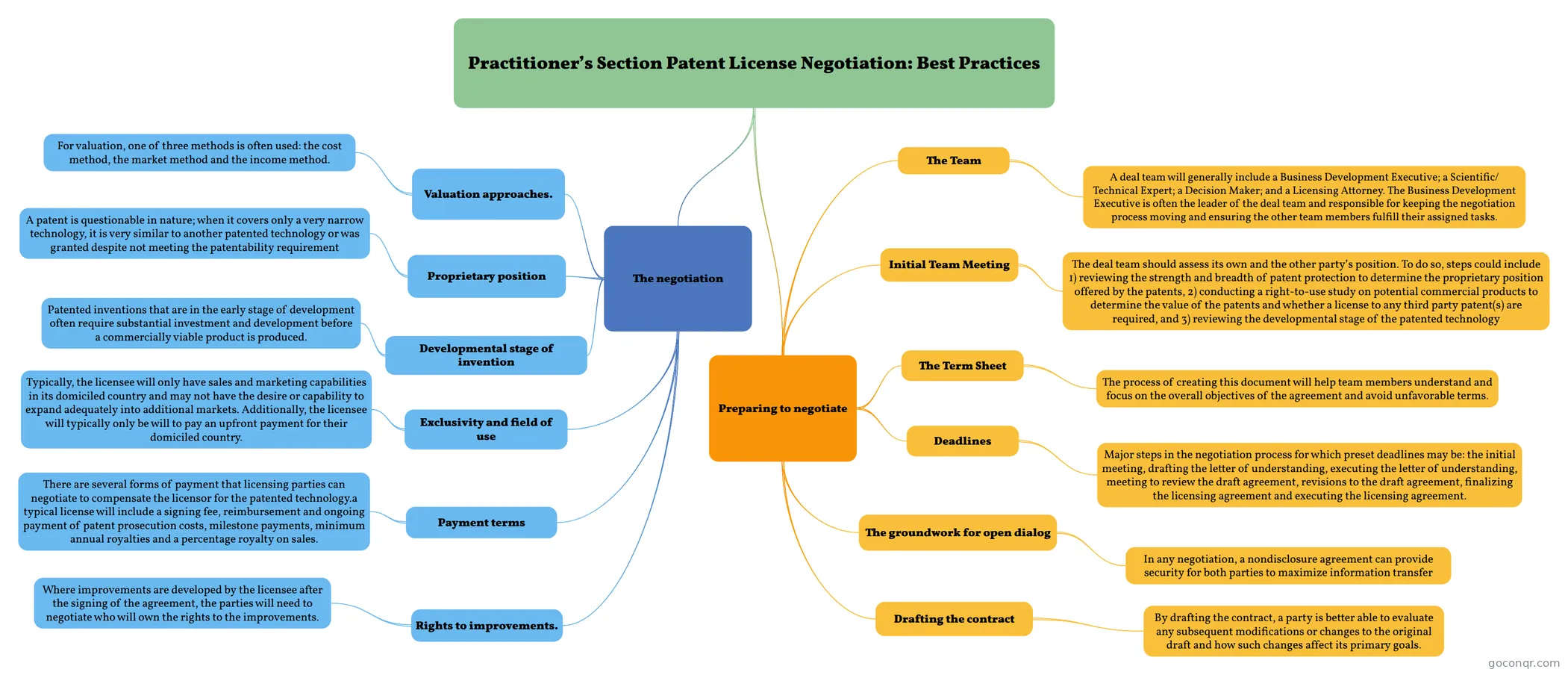
Mind map: Patent license negotiation best practices
Inhalt der Mindmap
Practitioner’s Section Patent License Negotiation: Best Practices
The negotiation
- Valuation approaches.
- For valuation, one of three methods is often used: the cost method, the market method and the income method.
- Proprietary position
- A patent is questionable in nature; when it covers only a very narrow technology, it is very similar to another patented technology or was granted despite not meeting the patentability requirement
- Developmental stage of invention
- Patented inventions that are in the early stage of development often require substantial investment and development before a commercially viable product is produced.
- Exclusivity and field of use
- Typically, the licensee will only have sales and marketing capabilities in its domiciled country and may not have the desire or capability to expand adequately into additional markets. Additionally, the licensee will typically only be will to pay an upfront payment for their domiciled country.
- Payment terms
- There are several forms of payment that licensing parties can negotiate to compensate the licensor for the patented technology.a typical license will include a signing fee, reimbursement and ongoing payment of patent prosecution costs, milestone payments, minimum annual royalties and a percentage royalty on sales.
- Rights to improvements.
- Where improvements are developed by the licensee after the signing of the agreement, the parties will need to negotiate who will own the rights to the improvements.
- Valuation approaches.
Preparing to negotiate
- The Team
- A deal team will generally include a Business Development Executive; a Scientific/ Technical Expert; a Decision Maker; and a Licensing Attorney. The Business Development Executive is often the leader of the deal team and responsible for keeping the negotiation process moving and ensuring the other team members fulfill their assigned tasks.
- The Term Sheet
- The process of creating this document will help team members understand and focus on the overall objectives of the agreement and avoid unfavorable terms.
- Initial Team Meeting
- The deal team should assess its own and the other party’s position. To do so, steps could include 1) reviewing the strength and breadth of patent protection to determine the proprietary position offered by the patents, 2) conducting a right-to-use study on potential commercial products to determine the value of the patents and whether a license to any third party patent(s) are required, and 3) reviewing the developmental stage of the patented technology
- Deadlines
- Major steps in the negotiation process for which preset deadlines may be: the initial meeting, drafting the letter of understanding, executing the letter of understanding, meeting to review the draft agreement, revisions to the draft agreement, finalizing the licensing agreement and executing the licensing agreement.
- The groundwork for open dialog
- In any negotiation, a nondisclosure agreement can provide security for both parties to maximize information transfer
- Drafting the contract
- By drafting the contract, a party is better able to evaluate any subsequent modifications or changes to the original draft and how such changes affect its primary goals.
- The Team
Informationen
- Beschreibung
- Valoracion y negociacion de tecnologia Mindmap am Practitioner’s Section Patent License Negotiation: Best Practices, erstellt von orlando velez am 12/03/2018.
- Erstellt von
- orlando velez
- Aufrufe
- 3
- Bewertung
Mehr zu Patent License Agreements and Negotiation