
Mindmap
LA 10, 11
Inhalt der Mindmap
LA 10, 11
The inverse of a linear transformation and of a matrix
- Let A be a matrix of a linear map T. A linear map T is invertible if and only if its matrix A is invertible. The inverses T −1 and A−1 are unique.
- A linear map T : U → V is invertible if and only if T satisfies the equivalent conditions of Corollary 9.7. In particular, if T is invertible, then dim(U) = dim(V ), so only square matrices can be invertible
- If A and B are invertible n × n matrices, then AB is invertible, and (AB) −1 = B^−1A^−1
- The row reduced form of an invertible n × n matrix A is In.
- To compute A−1 , we reduce A to its row reduced form In, using elementary row operations, while simultaneously applying the same row operations, but starting with the identity matrix In. It turns out that these operations transform In to A−1 . In practice, we might not know whether or not A is invertible before we start, but we will find out while carrying out this procedure because, if A is not invertible, then its rank will be less than n, and it will not row reduce to In
- Elementary matrices
- Each elementary row operation on a matrix can be achieved by multiplying the matrix on the left by a corresponding matrix known as an elementary matrix. There are three types of these, all being slightly different from the identity matrix. 1. E(n) 1 λ,i,j (where i 6= j) is the an n × n matrix equal to the identity, but with an additional non-zero entry λ in the (i, j) position. 2. E(n) 2 i,j is the n × n identity matrix with its ith and jth rows interchanged. 3. E(n) 3 λ,i (where λ 6= 0) is the n × n identity matrix with its (i, i) entry replaced by λ.
- Let A be any m × n matrix. Then E(m) 1 λ,i,jA is the result we get by adding λ times the jth row of A to the ith row of A. Similarly E(m) 2 i,jA is equal to A with its ith and jth rows interchanged, and E(m) 3 λ,i is equal to A with its ith row multiplied by λ.
- An invertible matrix is a product of elementary matrices
- Let A be any m × n matrix. Then E(m) 1 λ,i,jA is the result we get by adding λ times the jth row of A to the ith row of A. Similarly E(m) 2 i,jA is equal to A with its ith and jth rows interchanged, and E(m) 3 λ,i is equal to A with its ith row multiplied by λ.
- Each elementary row operation on a matrix can be achieved by multiplying the matrix on the left by a corresponding matrix known as an elementary matrix. There are three types of these, all being slightly different from the identity matrix. 1. E(n) 1 λ,i,j (where i 6= j) is the an n × n matrix equal to the identity, but with an additional non-zero entry λ in the (i, j) position. 2. E(n) 2 i,j is the n × n identity matrix with its ith and jth rows interchanged. 3. E(n) 3 λ,i (where λ 6= 0) is the n × n identity matrix with its (i, i) entry replaced by λ.
- Elementary matrices
- To compute A−1 , we reduce A to its row reduced form In, using elementary row operations, while simultaneously applying the same row operations, but starting with the identity matrix In. It turns out that these operations transform In to A−1 . In practice, we might not know whether or not A is invertible before we start, but we will find out while carrying out this procedure because, if A is not invertible, then its rank will be less than n, and it will not row reduce to In
- The row reduced form of an invertible n × n matrix A is In.
- If A and B are invertible n × n matrices, then AB is invertible, and (AB) −1 = B^−1A^−1
- A linear map T : U → V is invertible if and only if T satisfies the equivalent conditions of Corollary 9.7. In particular, if T is invertible, then dim(U) = dim(V ), so only square matrices can be invertible
- Solving systems of linear equations revisited again
- Let A be an n × n matrix. Then (i) the homogeneous system of equations Ax = 0 has a non-zero solution if and only if A is singular; (ii) the equation system Ax = b has a unique solution if and only if A is nonsingular.
- Let A be a matrix of a linear map T. A linear map T is invertible if and only if its matrix A is invertible. The inverses T −1 and A−1 are unique.
The determinant of a matrix
- Now we turn to the general definition for n×n matrices. Suppose that we take the product of n entries from the matrix, where we take exactly one entry from each row and one from each column. Such a product is called an elementary product. There are n! such products altogether, and the determinant is the sum of n! terms, each of which is plus or minus one of these elementary products. We say that it is a sum of n! signed elementary products.
- A permutation of a set, which we shall take here to be the set Xn = {1, 2, 3, . . . , n}, is simply a bijection from Xn to itself. The set of all such permutations of Xn is called the symmetric group Sn. There are n! permutations altogether, so |Sn| = n!.
- An elementary product contains one entry from each row of A, so let the entry in the product from the ith row be aiφ(i) , where φ is some as-yet unknown function from Xn to Xn.
- Since the product also contains exactly one entry from each column, each integer j ∈ Xn must occur exactly once as φ(i). But this is just saying that φ: Xn → Xn is a bijection; that is φ ∈ Sn. Conversely, any φ ∈ Sn defines an elementary product in this way.
- We still have to decide which of the elementary products has a plus sign and which has a minus sign. In fact this depends on the sign of the permutation φ
- Since the product also contains exactly one entry from each column, each integer j ∈ Xn must occur exactly once as φ(i). But this is just saying that φ: Xn → Xn is a bijection; that is φ ∈ Sn. Conversely, any φ ∈ Sn defines an elementary product in this way.
- An elementary product contains one entry from each row of A, so let the entry in the product from the ith row be aiφ(i) , where φ is some as-yet unknown function from Xn to Xn.
- A permutation of a set, which we shall take here to be the set Xn = {1, 2, 3, . . . , n}, is simply a bijection from Xn to itself. The set of all such permutations of Xn is called the symmetric group Sn. There are n! permutations altogether, so |Sn| = n!.
- The effect of matrix operations on the determinant
- Elementary row operations affect the determinant of a matrix as follows. (i) det(In) = 1. (ii) Let B result from A by applying (R2) (interchanging two rows). Then det(B) = − det(A). (iii) If A has two equal rows then det(A) = 0. (iv) Let B result from A by applying (R1) (adding a multiple of one row to another). Then det(B) = det(A). (v) Let B result from A by applying (R3) (multiplying a row by a scalar λ). Then det(B) = λ det(A)
- All of this remains true if we replace rows by columns
- A matrix is called upper triangular if all of its entries below the main diagonal are zero; that is, (aij ) is upper triangular if aij = 0 for all i > j. The matrix is called diagonal if all entries not on the main diagonal are zero; that is, aij = 0 for i =/= j.
- If A = (aij ) is upper triangular, then det(A) = a11a22 . . . ann is the product of the entries on the main diagonal of A.
- Let A = (aij ) be an m × n matrix. We define the transpose AT of A to be the n × m matrix (bij ), where bij = aji for 1 ≤ i ≤ n, 1 ≤ j ≤ m
- Let A = (aij ) be an n × n matrix. Then det(A^T) = det(A).
- For an n × n matrix A, det(A) = 0 if and only if A is singular
- If E is an n×n elementary matrix, and B is any n×n matrix, then det(EB) = det(E) det(B).
- For an n × n matrix A, det(A) = 0 if and only if A is singular
- For any two n × n matrices A and B, we have det(AB) = det(A) det(B)
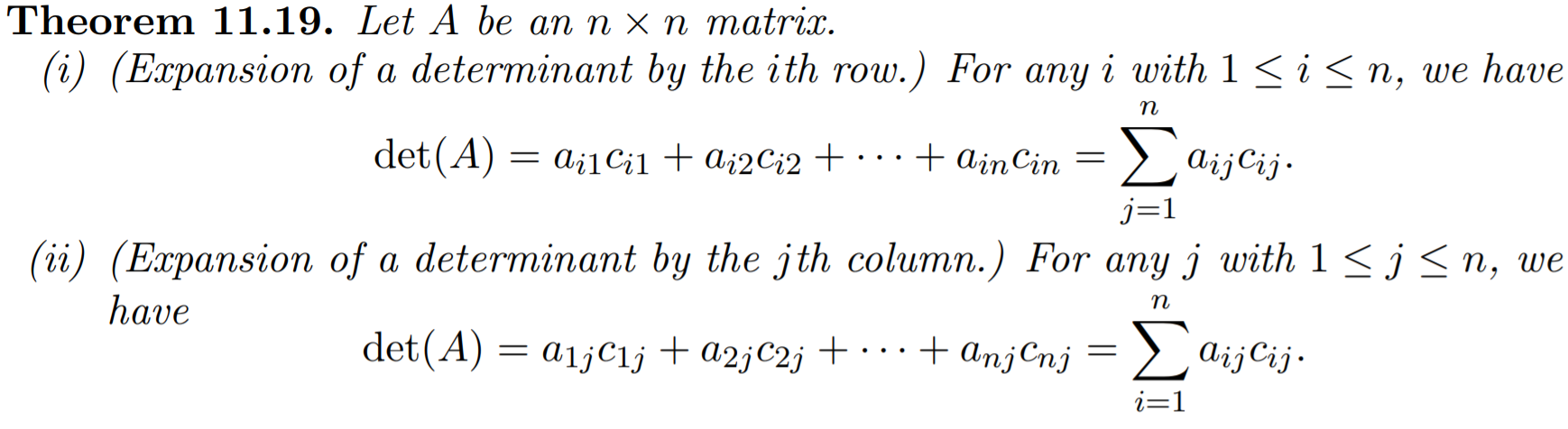
- Let A = (aij ) be an n×n matrix. Let Aij be the (n−1)×(n−1) matrix obtained from A by deleting the ith row and the jth column of A. Now let Mij = det(Aij ). Then Mij is called the (i, j)th minor of A
- We define cij to be equal to Mij if i + j is even, and to −Mij if i + j is odd. Or, more concisely, cij = (−1)i+jMij = (−1)i+j det(Aij ). Then cij is called the (i, j)th cofactor of A
- Let A be an n × n matrix. We define the adjugate matrix adj(A) of A to be the n × n matrix of which the (i, j)th element is the cofactor cji. In other words, it is the transpose of the matrix of cofactors. The adjugate is also sometimes called the adjoint
- A adj(A) = det(A)In = adj(A) A
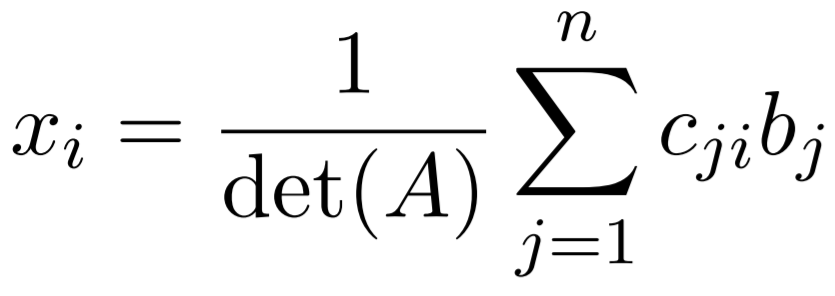
- Now let Ai be the matrix obtained from A by substituting β for the ith column of A. Then the sum is precisely the expansion of det(Ai) by its ith column (see Theorem 11.19). Hence we have xi = det(Ai)/ det(A). This is Cramer’s rule.
- Let A be an n × n matrix. We define the adjugate matrix adj(A) of A to be the n × n matrix of which the (i, j)th element is the cofactor cji. In other words, it is the transpose of the matrix of cofactors. The adjugate is also sometimes called the adjoint
- We define cij to be equal to Mij if i + j is even, and to −Mij if i + j is odd. Or, more concisely, cij = (−1)i+jMij = (−1)i+j det(Aij ). Then cij is called the (i, j)th cofactor of A
- Let A = (aij ) be an n × n matrix. Then det(A^T) = det(A).
- Let A = (aij ) be an m × n matrix. We define the transpose AT of A to be the n × m matrix (bij ), where bij = aji for 1 ≤ i ≤ n, 1 ≤ j ≤ m
- If A = (aij ) is upper triangular, then det(A) = a11a22 . . . ann is the product of the entries on the main diagonal of A.
- Elementary row operations affect the determinant of a matrix as follows. (i) det(In) = 1. (ii) Let B result from A by applying (R2) (interchanging two rows). Then det(B) = − det(A). (iii) If A has two equal rows then det(A) = 0. (iv) Let B result from A by applying (R1) (adding a multiple of one row to another). Then det(B) = det(A). (v) Let B result from A by applying (R3) (multiplying a row by a scalar λ). Then det(B) = λ det(A)
- Now we turn to the general definition for n×n matrices. Suppose that we take the product of n entries from the matrix, where we take exactly one entry from each row and one from each column. Such a product is called an elementary product. There are n! such products altogether, and the determinant is the sum of n! terms, each of which is plus or minus one of these elementary products. We say that it is a sum of n! signed elementary products.
Bilder und Dateien der Mindmap

Informationen
- Beschreibung
- Mindmap am LA 10, 11, erstellt von Anthony Rajecki-Doyle am 05/04/2018.
- Erstellt von
- Anthony Rajecki-Doyle
- Aufrufe
- 0
- Bewertung