
Mindmap
GI Drugs
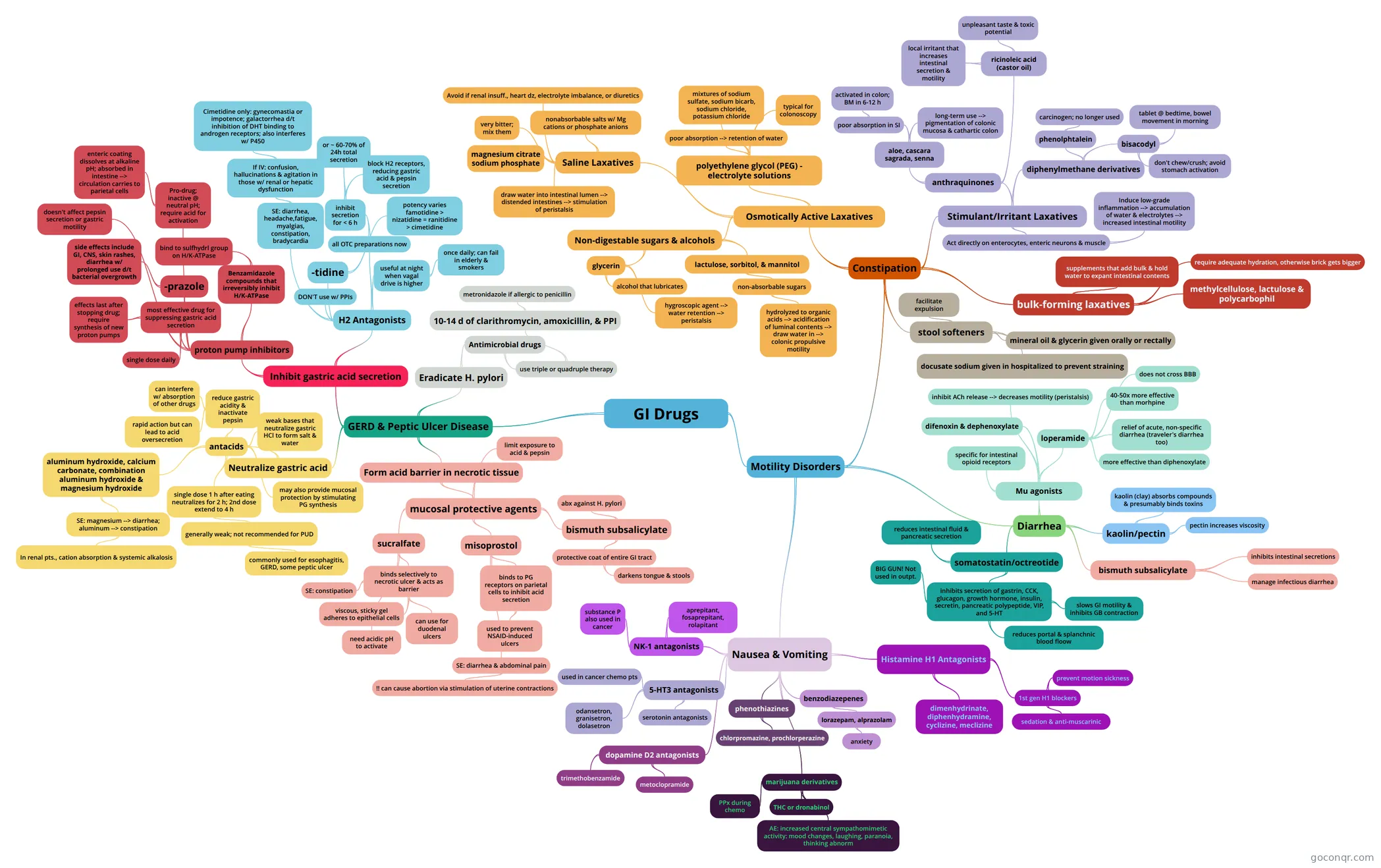
Mind map: GI drugs
Inhalt der Mindmap
GI Drugs
GERD & Peptic Ulcer Disease
- Inhibit gastric acid secretion
- proton pump inhibitors
- Benzamidazole compounds that irreversibly inhibit H/K-ATPase
- bind to sulfhydrl group on H/K-ATPase
- Pro-drug; inactive @ neutral pH; require acid for activation
- enteric coating dissolves at alkaline pH; absorbed in intestine --> circulation carries to parietal cells
- -prazole
- side effects include GI, CNS, skin rashes, diarrhea w/ prolonged use d/t bacterial overgrowth
- most effective drug for suppressing gastric acid secretion
- single dose daily
- effects last after stopping drug; require synthesis of new proton pumps
- doesn't affect pepsin secretion or gastric motility
- Benzamidazole compounds that irreversibly inhibit H/K-ATPase
- H2 Antagonists
- -tidine
- potency varies famotidine > nizatidine = ranitidine > cimetidine
- all OTC preparations now
- inhibit secretion for < 6 h
- or ~ 60-70% of 24h total secretion
- block H2 receptors, reducing gastric acid & pepsin secretion
- inhibit secretion for < 6 h
- useful at night when vagal drive is higher
- once daily; can fail in elderly & smokers
- DON'T use w/ PPIs
- SE: diarrhea, headache,fatigue, myalgias, constipation, bradycardia
- If IV: confusion, hallucinations & agitation in those w/ renal or hepatic dysfunction
- Cimetidine only: gynecomastia or impotence; galactorrhea d/t inhibition of DHT binding to androgen receptors; also interferes w/ P450
- If IV: confusion, hallucinations & agitation in those w/ renal or hepatic dysfunction
- -tidine
- proton pump inhibitors
- Neutralize gastric acid
- antacids
- weak bases that neutralize gastric HCl to form salt & water
- reduce gastric acidity & inactivate pepsin
- can interfere w/ absorption of other drugs
- rapid action but can lead to acid oversecretion
- may also provide mucosal protection by stimulating PG synthesis
- aluminum hydroxide, calcium carbonate, combination aluminum hydroxide & magnesium hydroxide
- SE: magnesium --> diarrhea; aluminum --> constipation
- In renal pts., cation absorption & systemic alkalosis
- SE: magnesium --> diarrhea; aluminum --> constipation
- single dose 1 h after eating neutralizes for 2 h; 2nd dose extend to 4 h
- generally weak; not recommended for PUD
- commonly used for esophagitis, GERD, some peptic ulcer
- generally weak; not recommended for PUD
- antacids
- Form acid barrier in necrotic tissue
- mucosal protective agents
- limit exposure to acid & pepsin
- sucralfate
- binds selectively to necrotic ulcer & acts as barrier
- viscous, sticky gel adheres to epithelial cells
- SE: constipation
- can use for duodenal ulcers
- need acidic pH to activate
- binds selectively to necrotic ulcer & acts as barrier
- misoprostol
- binds to PG receptors on parietal cells to inhibit acid secretion
- used to prevent NSAID-induced ulcers
- SE: diarrhea & abdominal pain
- !! can cause abortion via stimulation of uterine contractions
- binds to PG receptors on parietal cells to inhibit acid secretion
- bismuth subsalicylate
- protective coat of entire GI tract
- darkens tongue & stools
- abx against H. pylori
- protective coat of entire GI tract
- mucosal protective agents
- Eradicate H. pylori
- Antimicrobial drugs
- use triple or quadruple therapy
- 10-14 d of clarithromycin, amoxicillin, & PPI
- metronidazole if allergic to penicillin
- 10-14 d of clarithromycin, amoxicillin, & PPI
- use triple or quadruple therapy
- Antimicrobial drugs
- Inhibit gastric acid secretion
Motility Disorders
- Constipation
- Osmotically Active Laxatives
- Saline Laxatives
- nonabsorbable salts w/ Mg cations or phosphate anions
- draw water into intestinal lumen --> distended intestines --> stimulation of peristalsis
- very bitter; mix them
- Avoid if renal insuff., heart dz, electrolyte imbalance, or diuretics
- magnesium citrate sodium phosphate
- Non-digestable sugars & alcohols
- glycerin
- alcohol that lubricates
- hygroscopic agent --> water retention --> peristalsis
- lactulose, sorbitol, & mannitol
- non-absorbable sugars
- hydrolyzed to organic acids --> acidification of luminal contents --> draw water in --> colonic propulsive motility
- non-absorbable sugars
- glycerin
- polyethylene glycol (PEG) - electrolyte solutions
- poor absorption --> retention of water
- mixtures of sodium sulfate, sodium bicarb, sodium chloride, potassium chloride
- typical for colonoscopy
- Saline Laxatives
- Stimulant/Irritant Laxatives
- Act directly on enterocytes, enteric neurons & muscle
- Induce low-grade inflammation --> accumulation of water & electrolytes --> increased intestinal motility
- diphenylmethane derivatives
- bisacodyl
- tablet @ bedtime, bowel movement in morning
- don't chew/crush; avoid stomach activation
- phenolphtalein
- carcinogen; no longer used
- bisacodyl
- anthraquinones
- aloe, cascara sagrada, senna
- poor absorption in SI
- activated in colon; BM in 6-12 h
- long-term use --> pigmentation of colonic mucosa & cathartic colon
- poor absorption in SI
- ricinoleic acid (castor oil)
- local irritant that increases intestinal secretion & motility
- unpleasant taste & toxic potential
- aloe, cascara sagrada, senna
- Act directly on enterocytes, enteric neurons & muscle
- bulk-forming laxatives
- supplements that add bulk & hold water to expant intestinal contents
- require adequate hydration, otherwise brick gets bigger
- methylcellulose, lactulose & polycarbophil
- stool softeners
- facilitate expulsion
- mineral oil & glycerin given orally or rectally
- docusate sodium given in hospitalized to prevent straining
- Osmotically Active Laxatives
- Diarrhea
- Mu agonists
- loperamide
- 40-50x more effective than morhpine
- relief of acute, non-specific diarrhea (traveler's diarrhea too)
- more effective than diphenoxylate
- does not cross BBB
- difenoxin & dephenoxylate
- inhibit ACh release --> decreases motility (peristalsis)
- specific for intestinal opioid receptors
- loperamide
- kaolin/pectin
- kaolin (clay) absorbs compounds & presumably binds toxins
- pectin increases viscosity
- bismuth subsalicylate
- inhibits intestinal secretions
- manage infectious diarrhea
- somatostatin/octreotide
- inhibits secretion of gastrin, CCK, glucagon, growth hormone, insulin, secretin, pancreatic polypeptide, VIP, and 5-HT
- slows GI motility & inhibits GB contraction
- reduces portal & splanchnic blood floow
- BIG GUN! Not used in outpt.
- reduces intestinal fluid & pancreatic secretion
- inhibits secretion of gastrin, CCK, glucagon, growth hormone, insulin, secretin, pancreatic polypeptide, VIP, and 5-HT
- Mu agonists
- Nausea & Vomiting
- Histamine H1 Antagonists
- 1st gen H1 blockers
- sedation & anti-muscarinic
- prevent motion sickness
- dimenhydrinate, diphenhydramine, cyclizine, meclizine
- 1st gen H1 blockers
- dopamine D2 antagonists
- metoclopramide
- trimethobenzamide
- 5-HT3 antagonists
- odansetron, granisetron, dolasetron
- serotonin antagonists
- used in cancer chemo pts
- NK-1 antagonists
- aprepitant, fosaprepitant, rolapitant
- substance P also used in cancer
- phenothiazines
- chlorpromazine, prochlorperazine
- benzodiazepenes
- lorazepam, alprazolam
- anxiety
- lorazepam, alprazolam
- marijuana derivatives
- THC or dronabinol
- PPx during chemo
- AE: increased central sympathomimetic activity: mood changes, laughing, paranoia, thinking abnorm
- Histamine H1 Antagonists
- Constipation
Informationen
- Beschreibung
- Medicine Mindmap am GI Drugs, erstellt von Amanda Curl am 08/04/2018.
- Erstellt von
- Amanda Curl
- Aufrufe
- 3
- Tags
- Bewertung