
Mindmap
Earth's Life Support Systems
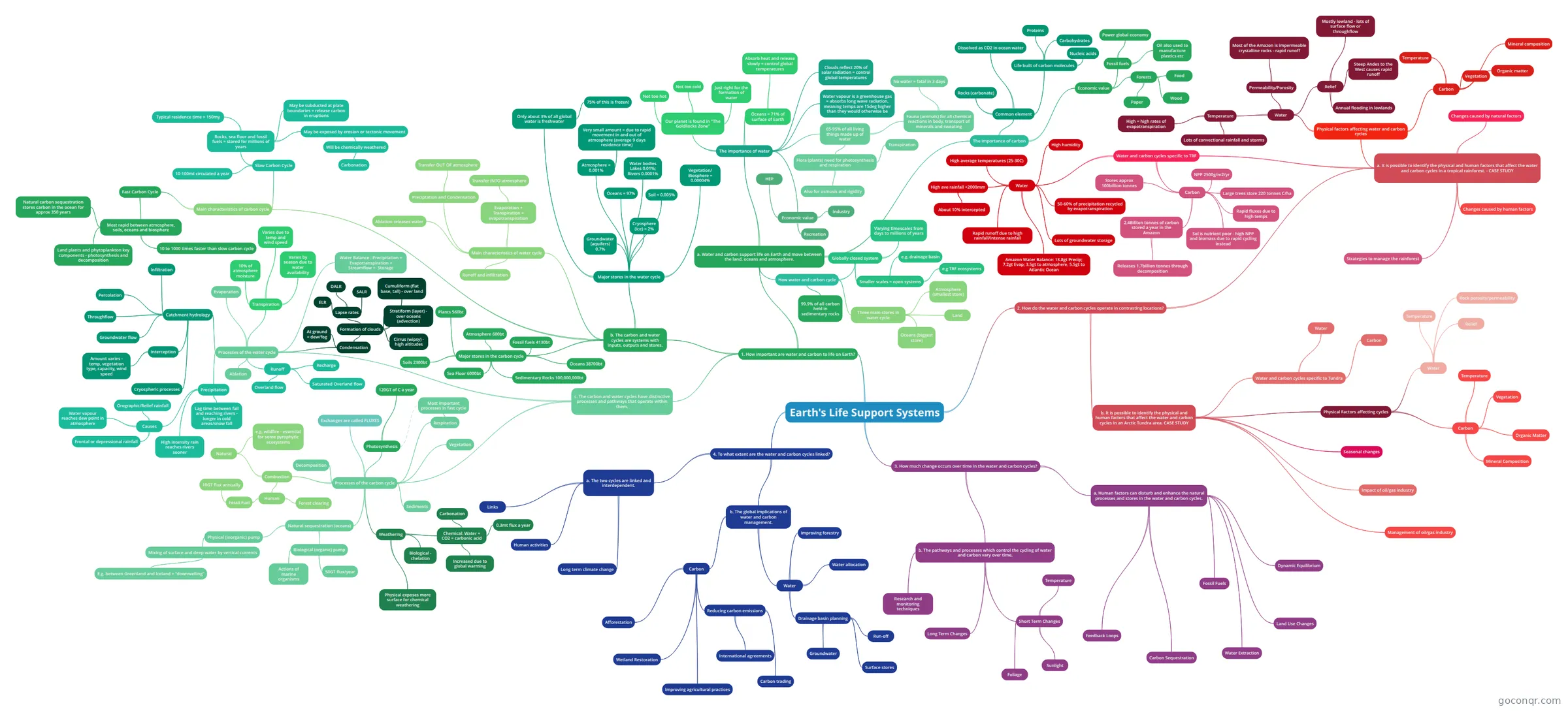
Mind map: Earth's life support systems
Inhalt der Mindmap
Earth's Life Support Systems
1. How important are water and carbon to life on Earth?
- a. Water and carbon support life on Earth and move between the land, oceans and atmosphere.
- The importance of water
- Our planet is found in "The Goldilocks Zone"
- Not too hot
- Not too cold
- Just right for the formation of water
- Oceans = 71% of surface of Earth
- Absorb heat and release slowly = control global temperatures
- Clouds reflect 20% of solar radiation = control global temperatures
- Water vapour is a greenhouse gas = absorbs long wave radiation, meaning temps are 15deg higher than they would otherwise be
- 65-95% of all living things made up of water
- Flora (plants) need for photosynthesis and respiration
- Also for osmosis and rigidity
- Transpiration
- Fauna (animals) for all chemical reactions in body, transport of minerals and sweating
- No water = fatal in 3 days
- Flora (plants) need for photosynthesis and respiration
- Economic value
- HEP
- Recreation
- Industry
- Our planet is found in "The Goldilocks Zone"
- The importance of carbon
- Common element
- Rocks (carbonate)
- Dissolved as CO2 in ocean water
- Life built of carbon molecules
- Proteins
- Carbohydrates
- Nucleic acids
- Economic value
- Fossil fuels
- Oil also used to manufacture plastics etc
- Power global economy
- Forests
- Food
- Wood
- Paper
- Fossil fuels
- Common element
- How water and carbon cycle
- Globally closed system
- Varying timescales from days to millions of years
- Smaller scales = open systems
- e.g. drainage basin
- e.g TRF ecosystems
- Three main stores in water cycle
- Atmosphere (smallest store)
- Land
- Oceans (biggest store)
- 99.9% of all carbon held in sedimentary rocks
- Globally closed system
- The importance of water
- b. The carbon and water cycles are systems with inputs, outputs and stores.
- Major stores in the water cycle
- Atmosphere = 0.001%
- Very small amount = due to rapid movement in and out of atmosphere (average 9 days residence time)
- Oceans = 97%
- Cryosphere (ice) = 2%
- Water bodies Lakes 0.01%; Rivers 0.0001%
- Soil = 0.005%
- Vegetation/ Biosphere = 0.00004%
- Groundwater (aquifers) 0.7%
- Only about 3% of all global water is freshwater
- 75% of this is frozen!
- Atmosphere = 0.001%
- Main characteristics of water cycle
- Evaporation + Transpiration = evapotranspiration
- Transfer INTO atmosphere
- Preciptation and Condensation
- Transfer OUT OF atmosphere
- Ablation releases water
- Runoff and infiltration
- Evaporation + Transpiration = evapotranspiration
- Main characteristics of carbon cycle
- Slow Carbon Cycle
- Rocks, sea floor and fossil fuels = stored for millions of years
- Typical residence time = 150my
- May be subducted at plate boundaries = release carbon in eruptions
- May be exposed by erosion or tectonic movement
- Will be chemically weathered
- Carbonation
- Will be chemically weathered
- 10-100mt circulated a year
- Rocks, sea floor and fossil fuels = stored for millions of years
- Fast Carbon Cycle
- Most rapid between atmosphere, soils, oceans and biosphere
- 10 to 1000 times faster than slow carbon cycle
- Land plants and phytoplankton key components - photosynthesis and decomposition
- Natural carbon sequestration stores carbon in the ocean for approx 350 years
- Most rapid between atmosphere, soils, oceans and biosphere
- Slow Carbon Cycle
- Major stores in the carbon cycle
- Atmosphere 600bt
- Oceans 38700bt
- Sedimentary Rocks 100,000,000bt
- Sea Floor 6000bt
- Fossil fuels 4130bt
- Plants 560bt
- Soils 2300bt
- Major stores in the water cycle
- c. The carbon and water cycles have distinctive processes and pathways that operate within them.
- Processes of the water cycle
- Evaporation
- Transpiration
- 10% of atmosphere moisture
- Varies by season due to water availability
- Varies due to temp and wind speed
- Condensation
- Formation of clouds
- Cumuliform (flat base, tall) - over land
- Stratiform (layer) - over oceans (advection)
- Cirrus (wipsy) - high altitudes
- Lapse rates
- ELR
- DALR
- SALR
- At ground = dew/fog
- Formation of clouds
- Precipitation
- Causes
- Water vapour reaches dew point in atmosphere
- Frontal or depressional rainfall
- Orographic/Relief rainfall
- Lag time between fall and reaching rivers - longer in cold areas/snow fall
- High intensity rain reaches rivers sooner
- Causes
- Ablation
- Runoff
- Overland flow
- Saturated Overland flow
- Recharge
- Catchment hydrology
- Infiltration
- Percolation
- Throughflow
- Groundwater flow
- Cryospheric processes
- Interception
- Amount varies - temp, vegetation type, capacity, wind speed
- Water Balance : Precipitation = Evapotranspiration + Streamflow +- Storage
- Processes of the carbon cycle
- Photosynthesis
- 120GT of C a year
- Respiration
- Most important processes in fast cycle
- Decomposition
- Combustion
- Natural
- e.g. wildfire - essential for some pyrophytic ecosystems
- Human
- Fossil Fuel
- 10GT flux annually
- Forest clearing
- Fossil Fuel
- Natural
- Natural sequestration (oceans)
- Physical (inorganic) pump
- Mixing of surface and deep water by vertical currents
- E.g. between Greenland and Iceland = "downwelling"
- Mixing of surface and deep water by vertical currents
- Biological (organic) pump
- 50GT flux/year
- Actions of marine organisms
- Physical (inorganic) pump
- Vegetation
- Sediments
- Weathering
- Chemical: Water + CO2 = carbonic acid
- Increased due to global warming
- Carbonation
- 0.3mt flux a year
- Physical exposes more surface for chemical weathering
- Biological - chelation
- Chemical: Water + CO2 = carbonic acid
- Exchanges are called FLUXES
- Photosynthesis
- Processes of the water cycle
- a. Water and carbon support life on Earth and move between the land, oceans and atmosphere.
2. How do the water and carbon cycles operate in contrasting locations?
- a. It is possible to identify the physical and human factors that affect the water and carbon cycles in a tropical rainforest. - CASE STUDY
- Water and carbon cycles specific to TRF
- Water
- High average temperatures (25-30C)
- High ave rainfall +2000mm
- About 10% intercepted
- 50-60% of precipitation recycled by evapotranspiration
- Rapid runoff due to high rainfall/intense rainfall
- High humidity
- Lots of groundwater storage
- Amazon Water Balance: 13.8gt Precip; 7.2gt Evap; 3.5gt to atmosphere, 5.5gt to Atlantic Ocean
- Carbon
- NPP 2500g/m2/yr
- Large trees store 220 tonnes C/ha
- 2.4Billton tonnes of carbon stored a year in the Amazon
- Releases 1.7billion tonnes through decomposition
- Rapid fluxes due to high temps
- Sol is nutrient poor - high NPP and biomass due to rapid cycling instead
- Stores approx 100billion tonnes
- Water
- Physical factors affecting water and carbon cycles
- Water
- Temperature
- High = high rates of evapotranspiration
- Lots of convectional rainfall and storms
- Permeability/Porosity
- Most of the Amazon is impermeable crystalline rocks - rapid runoff
- Relief
- Mostly lowland - lots of surface flow or throughflow
- Steep Andes to the West causes rapid runoff
- Annual flooding in lowlands
- Temperature
- Carbon
- Temperature
- Vegetation
- Organic matter
- Mineral composition
- Water
- Changes caused by natural factors
- Changes caused by human factors
- Strategies to manage the rainforest
- Water and carbon cycles specific to TRF
- b. It is possible to identify the physical and human factors that affect the water and carbon cycles in an Arctic Tundra area. CASE STUDY
- Water and carbon cycles specific to Tundra
- Water
- Carbon
- Physical Factors affecting cycles
- Water
- Temperature
- Rock porosity/permeability
- Relief
- Carbon
- Temperature
- Vegetation
- Organic Matter
- Mineral Composition
- Water
- Seasonal changes
- Impact of oil/gas industry
- Management of oil/gas industry
- Water and carbon cycles specific to Tundra
- a. It is possible to identify the physical and human factors that affect the water and carbon cycles in a tropical rainforest. - CASE STUDY
3. How much change occurs over time in the water and carbon cycles?
- a. Human factors can disturb and enhance the natural processes and stores in the water and carbon cycles.
- Dynamic Equilibrium
- Land Use Changes
- Water Extraction
- Fossil Fuels
- Carbon Sequestration
- Feedback Loops
- b. The pathways and processes which control the cycling of water and carbon vary over time.
- Short Term Changes
- Temperature
- Sunlight
- Foliage
- Long Term Changes
- Research and monitoring techniques
- Short Term Changes
- a. Human factors can disturb and enhance the natural processes and stores in the water and carbon cycles.
4. To what extent are the water and carbon cycles linked?
- a. The two cycles are linked and interdependent.
- Links
- Human activities
- Long term climate change
- b. The global implications of water and carbon management.
- Carbon
- Afforestation
- Wetland Restoration
- Improving agricultural practices
- Reducing carbon emissions
- Carbon trading
- International agreements
- Water
- Improving forestry
- Water allocation
- Drainage basin planning
- Run-off
- Surface stores
- Groundwater
- Carbon
- a. The two cycles are linked and interdependent.
Informationen
- Beschreibung
- Mindmap am Earth's Life Support Systems, erstellt von Geoglou Geogger am 22/04/2018.
- Erstellt von
- Geoglou Geogger
- Aufrufe
- 4
- Bewertung
Mehr zu Water and Carbon Cycles