
Mindmap
Cognition and Emotion
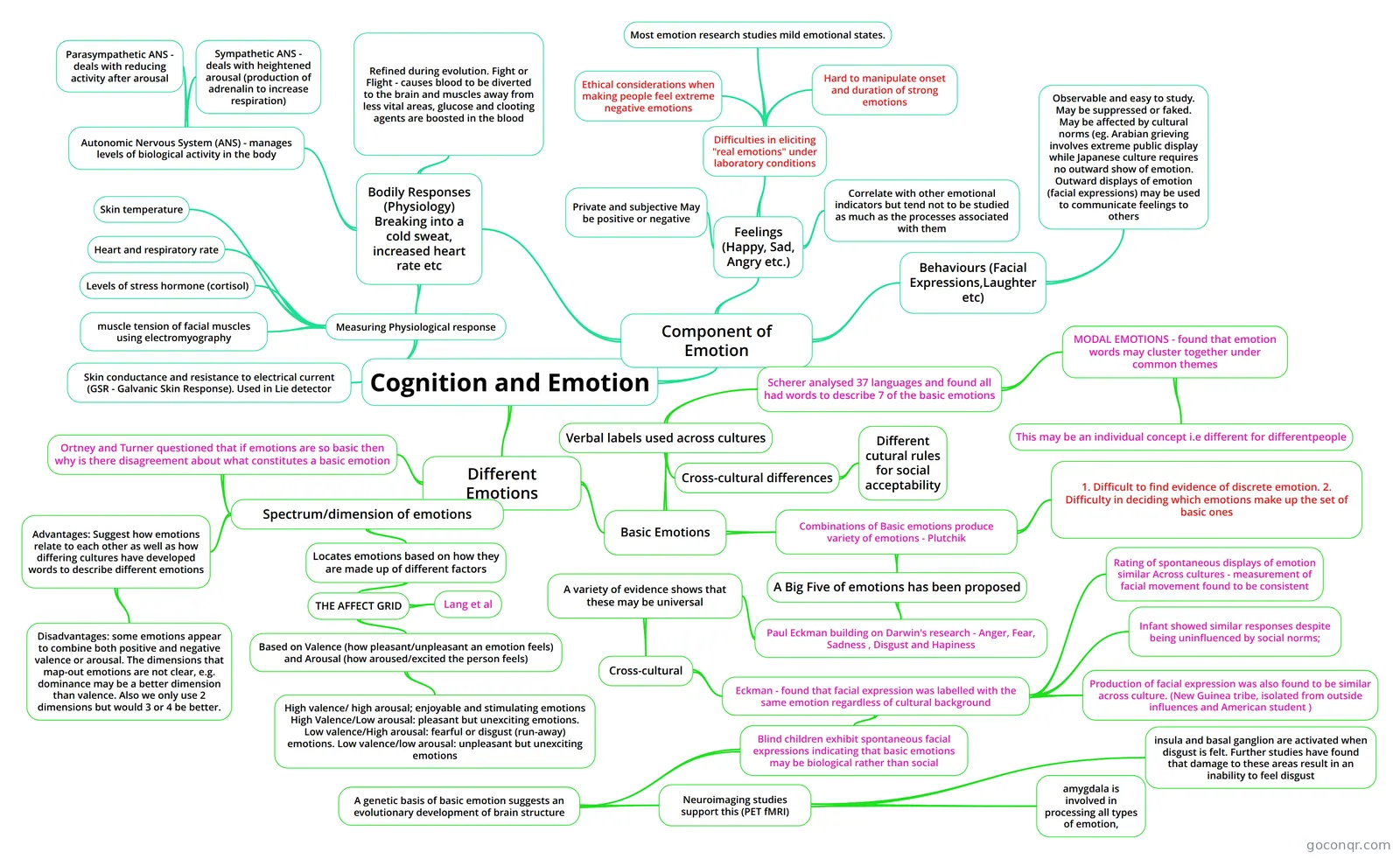
Mind map: Cognition and emotion
Inhalt der Mindmap
Cognition and Emotion
Component of Emotion
- Behaviours (Facial Expressions,Laughter etc)
- Observable and easy to study. May be suppressed or faked. May be affected by cultural norms (eg. Arabian grieving involves extreme public display while Japanese culture requires no outward show of emotion. Outward displays of emotion (facial expressions) may be used to communicate feelings to others
- Bodily Responses (Physiology) Breaking into a cold sweat, increased heart rate etc
- Refined during evolution. Fight or Flight - causes blood to be diverted to the brain and muscles away from less vital areas, glucose and clooting agents are boosted in the blood
- Autonomic Nervous System (ANS) - manages levels of biological activity in the body
- Sympathetic ANS - deals with heightened arousal (production of adrenalin to increase respiration)
- Parasympathetic ANS - deals with reducing activity after arousal
- Measuring Physiological response
- Skin conductance and resistance to electrical current (GSR - Galvanic Skin Response). Used in Lie detector
- Heart and respiratory rate
- Levels of stress hormone (cortisol)
- Skin temperature
- muscle tension of facial muscles using electromyography
- Feelings (Happy, Sad, Angry etc.)
- Private and subjective May be positive or negative
- Correlate with other emotional indicators but tend not to be studied as much as the processes associated with them
- Difficulties in eliciting "real emotions" under laboratory conditions
- Ethical considerations when making people feel extreme negative emotions
- Hard to manipulate onset and duration of strong emotions
- Most emotion research studies mild emotional states.
- Behaviours (Facial Expressions,Laughter etc)
Different Emotions
- Basic Emotions
- Combinations of Basic emotions produce variety of emotions - Plutchik
- 1. Difficult to find evidence of discrete emotion. 2. Difficulty in deciding which emotions make up the set of basic ones
- A Big Five of emotions has been proposed
- Paul Eckman building on Darwin's research - Anger, Fear, Sadness , Disgust and Hapiness
- A variety of evidence shows that these may be universal
- Cross-cultural
- Eckman - found that facial expression was labelled with the same emotion regardless of cultural background
- Production of facial expression was also found to be similar across culture. (New Guinea tribe, isolated from outside influences and American student )
- Rating of spontaneous displays of emotion similar Across cultures - measurement of facial movement found to be consistent
- Blind children exhibit spontaneous facial expressions indicating that basic emotions may be biological rather than social
- A genetic basis of basic emotion suggests an evolutionary development of brain structure
- Neuroimaging studies support this (PET fMRI)
- amygdala is involved in processing all types of emotion,
- insula and basal ganglion are activated when disgust is felt. Further studies have found that damage to these areas result in an inability to feel disgust
- Neuroimaging studies support this (PET fMRI)
- A genetic basis of basic emotion suggests an evolutionary development of brain structure
- Infant showed similar responses despite being uninfluenced by social norms;
- Eckman - found that facial expression was labelled with the same emotion regardless of cultural background
- Cross-cultural
- A variety of evidence shows that these may be universal
- Paul Eckman building on Darwin's research - Anger, Fear, Sadness , Disgust and Hapiness
- Verbal labels used across cultures
- Scherer analysed 37 languages and found all had words to describe 7 of the basic emotions
- MODAL EMOTIONS - found that emotion words may cluster together under common themes
- This may be an individual concept i.e different for differentpeople
- MODAL EMOTIONS - found that emotion words may cluster together under common themes
- Cross-cultural differences
- Different cutural rules for social acceptability
- Scherer analysed 37 languages and found all had words to describe 7 of the basic emotions
- Combinations of Basic emotions produce variety of emotions - Plutchik
- Ortney and Turner questioned that if emotions are so basic then why is there disagreement about what constitutes a basic emotion
- Spectrum/dimension of emotions
- Locates emotions based on how they are made up of different factors
- THE AFFECT GRID
- Based on Valence (how pleasant/unpleasant an emotion feels) and Arousal (how aroused/excited the person feels)
- High valence/ high arousal; enjoyable and stimulating emotions High Valence/Low arousal: pleasant but unexciting emotions. Low valence/High arousal: fearful or disgust (run-away) emotions. Low valence/low arousal: unpleasant but unexciting emotions
- Lang et al
- Based on Valence (how pleasant/unpleasant an emotion feels) and Arousal (how aroused/excited the person feels)
- THE AFFECT GRID
- Advantages: Suggest how emotions relate to each other as well as how differing cultures have developed words to describe different emotions
- Disadvantages: some emotions appear to combine both positive and negative valence or arousal. The dimensions that map-out emotions are not clear, e.g. dominance may be a better dimension than valence. Also we only use 2 dimensions but would 3 or 4 be better.
- Locates emotions based on how they are made up of different factors
- Spectrum/dimension of emotions
- Basic Emotions
Informationen
- Beschreibung
- degree cognition and emotion pt2 Mindmap am Cognition and Emotion, erstellt von p grant am 03/10/2014.
- Erstellt von
- p grant
- Aufrufe
- 16
- Bewertung