
Mindmap
Typhoid and Cholera
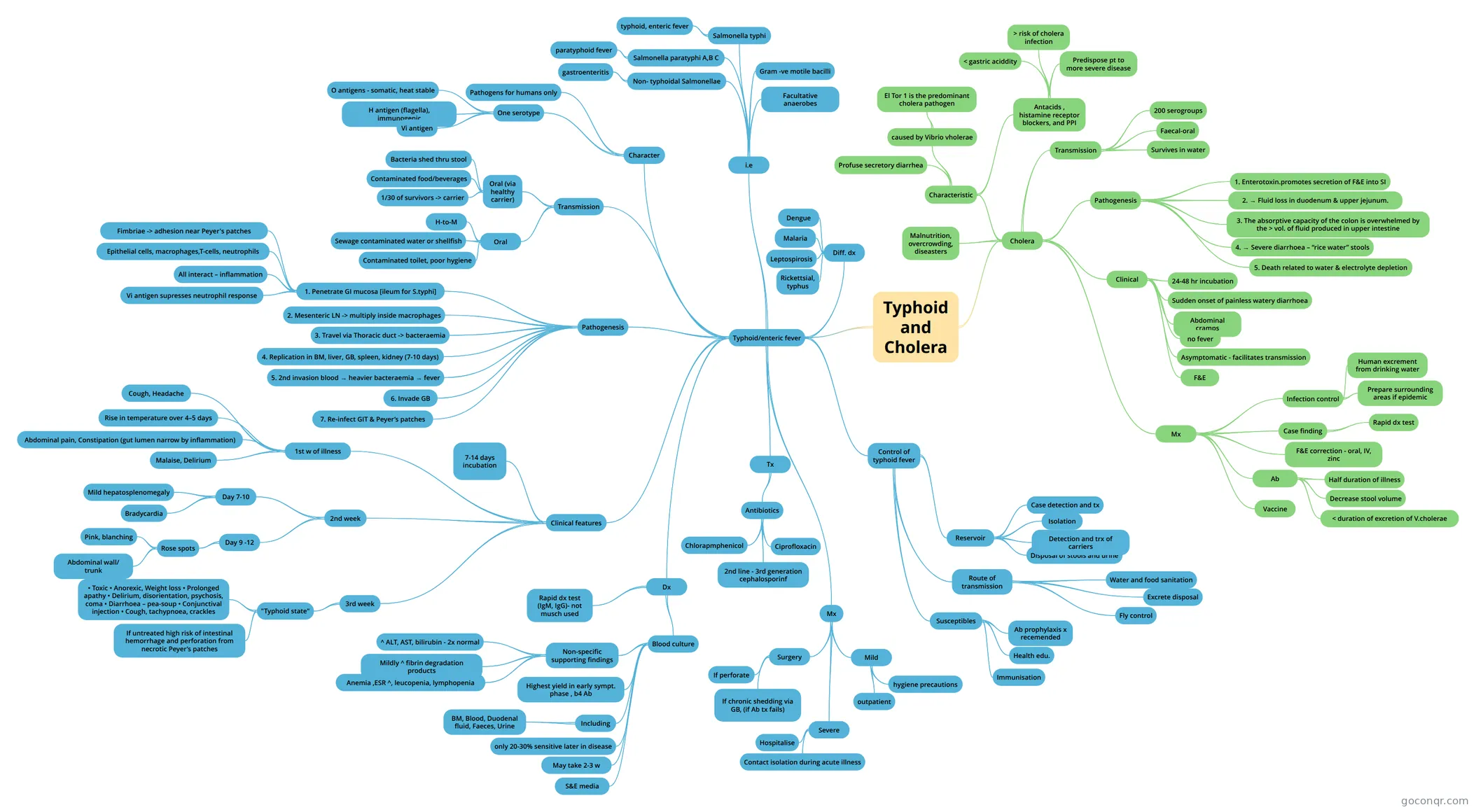
Mind map: Typhoid and cholera
Inhalt der Mindmap
Typhoid and Cholera
Typhoid/enteric fever
- i.e
- Salmonella typhi
- typhoid, enteric fever
- Salmonella paratyphi A,B C
- paratyphoid fever
- Non- typhoidal Salmonellae
- gastroenteritis
- Gram -ve motile bacilli
- Facultative anaerobes
- Salmonella typhi
- Character
- Pathogens for humans only
- One serotype
- O antigens - somatic, heat stable
- H antigen (flagella), immunogenic
- Vi antigen
- Transmission
- Oral (via healthy carrier)
- Bacteria shed thru stool
- Contaminated food/beverages
- 1/30 of survivors -> carrier
- Oral
- H-to-M
- Sewage contaminated water or shellfish
- Contaminated toilet, poor hygiene
- Oral (via healthy carrier)
- Pathogenesis
- 1. Penetrate GI mucosa [ileum for S.typhi]
- Fimbriae -> adhesion near Peyer's patches
- Epithelial cells, macrophages,T-cells, neutrophils
- All interact – inflammation
- Vi antigen supresses neutrophil response
- 2. Mesenteric LN -> multiply inside macrophages
- 3. Travel via Thoracic duct -> bacteraemia
- 4. Replication in BM, liver, GB, spleen, kidney (7-10 days)
- 5. 2nd invasion blood → heavier bacteraemia → fever
- 6. Invade GB
- 7. Re-infect GIT & Peyer’s patches
- 1. Penetrate GI mucosa [ileum for S.typhi]
- Clinical features
- 7-14 days incubation
- 1st w of illness
- Rise in temperature over 4–5 days
- Cough, Headache
- Abdominal pain, Constipation (gut lumen narrow by inflammation)
- Malaise, Delirium
- 2nd week
- Day 7-10
- Mild hepatosplenomegaly
- Bradycardia
- Day 9 -12
- Rose spots
- Pink, blanching
- Abdominal wall/ trunk
- Rose spots
- Day 7-10
- 3rd week
- "Typhoid state"
- • Toxic • Anorexic, Weight loss • Prolonged apathy • Delirium, disorientation, psychosis, coma • Diarrhoea – pea-soup • Conjunctival injection • Cough, tachypnoea, crackles
- If untreated high risk of intestinal hemorrhage and perforation from necrotic Peyer’s patches
- "Typhoid state"
- Diff. dx
- Malaria
- Dengue
- Rickettsial, typhus
- Leptospirosis
- Dx
- Blood culture
- Highest yield in early sympt. phase , b4 Ab
- Including
- BM, Blood, Duodenal fluid, Faeces, Urine
- S&E media
- May take 2-3 w
- only 20-30% sensitive later in disease
- Non-specific supporting findings
- Anemia ,ESR ^, leucopenia, lymphopenia
- Mildly ^ fibrin degradation products
- ^ ALT, AST, bilirubin - 2x normal
- Rapid dx test (IgM, IgG)- not musch used
- Blood culture
- Tx
- Antibiotics
- Chlorapmphenicol
- Ciprofloxacin
- 2nd line - 3rd generation cephalosporinf
- Antibiotics
- Mx
- Mild
- outpatient
- hygiene precautions
- Severe
- Hospitalise
- Contact isolation during acute illness
- Surgery
- If perforate
- If chronic shedding via GB, (if Ab tx fails)
- Mild
- Control of typhoid fever
- Reservoir
- Case detection and tx
- Isolation
- Disposal of stools and urine
- Detection and trx of carriers
- Route of transmission
- Water and food sanitation
- Excrete disposal
- Fly control
- Susceptibles
- Immunisation
- Health edu.
- Ab prophylaxis x recemended
- Reservoir
- i.e
Cholera
- Characteristic
- Profuse secretory diarrhea
- caused by Vibrio vholerae
- El Tor 1 is the predominant cholera pathogen
- Antacids , histamine receptor blockers, and PPI
- < gastric aciddity
- > risk of cholera infection
- Predispose pt to more severe disease
- Transmission
- Faecal-oral
- Survives in water
- 200 serogroups
- Pathogenesis
- 1. Enterotoxin.promotes secretion of F&E into SI
- 2. → Fluid loss in duodenum & upper jejunum.
- 3. The absorptive capacity of the colon is overwhelmed by the > vol. of fluid produced in upper intestine
- 4. → Severe diarrhoea – “rice water” stools
- 5. Death related to water & electrolyte depletion
- Malnutrition, overcrowding, diseasters
- Clinical
- 24-48 hr incubation
- Sudden onset of painless watery diarrhoea
- Abdominal cramps
- no fever
- Asymptomatic - facilitates transmission
- F&E
- Mx
- Infection control
- Human excrement from drinking water
- Prepare surrounding areas if epidemic
- Case finding
- Rapid dx test
- F&E correction - oral, IV, zinc
- Ab
- Half duration of illness
- Decrease stool volume
- < duration of excretion of V.cholerae
- Vaccine
- Infection control
- Characteristic
Informationen
- Beschreibung
- Undergraduate Medicine Tropical Medicine Mindmap am Typhoid and Cholera, erstellt von Amalin Najiha Mohd Sabri am 11/08/2018.
- Erstellt von
- Amalin Najiha Mohd Sabri
- Aufrufe
- 7
- Bewertung