
Mindmap
Planning and Preparation for Effective Negotiation
Mind map: Planning and Preparation for Effective Negotiation
Inhalt der Mindmap
Planning and Preparation for Effective Negotiation
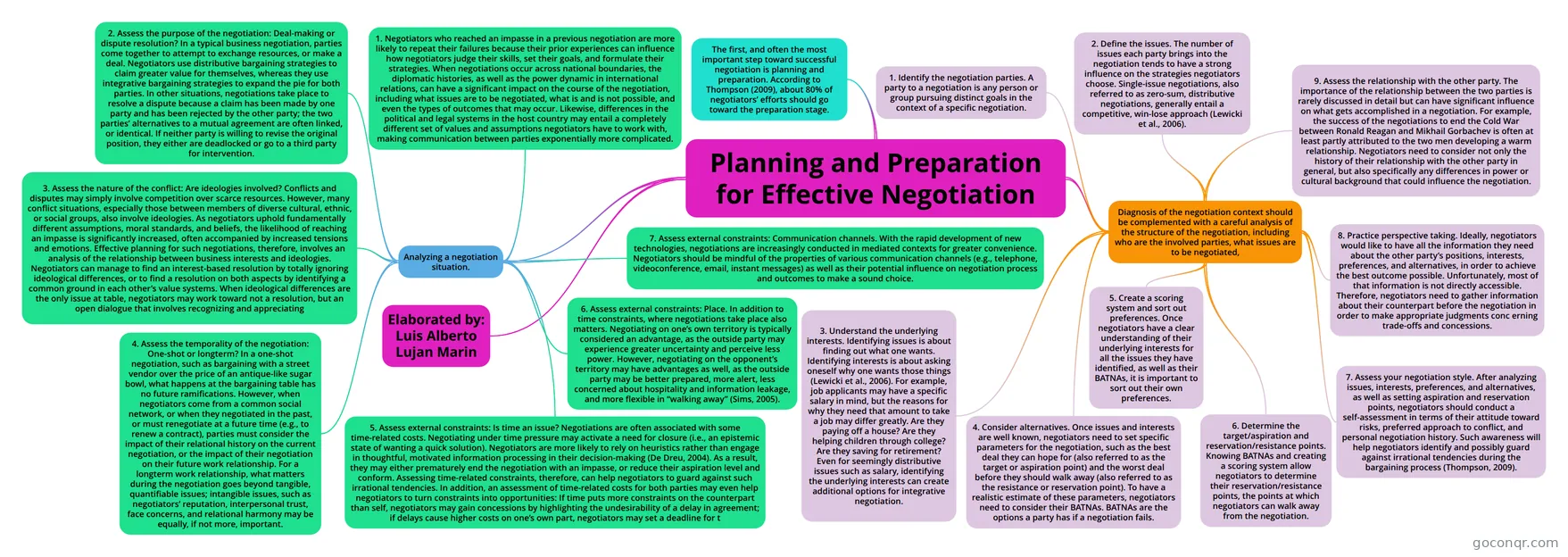
The first, and often the most important step toward successful negotiation is planning and preparation. According to Thompson (2009), about 80% of negotiators’ efforts should go toward the preparation stage.
Analyzing a negotiation situation.
- 1. Negotiators who reached an impasse in a previous negotiation are more likely to repeat their failures because their prior experiences can influence how negotiators judge their skills, set their goals, and formulate their strategies. When negotiations occur across national boundaries, the diplomatic histories, as well as the power dynamic in international relations, can have a significant impact on the course of the negotiation, including what issues are to be negotiated, what is and is not possible, and even the types of outcomes that may occur. Likewise, differences in the political and legal systems in the host country may entail a completely different set of values and assumptions negotiators have to work with, making communication between parties exponentially more complicated.
- 2. Assess the purpose of the negotiation: Deal-making or dispute resolution? In a typical business negotiation, parties come together to attempt to exchange resources, or make a deal. Negotiators use distributive bargaining strategies to claim greater value for themselves, whereas they use integrative bargaining strategies to expand the pie for both parties. In other situations, negotiations take place to resolve a dispute because a claim has been made by one party and has been rejected by the other party; the two parties’ alternatives to a mutual agreement are often linked, or identical. If neither party is willing to revise the original position, they either are deadlocked or go to a third party for intervention.
- 3. Assess the nature of the conflict: Are ideologies involved? Conflicts and disputes may simply involve competition over scarce resources. However, many conflict situations, especially those between members of diverse cultural, ethnic, or social groups, also involve ideologies. As negotiators uphold fundamentally different assumptions, moral standards, and beliefs, the likelihood of reaching an impasse is significantly increased, often accompanied by increased tensions and emotions. Effective planning for such negotiations, therefore, involves an analysis of the relationship between business interests and ideologies. Negotiators can manage to find an interest-based resolution by totally ignoring ideological differences, or to find a resolution on both aspects by identifying a common ground in each other’s value systems. When ideological differences are the only issue at table, negotiators may work toward not a resolution, but an open dialogue that involves recognizing and appreciating
- 6. Assess external constraints: Place. In addition to time constraints, where negotiations take place also matters. Negotiating on one’s own territory is typically considered an advantage, as the outside party may experience greater uncertainty and perceive less power. However, negotiating on the opponent’s territory may have advantages as well, as the outside party may be better prepared, more alert, less concerned about hospitality and information leakage, and more flexible in “walking away” (Sims, 2005).
- 7. Assess external constraints: Communication channels. With the rapid development of new technologies, negotiations are increasingly conducted in mediated contexts for greater convenience. Negotiators should be mindful of the properties of various communication channels (e.g., telephone, videoconference, email, instant messages) as well as their potential influence on negotiation process and outcomes to make a sound choice.
- 5. Assess external constraints: Is time an issue? Negotiations are often associated with some time-related costs. Negotiating under time pressure may activate a need for closure (i.e., an epistemic state of wanting a quick solution). Negotiators are more likely to rely on heuristics rather than engage in thoughtful, motivated information processing in their decision-making (De Dreu, 2004). As a result, they may either prematurely end the negotiation with an impasse, or reduce their aspiration level and conform. Assessing time-related constraints, therefore, can help negotiators to guard against such irrational tendencies. In addition, an assessment of time-related costs for both parties may even help negotiators to turn constraints into opportunities: If time puts more constraints on the counterpart than self, negotiators may gain concessions by highlighting the undesirability of a delay in agreement; if delays cause higher costs on one’s own part, negotiators may set a deadline for t
- 4. Assess the temporality of the negotiation: One-shot or longterm? In a one-shot negotiation, such as bargaining with a street vendor over the price of an antique-like sugar bowl, what happens at the bargaining table has no future ramifications. However, when negotiators come from a common social network, or when they negotiated in the past, or must renegotiate at a future time (e.g., to renew a contract), parties must consider the impact of their relational history on the current negotiation, or the impact of their negotiation on their future work relationship. For a longterm work relationship, what matters during the negotiation goes beyond tangible, quantifiable issues; intangible issues, such as negotiators’ reputation, interpersonal trust, face concerns, and relational harmony may be equally, if not more, important.
Diagnosis of the negotiation context should be complemented with a careful analysis of the structure of the negotiation, including who are the involved parties, what issues are to be negotiated,
- 4. Consider alternatives. Once issues and interests are well known, negotiators need to set specific parameters for the negotiation, such as the best deal they can hope for (also referred to as the target or aspiration point) and the worst deal before they should walk away (also referred to as the resistance or reservation point). To have a realistic estimate of these parameters, negotiators need to consider their BATNAs. BATNAs are the options a party has if a negotiation fails.
- 3. Understand the underlying interests. Identifying issues is about finding out what one wants. Identifying interests is about asking oneself why one wants those things (Lewicki et al., 2006). For example, job applicants may have a specific salary in mind, but the reasons for why they need that amount to take a job may differ greatly. Are they paying off a house? Are they helping children through college? Are they saving for retirement? Even for seemingly distributive issues such as salary, identifying the underlying interests can create additional options for integrative negotiation.
- 6. Determine the target/aspiration and reservation/resistance points. Knowing BATNAs and creating a scoring system allow negotiators to determine their reservation/resistance points, the points at which negotiators can walk away from the negotiation.
- 2. Define the issues. The number of issues each party brings into the negotiation tends to have a strong influence on the strategies negotiators choose. Single-issue negotiations, also referred to as zero-sum, distributive negotiations, generally entail a competitive, win-lose approach (Lewicki et al., 2006).
- 1. Identify the negotiation parties. A party to a negotiation is any person or group pursuing distinct goals in the context of a specific negotiation.
- 5. Create a scoring system and sort out preferences. Once negotiators have a clear understanding of their underlying interests for all the issues they have identified, as well as their BATNAs, it is important to sort out their own preferences.
- 9. Assess the relationship with the other party. The importance of the relationship between the two parties is rarely discussed in detail but can have significant influence on what gets accomplished in a negotiation. For example, the success of the negotiations to end the Cold War between Ronald Reagan and Mikhail Gorbachev is often at least partly attributed to the two men developing a warm relationship. Negotiators need to consider not only the history of their relationship with the other party in general, but also specifically any differences in power or cultural background that could influence the negotiation.
- 8. Practice perspective taking. Ideally, negotiators would like to have all the information they need about the other party’s positions, interests, preferences, and alternatives, in order to achieve the best outcome possible. Unfortunately, most of that information is not directly accessible. Therefore, negotiators need to gather information about their counterpart before the negotiation in order to make appropriate judgments conc erning trade-offs and concessions.
- 7. Assess your negotiation style. After analyzing issues, interests, preferences, and alternatives, as well as setting aspiration and reservation points, negotiators should conduct a self-assessment in terms of their attitude toward risks, preferred approach to conflict, and personal negotiation history. Such awareness will help negotiators identify and possibly guard against irrational tendencies during the bargaining process (Thompson, 2009).
Elaborated by: Luis Alberto Lujan Marin
Informationen
- Beschreibung
- Mindmap am Planning and Preparation for Effective Negotiation, erstellt von Luis Alberto Lujan Marïn am 21/09/2018.
- Erstellt von
- Luis Alberto Lujan Marïn
- Aufrufe
- 0
- Bewertung
Mehr zu Negotiation Planning and Preparation