
Mindmap
Hyperinflation crisis 1923
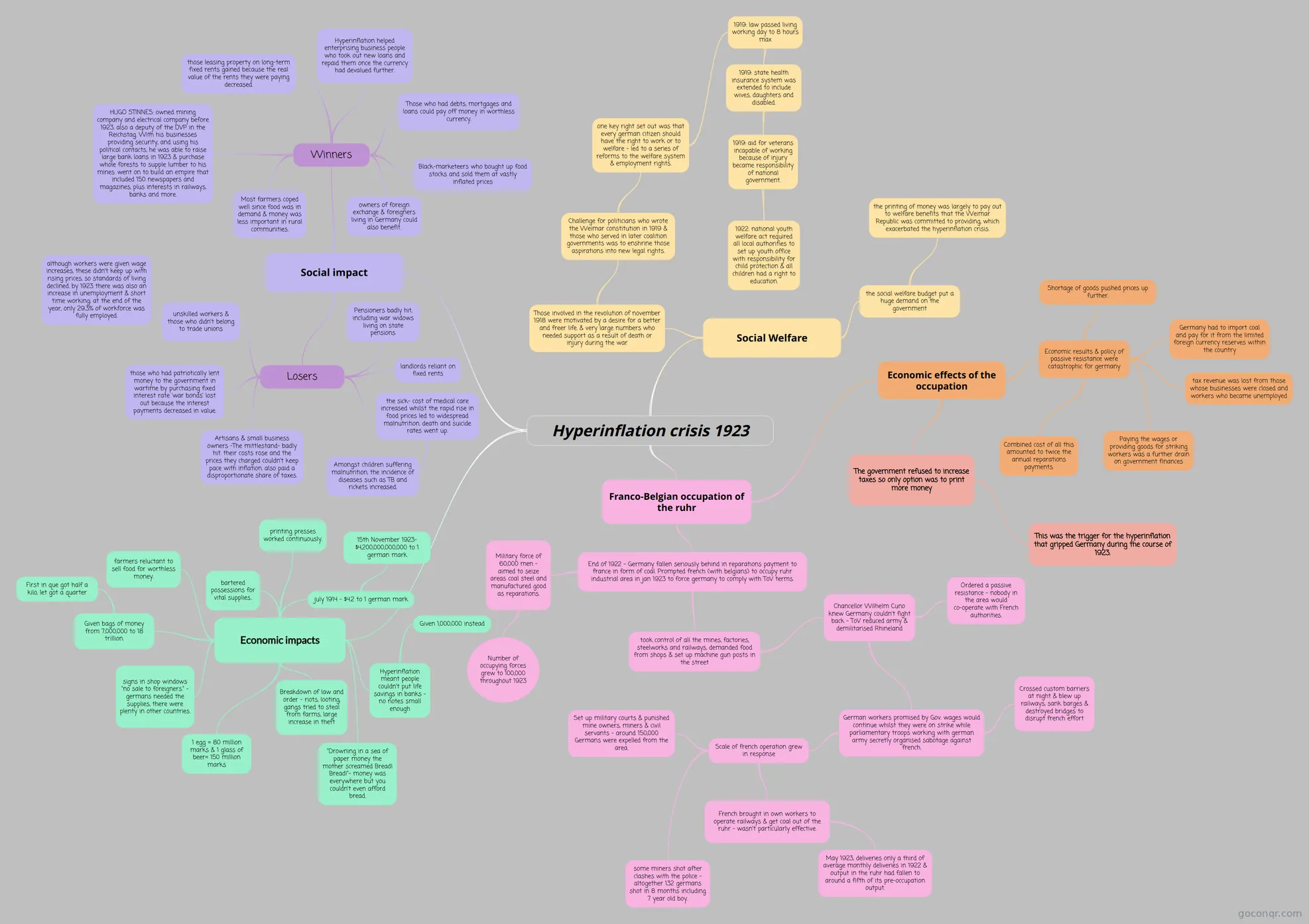
Mind map: Hyperinflation crisis 1923
Inhalt der Mindmap
Hyperinflation crisis 1923
Franco-Belgian occupation of the ruhr
- End of 1922 - Germany fallen seriously behind in reparations payment to france in form of coal. Prompted french (with belgians) to occupy ruhr industrial area in jan 1923 to force germany to comply with ToV terms.
- Military force of 60,000 men - aimed to seize areas coal steel and manufactured good as reparations.
- Number of occupying forces grew to 100,000 throughout 1923
- took control of all the mines, factories, steelworks and railways, demanded food from shops & set up machine gun posts in the street
- Chancellor Wilhelm Cuno knew Germany couldn't fight back - ToV reduced army & demilitarised Rhineland
- Ordered a passive resistance - nobody in the area would co-operate with French authorities.
- German workers promised by Gov. wages would continue whilst they were on strike while parliamentary troops working with german army secretly organised sabotage against french.
- Crossed custom barriers at night & blew up railways, sank barges & destroyed bridges to disrupt french effort
- Scale of french operation grew in response
- Set up military courts & punished mine owners, miners & civil servants - around 150,000 Germans were expelled from the area.
- some miners shot after clashes with the police - altogether 132 germans shot in 8 months including 7 year old boy.
- French brought in own workers to operate railways & get coal out of the ruhr - wasn't particularly effective.
- May 1923, deliveries only a third of average monthly deliveries in 1922 & output in the ruhr had fallen to around a fifth of its pre-occupation output.
- Chancellor Wilhelm Cuno knew Germany couldn't fight back - ToV reduced army & demilitarised Rhineland
- Military force of 60,000 men - aimed to seize areas coal steel and manufactured good as reparations.
- Economic effects of the occupation
- Economic results & policy of passive resistance were catastrophic for germany
- Paying the wages or providing goods for striking workers was a further drain on government finances
- tax revenue was lost from those whose businesses were closed and workers who became unemployed
- Germany had to import coal and pay for it from the limited foreign currency reserves within the country
- Shortage of goods pushed prices up further.
- Combined cost of all this amounted to twice the annual reparations payments.
- The government refused to increase taxes so only option was to print more money
- This was the trigger for the hyperinflation that gripped Germany during the course of 1923.
- Economic results & policy of passive resistance were catastrophic for germany
- End of 1922 - Germany fallen seriously behind in reparations payment to france in form of coal. Prompted french (with belgians) to occupy ruhr industrial area in jan 1923 to force germany to comply with ToV terms.
Social Welfare
- Those involved in the revolution of november 1918 were motivated by a desire for a better and freer life. & very large numbers who needed support as a result of death or injury during the war
- Challenge for politicians who wrote the Weimar constitution in 1919 & those who served in later coalition governments was to enshrine those aspirations into new legal rights.
- one key right set out was that every german citizen should have the right to work or to welfare - led to a series of reforms to the welfare system & employment rights.
- 1919: law passed living working day to 8 hours max
- 1919: state health insurance system was extended to include wives, daughters and disabled.
- 1919: aid for veterans incapable of working because of injury became responsibility of national government.
- 1922: national youth welfare act required all local authorities to set up youth office with responsibility for child protection & all children had a right to education.
- 1919: aid for veterans incapable of working because of injury became responsibility of national government.
- 1919: state health insurance system was extended to include wives, daughters and disabled.
- 1919: law passed living working day to 8 hours max
- one key right set out was that every german citizen should have the right to work or to welfare - led to a series of reforms to the welfare system & employment rights.
- Challenge for politicians who wrote the Weimar constitution in 1919 & those who served in later coalition governments was to enshrine those aspirations into new legal rights.
- the social welfare budget put a huge demand on the government
- the printing of money was largely to pay out to welfare benefits that the Weimar Republic was committed to providing, which exacerbated the hyperinflation crisis.
- Those involved in the revolution of november 1918 were motivated by a desire for a better and freer life. & very large numbers who needed support as a result of death or injury during the war
Social impact
- Winners
- Black-marketeers who bought up food stocks and sold them at vastly inflated prices
- Those who had debts, mortgages and loans could pay off money in worthless currency.
- Hyperinflation helped enterprising business people who took out new loans and repaid them once the currency had devalued further.
- those leasing property on long-term fixed rents gained because the real value of the rents they were paying decreased.
- owners of foreign exchange & foreigners living in Germany could also benefit.
- Most farmers coped well since food was in demand & money was less important in rural communities.
- HUGO STINNES: owned mining company and electrical company before 1923. also a deputy of the DVP in the Reichstag. With his businesses providing security, and using his political contacts, he was able to raise large bank loans in 1923 & purchase whole forests to supple lumber to his mines. went on to build an empire that included 150 newspapers and magazines, plus interests in railways, banks and more.
- Losers
- Pensioners badly hit, including war widows living on state pensions.
- those who had patriotically lent money to the government in wartime by purchasing fixed interest rate 'war bonds' lost out because the interest payments decreased in value.
- landlords reliant on fixed rents
- unskilled workers & those who didn't belong to trade unions
- although workers were given wage increases, these didn't keep up with rising prices, so standards of living declined. by 1923 there was also an increase in unemployment & short time working; at the end of the year, only 29.3% of workforce was fully employed.
- Artisans & small business owners -The mittlestand- badly hit. their costs rose and the prices they charged couldn't keep pace with inflation. also paid a disproportionate share of taxes.
- the sick- cost of medical care increased whilst the rapid rise in food prices led to widespread malnutrition. death and suicide rates went up.
- Amongst children suffering malnutrition, the incidence of diseases such as TB and rickets increased.
- Winners
Economic impacts
- Hyperinflation meant people couldn't put life savings in banks - no notes small enough
- Given 1,000,000 instead
- july 1914 - $4.2 to 1 german mark
- 15th November 1923- $4,200,000,000,000 to 1 german mark
- "Drowning in a sea of paper money the mother screamed Bread! Bread!"- money was everywhere but you couldn't even afford bread.
- printing presses worked continuously.
- 1 egg = 80 million marks & 1 glass of beer= 150 million marks
- Breakdown of law and order - riots, looting, gangs tried to steal from farms, large increase in theft
- bartered possessions for vital supplies..
- farmers reluctant to sell food for worthless money.
- Given bags of money from 7,000,000 to 18 trillion.
- First in que got half a kilo, let got a quarter
- signs in shop windows "no sale to foreigners." - germans needed the supplies, there were plenty in other countries.
- Hyperinflation meant people couldn't put life savings in banks - no notes small enough
Informationen
- Beschreibung
- Democracy and Nazism - Germany 1918-1945 (Establishment & early years of the Weimar republic 1918-1924) Mindmap am Hyperinflation crisis 1923, erstellt von abi . am 30/01/2019.
- Erstellt von
- abi .
- Aufrufe
- 0
- Bewertung
Mehr zu The 1923 Crisis and Hyperinflation