
17121356
Beschreibung

Mindmap von Blerta Morina, aktualisiert more than 1 year ago

|
Erstellt von Blerta Morina
vor mehr als 7 Jahre
|
|
B1: You and Your Genes
- Cells and
Genetic
Material
- Eukaryotic
- Animal
Cells
- Nucleus
- Contains genetic
material, which is
arranged in
chromosomes
- Contains genetic
material, which is
arranged in
chromosomes
- Cytoplasm
- Where chemical
reaction happens.
- Where chemical
reaction happens.
- Cell
Membrane
- Controls
what goes in
and out.
- Controls
what goes in
and out.
- Mitochondria
- Contain the enzymes needed
to control most of the
reaction in aerobic respiration
- Contain the enzymes needed
to control most of the
reaction in aerobic respiration
- Ribosomes
- Involved in the
synthesis of
proteins.
- Involved in the
synthesis of
proteins.
- Nucleus
- Plant
Cells
- Cell
Wall
- Supports the
cell and
strengthens it.
- Supports the
cell and
strengthens it.
- Vacuole
- Contains cell
sap, a weak
solution of
sugar and salts
- Contains cell
sap, a weak
solution of
sugar and salts
- Chloroplasts
- Where
photosynthesis
occurs. They contain
a green substance:
chlorophyll
- Where
photosynthesis
occurs. They contain
a green substance:
chlorophyll
- Cell
Wall
- Animal
Cells
- Prokaryotic
- They store
their genetic
material as:
- One long
circular
chromomosome
- Plasmids
- Small loops of
extra DNA.
- Small loops of
extra DNA.
- One long
circular
chromomosome
- Subcellular
structures
- Cell
Membrane
- Cell wall
- Ribosomes
- Cell
Membrane
- They store
their genetic
material as:
- Eukaryotic
- Genomes and
Characterisitics
- Genetic
Material
- Plant and animal cells -
stored in the nucleus and
arranged into
chromosomes
- Chromosomes
- Come in pairs -
humans have 23 pairs
(46 chromosomes)
- A very long molecule of
DNA that's coiled up
- Come in pairs -
humans have 23 pairs
(46 chromosomes)
- DNA
- Polymer
- Molecule that's made of
small, repeating units
called monomers
- DNA is made from
monomers called
nucleotides
- DNA is made from
monomers called
nucleotides
- Molecule that's made of
small, repeating units
called monomers
- Each molecule contains
two strands of nucleotides
- Polymer
- Plant and animal cells -
stored in the nucleus and
arranged into
chromosomes
- Genes
- A short length of DNA
- Each gene codes for a particular
sequence of amino acids, put
together to make a specific protein
- Process of making a big molecule
(e.g. a protein) from lots of
smaller molecules (e.g. amino
acids) is called polymerisation)
- Process of making a big molecule
(e.g. a protein) from lots of
smaller molecules (e.g. amino
acids) is called polymerisation)
- Proteins
- Controls the development
of different characteristics.
- E.G. Dimples, and how
an organism
functions
- E.G. Dimples, and how
an organism
functions
- Controls the development
of different characteristics.
- Can exist in
different versions
- Each version gives a different form
of a characteristic e.g. blue or brown
eyes. Different versions of the same
gene are called alleles.
- Every chromosome in a
pair carries the same
genes, but they could each
carry different alleles.
- Different versions of a gene can
be called genetic variants
- Every chromosome in a
pair carries the same
genes, but they could each
carry different alleles.
- Each version gives a different form
of a characteristic e.g. blue or brown
eyes. Different versions of the same
gene are called alleles.
- A short length of DNA
- Genes and
Environment
- Influencing
Characteristics
- Genotype
- Combination of alleles an
organism has for each gene is
called its genotype.
- Combination of alleles an
organism has for each gene is
called its genotype.
- Phenotype
- The characteristics the
organism displays.
- The characteristics the
organism displays.
- Genotype
- Genetic
Material
- Genetic
Diagrams
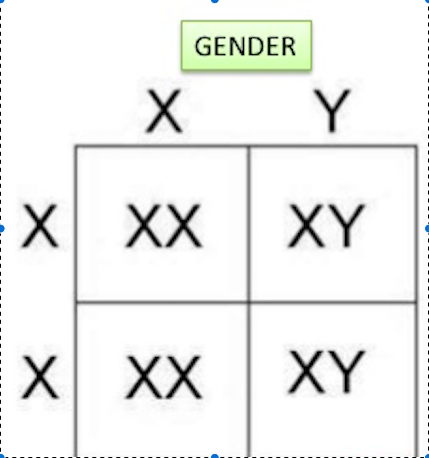
- XX = Female
parent XY =
Male parent
- 50% = Boy
50% = Girl
- XX = Female
parent XY =
Male parent
- Genome
Research and
Testing
- Genetic Testing -
Improving
Healthcare
- Some genetic variants put you at a higher
risk of developing a certain disease E.G.
cancer. If people knew they had a
particular variant, they can reduce the risk
of getting the disease by changing their
lifestyle.
- Sometimes, if you have a particular variant it
means that you will definitely have a disease E.G. if
you have two copies of the recessive CF allele then
you will have cystic fibrosis. Newborn babies are
tested for certain genetic variants, so doctors can
tell if they've inherited a genetic disorder.
- Some common genetic variants make some
drugs less effective. Genetic testing for these
variants could help the doctors to predict how
the patient will respond to specific drugs and
prescribe the ones that will be most effective
for them. There are drawback with this kind of
genetic testing.
- This could
lead to:
- Discrimination
- Employers may discriminate against people
who are genetically likely to get a disease.
- Employers may discriminate against people
who are genetically likely to get a disease.
- Increased
stress
- If people knew they were likely to get a brain
disease, they could panic every time they get a
headache, even if they never get the disease.
- If people knew they were likely to get a brain
disease, they could panic every time they get a
headache, even if they never get the disease.
- Discrimination
- This could
lead to:
- Some genetic variants put you at a higher
risk of developing a certain disease E.G.
cancer. If people knew they had a
particular variant, they can reduce the risk
of getting the disease by changing their
lifestyle.
- Genetic Testing -
Family Planning
- A couple who wants to have a
baby could use genetic testing
to identify the risk of their
baby having a particular
genetic disorder.
- They could test this
through:
- Parent
- May know there is a genetic
disorder within their family. Even if
they may not have the disorder,
genetic tests could reveal whether
they are a carrier for the condition.
- May know there is a genetic
disorder within their family. Even if
they may not have the disorder,
genetic tests could reveal whether
they are a carrier for the condition.
- Embryo
- A couple who know they are at a risk of
passing on a genetic disorder may choose
to have their eggs fertilised in a lab. An
embryo without the genetic variants
linked to the disorder can be implanted
into the womb to develop a baby.
- A couple who know they are at a risk of
passing on a genetic disorder may choose
to have their eggs fertilised in a lab. An
embryo without the genetic variants
linked to the disorder can be implanted
into the womb to develop a baby.
- Parent
- They could test this
through:
- A couple who wants to have a
baby could use genetic testing
to identify the risk of their
baby having a particular
genetic disorder.
- Genetic Testing -
Improving
Healthcare
- Genetic
Engineering
- Transfers Genes
Between
organisms.
- Transferring a gene from the
genome of one organism to the
genome of another to give the
organism that receives the gene
new and useful characteristics.
- A useful gene is cut from an organism's genome using enzymes and is
then replicated to produce other copies. Each copy is inserted into a
vector, which is usually a virus or bacterial plasmid depending on the
type of organism that the gene is being transferred to. The vectors are
mixed with other cells E.G. bacteria. The vectors will be taken up by the
cells, which become genetically modified. Most cells don't take vector and
the desired gene so the cells that are modified need to be identified and
selected. The selected cells are then allowed to replicate and each new
cell will contain the desired gene and produce the protein it codes for.
- Transferring a gene from the
genome of one organism to the
genome of another to give the
organism that receives the gene
new and useful characteristics.
- Useful in Agriculture and
Medicine
- Agriculture
- Crops can be genetically modified to be resistant
to herbicides. Making crops herbicide-resistant
means farmers can spray their crops to kill
weeds, without affecting the crop itself. This
increases crop yield, helping us to produce more
food for the population.
- Crops can be genetically modified to be resistant
to herbicides. Making crops herbicide-resistant
means farmers can spray their crops to kill
weeds, without affecting the crop itself. This
increases crop yield, helping us to produce more
food for the population.
- Medicine
- Genetically engineering bacteria has helped to improve healthcare by
producing human insulin. Researchers transfer human genes, that
produce useful proteins, into sheep and cows E.G. human antibodies
used in therapy for illnesses like arthritis. These proteins are
extracted from the animal E.G. from their milk.
- Agriculture
- Transfers Genes
Between
organisms.
Medienanhänge
Möchten Sie kostenlos Ihre eigenen Mindmaps mit GoConqr erstellen? Mehr erfahren.