
Mindmap
Crime and urban space
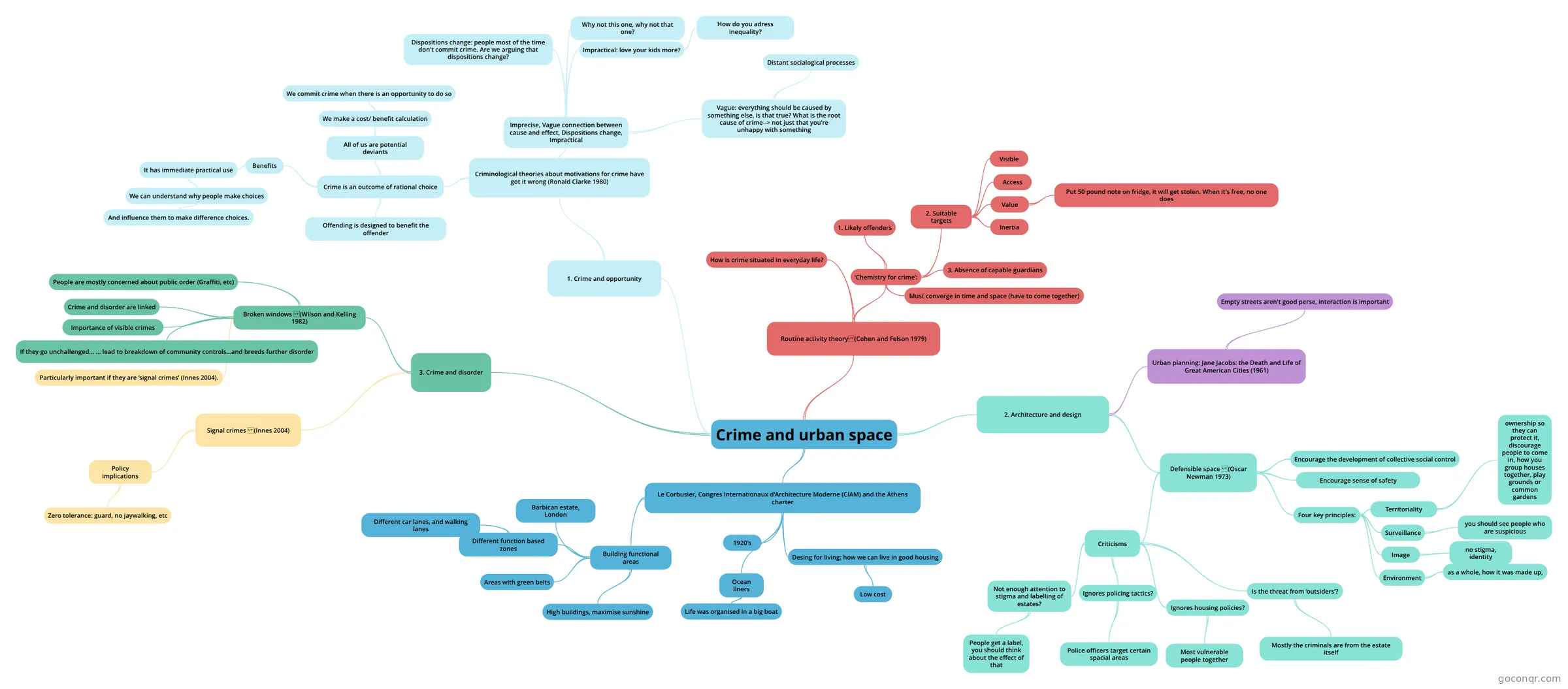
Mind map: crime and urban space
Inhalt der Mindmap
Crime and urban space
Le Corbusier, Congres Internationaux d'Architecture Moderne (CIAM) and the Athens charter
- 1920's
- Ocean liners
- Life was organised in a big boat
- Desing for living: how we can live in good housing
- Low cost
- Building functional areas
- High buildings, maximise sunshine
- Areas with green belts
- Different function based zones
- Different car lanes, and walking lanes
- Barbican estate, London
1. Crime and opportunity
- Criminological theories about motivations for crime have got it wrong (Ronald Clarke 1980)
- Imprecise, Vague connection between cause and effect, Dispositions change, Impractical
- Why not this one, why not that one?
- Impractical: love your kids more?
- How do you adress inequality?
- Vague: everything should be caused by something else, is that true? What is the root cause of crime--> not just that you're unhappy with something
- Distant socialogical processes
- Dispositions change: people most of the time don't commit crime. Are we arguing that dispositions change?
- Crime is an outcome of rational choice
- Offending is designed to benefit the offender
- All of us are potential deviants
- We make a cost/ benefit calculation
- We commit crime when there is an opportunity to do so
- We make a cost/ benefit calculation
- Benefits
- It has immediate practical use
- We can understand why people make choices
- And influence them to make difference choices.
- We can understand why people make choices
- It has immediate practical use
- Imprecise, Vague connection between cause and effect, Dispositions change, Impractical
- Criminological theories about motivations for crime have got it wrong (Ronald Clarke 1980)
Routine activity theory (Cohen and Felson 1979)
- ‘Chemistry for crime’:
- 1. Likely offenders
- 2. Suitable targets
- Visible
- Access
- Value
- Put 50 pound note on fridge, it will get stolen. When it's free, no one does
- Inertia
- 3. Absence of capable guardians
- Must converge in time and space (have to come together)
- How is crime situated in everyday life?
- ‘Chemistry for crime’:
2. Architecture and design
- Urban planning: Jane Jacobs: the Death and Life of Great American Cities (1961)
- Empty streets aren't good perse, interaction is important
- Defensible space (Oscar Newman 1973)
- Encourage the development of collective social control
- Encourage sense of safety
- Four key principles:
- Territoriality
- ownership so they can protect it, discourage people to come in, how you group houses together, play grounds or common gardens
- Surveillance
- you should see people who are suspicious
- Image
- no stigma, identity
- Environment
- as a whole, how it was made up,
- Territoriality
- Criticisms
- Not enough attention to stigma and labelling of estates?
- People get a label, you should think about the effect of that
- Ignores policing tactics?
- Police officers target certain spacial areas
- Ignores housing policies?
- Most vulnerable people together
- Is the threat from ‘outsiders’?
- Mostly the criminals are from the estate itself
- Not enough attention to stigma and labelling of estates?
- Urban planning: Jane Jacobs: the Death and Life of Great American Cities (1961)
3. Crime and disorder
- Broken windows (Wilson and Kelling 1982)
- People are mostly concerned about public order (Graffiti, etc)
- Crime and disorder are linked
- Importance of visible crimes
- Particularly important if they are ‘signal crimes’ (Innes 2004).
- If they go unchallenged… … lead to breakdown of community controls…and breeds further disorder
- Signal crimes (Innes 2004)
- Policy implications
- Zero tolerance: guard, no jaywalking, etc
- Policy implications
- Broken windows (Wilson and Kelling 1982)
Informationen
- Beschreibung
- Law, University Criminology Mindmap am Crime and urban space, erstellt von Willem van Veggel am 02/12/2014.
- Erstellt von
- Willem van Veggel
- Aufrufe
- 8
- Bewertung