
Mindmap
NEGOTIATIONS AND LICENSING
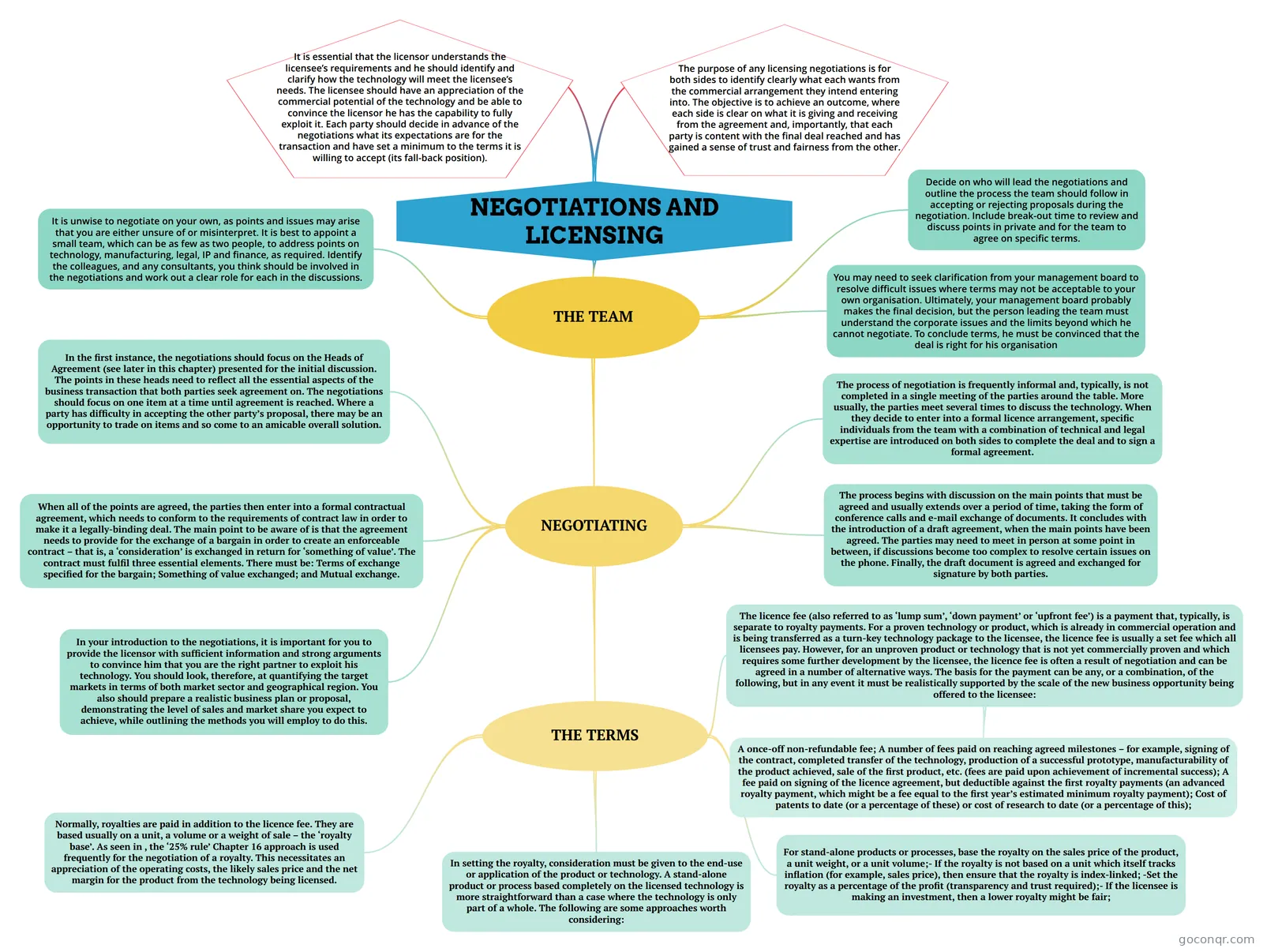
Mind map: Negotiations and licensing
Inhalt der Mindmap
NEGOTIATIONS AND LICENSING
It is essential that the licensor understands the licensee’s requirements and he should identify and clarify how the technology will meet the licensee’s needs. The licensee should have an appreciation of the commercial potential of the technology and be able to convince the licensor he has the capability to fully exploit it. Each party should decide in advance of the negotiations what its expectations are for the transaction and have set a minimum to the terms it is willing to accept (its fall-back position).
The purpose of any licensing negotiations is for both sides to identify clearly what each wants from the commercial arrangement they intend entering into. The objective is to achieve an outcome, where each side is clear on what it is giving and receiving from the agreement and, importantly, that each party is content with the final deal reached and has gained a sense of trust and fairness from the other.
THE TEAM
- It is unwise to negotiate on your own, as points and issues may arise that you are either unsure of or misinterpret. It is best to appoint a small team, which can be as few as two people, to address points on technology, manufacturing, legal, IP and finance, as required. Identify the colleagues, and any consultants, you think should be involved in the negotiations and work out a clear role for each in the discussions.
- Decide on who will lead the negotiations and outline the process the team should follow in accepting or rejecting proposals during the negotiation. Include break-out time to review and discuss points in private and for the team to agree on specific terms.
- You may need to seek clarification from your management board to resolve difficult issues where terms may not be acceptable to your own organisation. Ultimately, your management board probably makes the final decision, but the person leading the team must understand the corporate issues and the limits beyond which he cannot negotiate. To conclude terms, he must be convinced that the deal is right for his organisation
- NEGOTIATING
- The process of negotiation is frequently informal and, typically, is not completed in a single meeting of the parties around the table. More usually, the parties meet several times to discuss the technology. When they decide to enter into a formal licence arrangement, specific individuals from the team with a combination of technical and legal expertise are introduced on both sides to complete the deal and to sign a formal agreement.
- The process begins with discussion on the main points that must be agreed and usually extends over a period of time, taking the form of conference calls and e-mail exchange of documents. It concludes with the introduction of a draft agreement, when the main points have been agreed. The parties may need to meet in person at some point in between, if discussions become too complex to resolve certain issues on the phone. Finally, the draft document is agreed and exchanged for signature by both parties.
- In the first instance, the negotiations should focus on the Heads of Agreement (see later in this chapter) presented for the initial discussion. The points in these heads need to reflect all the essential aspects of the business transaction that both parties seek agreement on. The negotiations should focus on one item at a time until agreement is reached. Where a party has difficulty in accepting the other party’s proposal, there may be an opportunity to trade on items and so come to an amicable overall solution.
- When all of the points are agreed, the parties then enter into a formal contractual agreement, which needs to conform to the requirements of contract law in order to make it a legally-binding deal. The main point to be aware of is that the agreement needs to provide for the exchange of a bargain in order to create an enforceable contract – that is, a ‘consideration’ is exchanged in return for ‘something of value’. The contract must fulfil three essential elements. There must be: Terms of exchange specified for the bargain; Something of value exchanged; and Mutual exchange.
- In your introduction to the negotiations, it is important for you to provide the licensor with sufficient information and strong arguments to convince him that you are the right partner to exploit his technology. You should look, therefore, at quantifying the target markets in terms of both market sector and geographical region. You also should prepare a realistic business plan or proposal, demonstrating the level of sales and market share you expect to achieve, while outlining the methods you will employ to do this.
- THE TERMS
- The licence fee (also referred to as ‘lump sum’, ‘down payment’ or ‘upfront fee’) is a payment that, typically, is separate to royalty payments. For a proven technology or product, which is already in commercial operation and is being transferred as a turn-key technology package to the licensee, the licence fee is usually a set fee which all licensees pay. However, for an unproven product or technology that is not yet commercially proven and which requires some further development by the licensee, the licence fee is often a result of negotiation and can be agreed in a number of alternative ways. The basis for the payment can be any, or a combination, of the following, but in any event it must be realistically supported by the scale of the new business opportunity being offered to the licensee:
- A once-off non-refundable fee; A number of fees paid on reaching agreed milestones – for example, signing of the contract, completed transfer of the technology, production of a successful prototype, manufacturability of the product achieved, sale of the first product, etc. (fees are paid upon achievement of incremental success); A fee paid on signing of the licence agreement, but deductible against the first royalty payments (an advanced royalty payment, which might be a fee equal to the first year’s estimated minimum royalty payment); Cost of patents to date (or a percentage of these) or cost of research to date (or a percentage of this);
- Normally, royalties are paid in addition to the licence fee. They are based usually on a unit, a volume or a weight of sale – the ‘royalty base’. As seen in , the ‘25% rule’ Chapter 16 approach is used frequently for the negotiation of a royalty. This necessitates an appreciation of the operating costs, the likely sales price and the net margin for the product from the technology being licensed.
- In setting the royalty, consideration must be given to the end-use or application of the product or technology. A stand-alone product or process based completely on the licensed technology is more straightforward than a case where the technology is only part of a whole. The following are some approaches worth considering:
- For stand-alone products or processes, base the royalty on the sales price of the product, a unit weight, or a unit volume;- If the royalty is not based on a unit which itself tracks inflation (for example, sales price), then ensure that the royalty is index-linked; -Set the royalty as a percentage of the profit (transparency and trust required);- If the licensee is making an investment, then a lower royalty might be fair;
- The licence fee (also referred to as ‘lump sum’, ‘down payment’ or ‘upfront fee’) is a payment that, typically, is separate to royalty payments. For a proven technology or product, which is already in commercial operation and is being transferred as a turn-key technology package to the licensee, the licence fee is usually a set fee which all licensees pay. However, for an unproven product or technology that is not yet commercially proven and which requires some further development by the licensee, the licence fee is often a result of negotiation and can be agreed in a number of alternative ways. The basis for the payment can be any, or a combination, of the following, but in any event it must be realistically supported by the scale of the new business opportunity being offered to the licensee:
Informationen
- Beschreibung
- Mindmap am NEGOTIATIONS AND LICENSING, erstellt von Omar Santana am 02/05/2019.
- Erstellt von
- Omar Santana
- Aufrufe
- 4
- Bewertung
Mehr zu Licensing Negotiations