
Mindmap
Self Concept: Under Attack
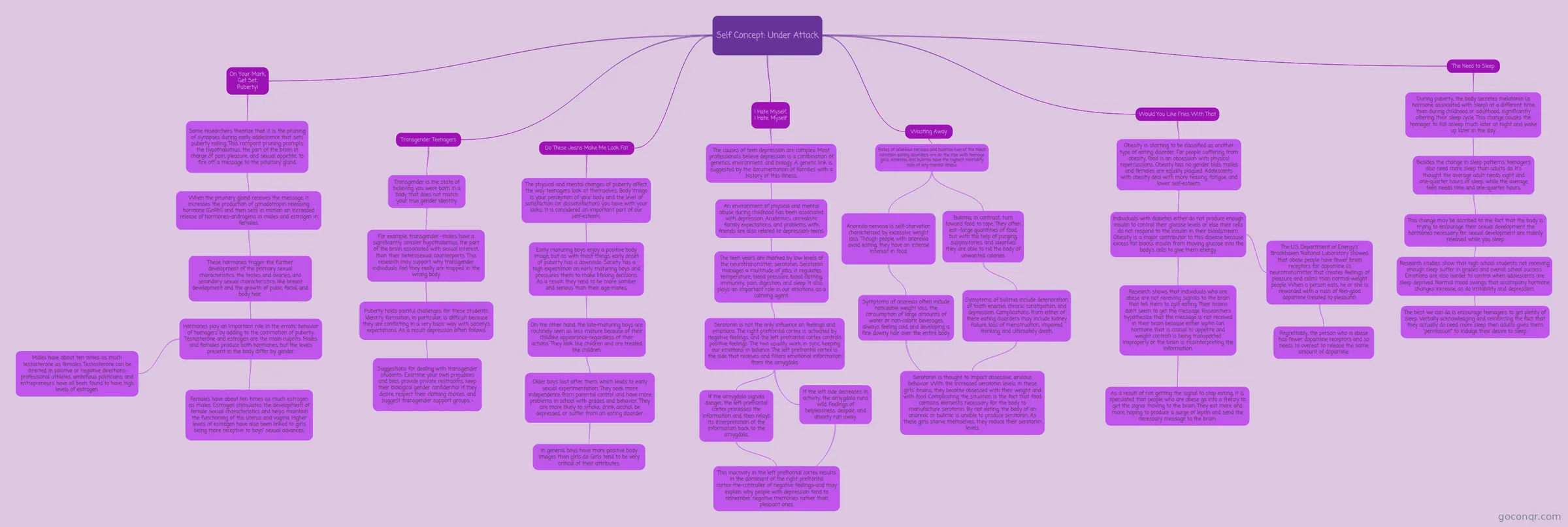
Mind map: Self concept under attack
Inhalt der Mindmap
Self Concept: Under Attack
On Your Mark, Get Set, Puberty!
- Some researchers theorize that it is the pruning of synapses during early adolescence that sets puberty rolling. This rampant pruning prompts the hypothalamus, the part of the brain in charge of pain, pleasure, and sexual appetite, to fire off a message to the pituitary gland.
- When the pituitary gland receives the message, it increases the production of gonadotropin releasing hormone (GnRH) and then sets in motion an increased release of hormones-androgens in males and estrogen in females.
- These hormones trigger the further development of the primary sexual characteristics, the testes and ovaries, and secondary sexual characteristics, like breast development and the growth of pubic, facial, and body hair.
- Hormones play an important role in the erratic behavior of teenagers by adding to the commotion of puberty. Testosterone and estrogen are the main culprits. Males and females produce both hormones, but the levels present in the body differ by gender.
- Males have about ten times as much testosterone as females Testosterone can be directed in positive or negative directions: professional athletes, ambitious politicians, and entrepreneurs have all been found to have high levels of estrogen.
- Females have about ten times as much estrogen as males. Estrogen stimulates the development of female sexual characteristics and helps maintain the functioning of the uterus and vagina. Higher levels of estrogen have also been linked to girls being more receptive to boys' sexual advances.
- Hormones play an important role in the erratic behavior of teenagers by adding to the commotion of puberty. Testosterone and estrogen are the main culprits. Males and females produce both hormones, but the levels present in the body differ by gender.
- These hormones trigger the further development of the primary sexual characteristics, the testes and ovaries, and secondary sexual characteristics, like breast development and the growth of pubic, facial, and body hair.
- When the pituitary gland receives the message, it increases the production of gonadotropin releasing hormone (GnRH) and then sets in motion an increased release of hormones-androgens in males and estrogen in females.
- Some researchers theorize that it is the pruning of synapses during early adolescence that sets puberty rolling. This rampant pruning prompts the hypothalamus, the part of the brain in charge of pain, pleasure, and sexual appetite, to fire off a message to the pituitary gland.
Transgender Teenagers
- Transgender is the state of believing you were born in a body that does not match your true gender identity.
- For example, transgender -males have a significantly smaller hypothalamus, the part of the brain associated with sexual interest, than their heterosexual counterparts. This research may support why transgender individuals feel they really are trapped in the wrong body
- Puberty holds painful challenges for these students. Identity formation, in particular, is difficult because they are conflicting in a very basic way with society's expectations. As a result depression often follows.
- Suggestions for dealing with transgender students: Examine your own prejudices and bias, provide private restrooms, keep their biological gender confidential if they desire, respect their clothing choices. and suggest transgender support groups. •
- Puberty holds painful challenges for these students. Identity formation, in particular, is difficult because they are conflicting in a very basic way with society's expectations. As a result depression often follows.
- For example, transgender -males have a significantly smaller hypothalamus, the part of the brain associated with sexual interest, than their heterosexual counterparts. This research may support why transgender individuals feel they really are trapped in the wrong body
- Transgender is the state of believing you were born in a body that does not match your true gender identity.
Do These Jeans Make Me Look Fat
- The physical and mental changes of puberty affect the way teenagers look at themselves. Body image is your perception of your body and the level of satisfaction (or dissatisfaction) you have with your looks. It is considered an important part of our self-esteem.
- Early maturing boys enjoy a positive body image, but as with most things, early onset of puberty has a downside: Society has a high expectation on early maturing boys and pressures them to make lifelong decisions. As a result, they tend to be more somber and serious than their age-mates.
- On the other hand, the late-maturing boys are routinely seen as less mature because of their childlike appearance-regardless of their actions. They look like children and are treated like children.
- Older boys lust after them, which leads to early sexual experimentation. They seek more independence from parental control and have more problems in school with grades and behavior. They are more likely to smoke, drink alcohol, be depressed, or suffer from an eating disorder.
- In general, boys have more positive body images than girls do. Girls tend to be very critical of their attributes.
- Older boys lust after them, which leads to early sexual experimentation. They seek more independence from parental control and have more problems in school with grades and behavior. They are more likely to smoke, drink alcohol, be depressed, or suffer from an eating disorder.
- On the other hand, the late-maturing boys are routinely seen as less mature because of their childlike appearance-regardless of their actions. They look like children and are treated like children.
- Early maturing boys enjoy a positive body image, but as with most things, early onset of puberty has a downside: Society has a high expectation on early maturing boys and pressures them to make lifelong decisions. As a result, they tend to be more somber and serious than their age-mates.
- The physical and mental changes of puberty affect the way teenagers look at themselves. Body image is your perception of your body and the level of satisfaction (or dissatisfaction) you have with your looks. It is considered an important part of our self-esteem.
I Hate Myself, I Hate. Myself
- The causes of teen depression are complex. Most professionals believe depression is a combination of genetics, environment, and biology. A genetic link is suggested by the documentation of families with a history of this illness.
- An environment of physical and mental abuse during childhood has been associated with depression. Academics, unrealistic family expectations, and problems with friends are also related to depression-teens.
- The teen years are marked by low levels of the neurotransmitter, serotonin. Serotonin manages a multitude of jobs; it regulates temperature, blood pressure, blood clotting, immunity, pain, digestion, and sleep. It also plays an important role in our emotions as a calming agent.
- Serotonin is not the only influence on feelings and emotions. The right prefrontal cortex is activated by negative feelings, and the left prefrontal cortex controls positive feelings. The two usually work in sync, keeping our emotions in balance. The left prefrontal cortex is the side that receives and filters emotional information from the amygdala.
- If the amygdala signals danger, the left prefrontal cortex processes the information and then relays its interpretation of the information back to the amygdala.
- This inactivity in the left prefrontal cortex results in the dominant of the right prefrontal cortex-the-controller of negative feelings-and may explain why people with depression tend to remember negative memories rather than pleasant ones.
- If the left side decreases in activity, the amygdala runs wild. Feelings of helplessness, despair, and anxiety run away.
- If the amygdala signals danger, the left prefrontal cortex processes the information and then relays its interpretation of the information back to the amygdala.
- Serotonin is not the only influence on feelings and emotions. The right prefrontal cortex is activated by negative feelings, and the left prefrontal cortex controls positive feelings. The two usually work in sync, keeping our emotions in balance. The left prefrontal cortex is the side that receives and filters emotional information from the amygdala.
- The teen years are marked by low levels of the neurotransmitter, serotonin. Serotonin manages a multitude of jobs; it regulates temperature, blood pressure, blood clotting, immunity, pain, digestion, and sleep. It also plays an important role in our emotions as a calming agent.
- An environment of physical and mental abuse during childhood has been associated with depression. Academics, unrealistic family expectations, and problems with friends are also related to depression-teens.
- The causes of teen depression are complex. Most professionals believe depression is a combination of genetics, environment, and biology. A genetic link is suggested by the documentation of families with a history of this illness.
The Need to Sleep
- During puberty, the body secretes melatonin (a hormone associated with sleep) at a different time than during childhood or adulthood, significantly altering their sleep cycle. This change causes the teenager to fall asleep much later at night and wake up later in the day.
- Besides the change in sleep patterns, teenagers also need more sleep than adults do. It's thought the average adult needs eight and one-quarter hours of sleep, while the average teen needs nine and one-quarter hours.
- This change may be ascribed to the fact that the body is trying to encourage their sexual development the hormones necessary for sexual development are mainly released while you sleep.
- Research studies show that high school students not receiving enough sleep suffer in grades and overall school success. Emotions are also harder to control when adolescents are sleep deprived. Normal mood swings that accompany hormone changes increase, as do irritability and depression.
- The best we can do is encourage teenagers to get plenty of sleep. Verbally acknowledging and reinforcing the fact that they actually do need more sleep then adults gives them "permission" to indulge their desire to sleep.
- Research studies show that high school students not receiving enough sleep suffer in grades and overall school success. Emotions are also harder to control when adolescents are sleep deprived. Normal mood swings that accompany hormone changes increase, as do irritability and depression.
- This change may be ascribed to the fact that the body is trying to encourage their sexual development the hormones necessary for sexual development are mainly released while you sleep.
- Besides the change in sleep patterns, teenagers also need more sleep than adults do. It's thought the average adult needs eight and one-quarter hours of sleep, while the average teen needs nine and one-quarter hours.
- During puberty, the body secretes melatonin (a hormone associated with sleep) at a different time than during childhood or adulthood, significantly altering their sleep cycle. This change causes the teenager to fall asleep much later at night and wake up later in the day.
Would You Like Fries With That
- Obesity is starting to be classified as another type of eating disorder. For people suffering from obesity, food is an obsession with physical repercussions. Obesity has no gender bias; males and females are equally plagued. Adolescents with obesity deal with more teasing, fatigue, and lower self-esteem.
- Individuals with diabetes either do not produce enough insulin to control their glucose levels or else their cells do not respond to the insulin in their bloodstream. Obesity is a major contributor to this disease because excess fat blocks insulin from moving glucose into the body's cells to give them energy.
- Research shows that individuals who are obese are not receiving signals to the brain that tell them to quit eating. Their brains don't seem to get the message. Researchers hypothesize that the message is not received in their brain because either leptin (an hormone that is crucial to appetite and weight control) is being transported improperly or the brain is misinterpreting the information.
- As a result of not getting the signal to stop eating, it is speculated that people who are obese go into a frenzy to get the signal moving to the brain. They eat more and more, hoping to produce a surge of leptin and send the necessary message to the brain.
- The U.S. Department of Energy's Brookhaven National Laboratory showed that obese people have fewer brain receptors for dopamine (a neurotransmitter that creates feelings of pleasure and calm) than normal-weight people. When a person eats, he or she is rewarded with a rush of feel-good dopamine (related to pleasure).
- Regrettably, the person who is obese has fewer dopamine receptors and so needs to overeat to release the same amount of dopamine.
- Research shows that individuals who are obese are not receiving signals to the brain that tell them to quit eating. Their brains don't seem to get the message. Researchers hypothesize that the message is not received in their brain because either leptin (an hormone that is crucial to appetite and weight control) is being transported improperly or the brain is misinterpreting the information.
- Individuals with diabetes either do not produce enough insulin to control their glucose levels or else their cells do not respond to the insulin in their bloodstream. Obesity is a major contributor to this disease because excess fat blocks insulin from moving glucose into the body's cells to give them energy.
- Obesity is starting to be classified as another type of eating disorder. For people suffering from obesity, food is an obsession with physical repercussions. Obesity has no gender bias; males and females are equally plagued. Adolescents with obesity deal with more teasing, fatigue, and lower self-esteem.
Wasting Away
- Rates of anorexia nervosa and bulimia-two of the most common eating disorders are on the rise with teenage girls. Anorexia and bulimia have the highest mortality rate of any mental illness.
- Anorexia nervosa is self-starvation characterized by excessive weight loss. Though people with anorexia avoid eating, they have an intense interest in food.
- Symptoms of anorexia often include noticeable weight loss, the consumption of large amounts of water or non-caloric beverages, always feeling cold, and developing a fine downy hair over the entire body.
- Symptoms of anorexia often include noticeable weight loss, the consumption of large amounts of water or non-caloric beverages, always feeling cold, and developing a fine downy hair over the entire body.
- Bulimia, in contrast, turn toward food to cope. They often eat -large quantities of food, but with the help of purging, suppositories, and laxatives they are able to rid the body of unwanted calories.
- Symptoms of bulimia include deterioration of tooth enamel, chronic constipation, and depression. Complications from either of there eating disorders may include kidney failure, loss of menstruation, impaired thinking and ultimately death.
- Serotonin is thought to impact obsessive, anxious behavior. With the increased serotonin levels in these girls' brains, they become obsessed with their weight and with food. Complicating the situation is the fact that food contains elements necessary for the body to manufacture serotonin. By not eating, the body of an anorexic or bulimic is unable to produce serotonin. As these girls starve themselves, they reduce their serotonin levels.
- Symptoms of bulimia include deterioration of tooth enamel, chronic constipation, and depression. Complications from either of there eating disorders may include kidney failure, loss of menstruation, impaired thinking and ultimately death.
- Anorexia nervosa is self-starvation characterized by excessive weight loss. Though people with anorexia avoid eating, they have an intense interest in food.
- Rates of anorexia nervosa and bulimia-two of the most common eating disorders are on the rise with teenage girls. Anorexia and bulimia have the highest mortality rate of any mental illness.
Informationen
- Beschreibung
- Mindmap am Self Concept: Under Attack, erstellt von Andrea W. am 22/09/2019.
- Erstellt von
- Andrea W.
- Aufrufe
- 0
- Bewertung