
Mindmap
Determinants of Aggregate Demand
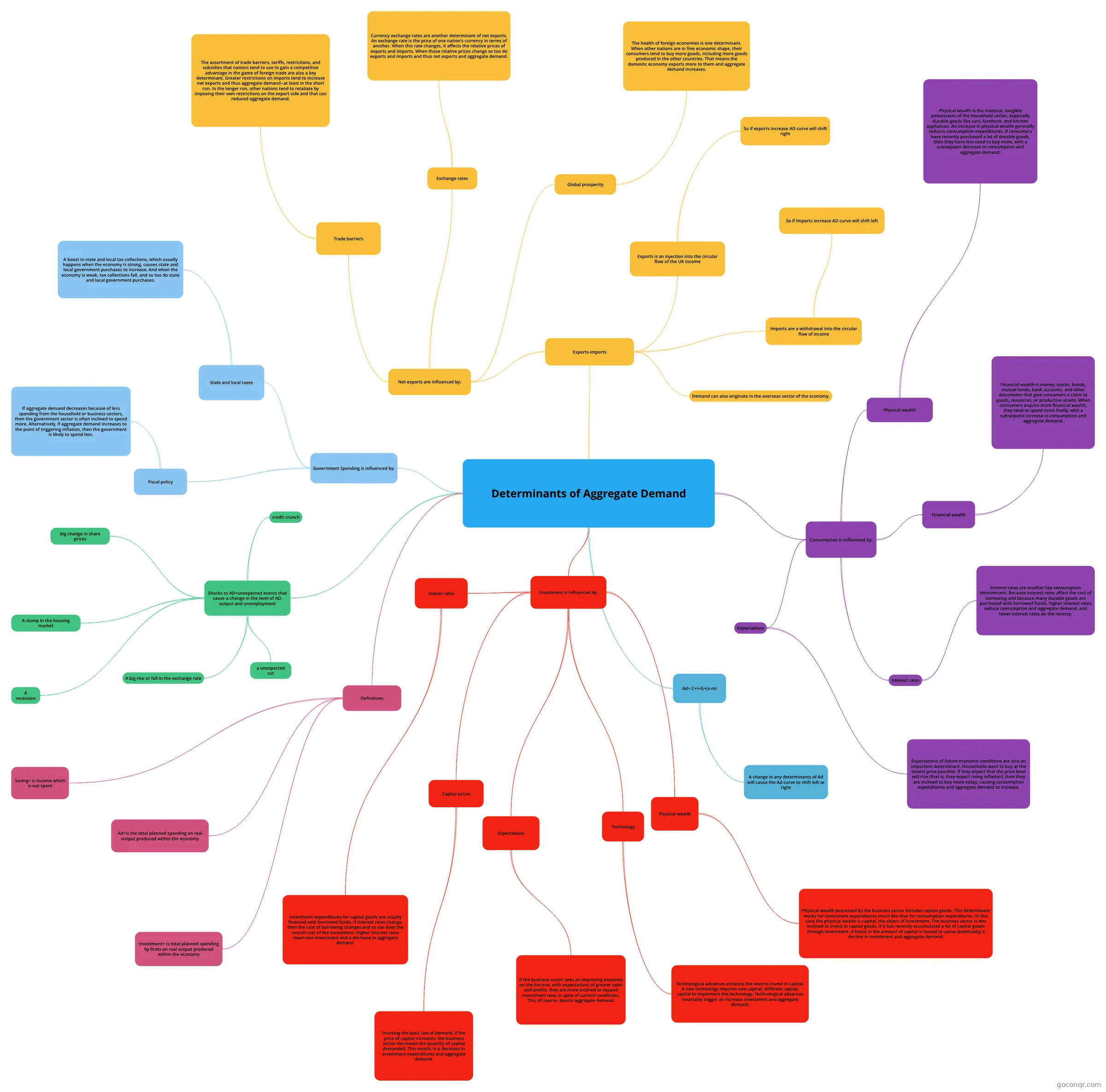
Mind map: Determinants of Aggregate Demand
Inhalt der Mindmap
Determinants of Aggregate Demand
Definitions
- Ad=is the total planned spending on real output produced within the economy
- Investment= is total planned spending by firms on real output produced within the economy
- Saving= is income which is not spent
Ad= C+I+G+(x-m)
- A change in any determinants of Ad will cause the Ad curve to shift left or right
Exports-imports
- Demand can also originate in the overseas sector of the economy.
- Exports is an injection into the circular flow of the UK income
- So if exports increase AD curve will shift right
- Imports are a withdrawal into the circular flow of income
- So if Imports increase AD curve will shift left
- Net exports are influenced by:
- Global prosperity
- The health of foreign economies is one determinant. When other nations are in fine economic shape, their consumers tend to buy more goods, including more goods produced in the other countries. That means the domestic economy exports more to them and aggregate demand increases.
- Exchange rates
- Currency exchange rates are another determinant of net exports. An exchange rate is the price of one nation's currency in terms of another. When this rate changes, it affects the relative prices of exports and imports. When those relative prices change so too do exports and imports and thus net exports and aggregate demand.
- Trade barriers
- The assortment of trade barriers, tariffs, restrictions, and subsidies that nations tend to use to gain a competitive advantage in the game of foreign trade are also a key determinant. Greater restrictions on imports tend to increase net exports and thus aggregate demand--at least in the short run. In the longer run, other nations tend to retaliate by imposing their own restrictions on the export side and that can reduced aggregate demand.
- Global prosperity
Shocks to AD=unexpected events that cause a change in the level of AD, output and unemployment
- A big rise or fall in the exchange rate
- A recession
- A slump in the housing market
- big change in share prices
- credit crunch
- a unexpected cut
Consumption is influenced by:
- Physical wealth
- Physical wealth is the material, tangible possessions of the household sector, especially durable goods like cars, furniture, and kitchen appliances. An increase in physical wealth generally reduces consumption expenditures. If consumers have recently purchased a lot of durable goods, then they have less need to buy more, with a subsequent decrease in consumption and aggregate demand.
- Financial wealth
- Financial wealth is money, stocks, bonds, mutual funds, bank accounts, and other documents that give consumers a claim to goods, resources, or productive assets. When consumers acquire more financial wealth, they tend to spend more freely, with a subsequent increase in consumption and aggregate demand.
- Interest rates
- Interest rates are another key consumption determinant. Because interest rates affect the cost of borrowing and because many durable goods are purchased with borrowed funds, higher interest rates reduce consumption and aggregate demand, and lower interest rates do the reverse.
- Expectations
- Expectations of future economic conditions are also an important determinant. Households want to buy at the lowest price possible. If they expect that the price level will rise (that is, they expect rising inflation), then they are inclined to buy more today, causing consumption expenditures and aggregate demand to increase.
- Physical wealth
Investment is influenced by:
- Interet rates
- Investment expenditures for capital goods are usually financed with borrowed funds. If interest rates change, then the cost of borrowing changes and so too does the overall cost of the investment. Higher interest rates mean less investment and a decrease in aggregate demand.
- Physical wealth
- Physical wealth possessed by the business sector includes capital goods. This determinant works for investment expenditures much like that for consumption expenditures. In this case the physical wealth is capital, the object of investment. The business sector is less inclined to invest in capital goods, if it has recently accumulated a lot of capital goods through investment. A boost in the amount of capital is bound to cause (eventually) a decline in investment and aggregate demand.
- Expectations
- If the business sector sees an improving economy on the horizon, with expectations of greater sales and profits, they are more inclined to expand investment now, in spite of current conditions. This, of course, boosts aggregate demand.
- Capital prices
- Invoking the basic law of demand, if the price of capital increases, the business sector decreases the quantity of capital demanded. This results in a decrease in investment expenditures and aggregate demand.
- Technology
- Technological advances enhance the need to invest in capital. A new technology requires new capital, different capital, capital to implement the technology. Technological advances invariably trigger an increase investment and aggregate demand.
- Interet rates
Government Spending is influenced by:
- Fiscal policy
- If aggregate demand decreases because of less spending from the household or business sectors, then the government sector is often inclined to spend more. Alternatively, if aggregate demand increases to the point of triggering inflation, then the government is likely to spend less.
- State and local taxes
- A boost in state and local tax collections, which usually happens when the economy is strong, causes state and local government purchases to increase. And when the economy is weak, tax collections fall, and so too do state and local government purchases.
- Fiscal policy
Informationen
- Beschreibung
- Mindmap am Determinants of Aggregate Demand, erstellt von isyedwards am 03/02/2015.
- Erstellt von
- isyedwards
- Aufrufe
- 0
- Bewertung
Mehr zu Aggregate demand and aggregate supply