
Mindmap
Cognition 12 & 13
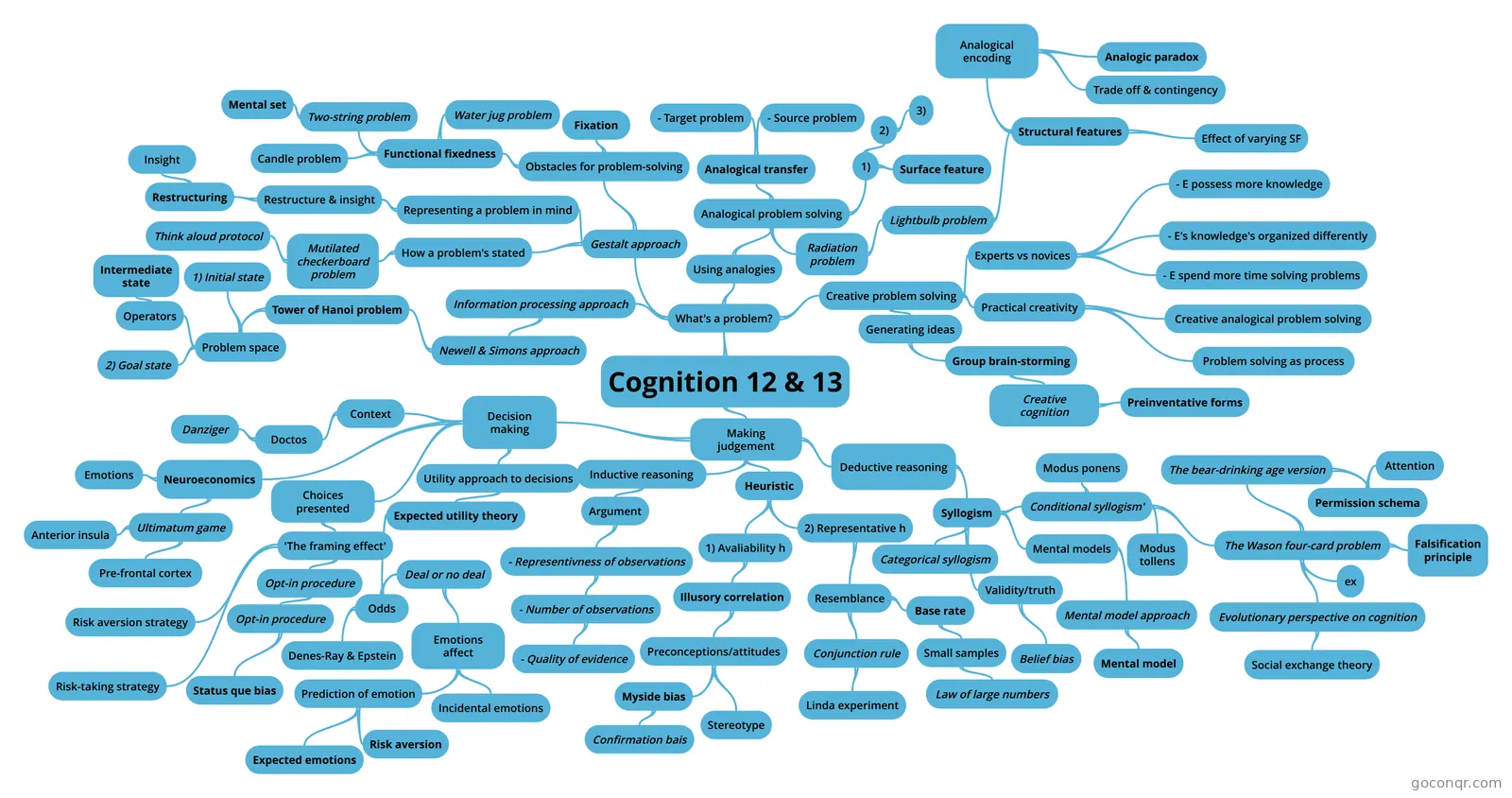
Mind map: Cognition 12 & 13
Inhalt der Mindmap
Cognition 12 & 13
What's a problem?
- - there's an obstacle between the present state & your goal - more complicated psychologist
- Gestalt approach
- - interested in perception, learning, problem-solving, attitudes. Problem: 1) how ppl represent a problem in their mind 2) how this solving involves reconstructuring/reorganization of the current state
- Representing a problem in mind
- Kohler - each way of going about solving a problem different rep->starting points- success is influenced by how the problem is represented
- Restructure & insight
- Restructuring
- = the process of changing a problem's representation
- Insight
- = sudden realization of a problems solution, involves finding a crucial element -> studies sudden insight vs methodical solution can predict how far away more - Metcalfe & Wiebe
- Restructuring
- Obstacles for problem-solving
- Fixation
- = a tendency to focus on a specific characteristic that keeps you from solving a problem
- Functional fixedness
- - type of fixation - focus on familiar functions & uses of an object - container as support to representation
- Candle problem
- - example of functional fixation by Karl Duncker - asked them to use various objects to solve task - one group box with candles mm vs group with emty box - Result = took longer for container box group
- Two-string problem
- - another example by Maier - tie two strings together
- Mental set
- = preconceptions about the representation of a problem - based on past experience
- Water jug problem
- Luchins - how mental sets create obstacles
- Fixation
- How a problem's stated
- Mutilated checkerboard problem
- - adopting the correct problem representation - experiment solve checkerboard - Result: those with description that emphasized the key difference
- Think aloud protocol
- - by Simon & Kaplan - technique-> reveals a shift in how ppl perceive elements of a problem =>analogy
- Mutilated checkerboard problem
- Information processing approach
- - how to study the mind - like a computer - Newell & Simon -> problem solving like a search, from language
- Newell & Simons approach
- Tower of Hanoi problem
- Problem space
- - the problem solver doesn't know the problem space-> searching for it - MEANS-ENDS ANALYSIS -> reducing the difference between the initial/goal state
- 1) Initial state
- 2) Goal state
- Operators
- = actions that take problems from one state to the other
- Intermediate state
- = problem solving involved a sequence of choices of steps, each action creating an intermediate state/subgoals
- Problem space
- Tower of Hanoi problem
- Using analogies
- = the process of noticing connections between similiar problems & applying solution for one problem to the other
- Analogical problem solving
- = using previous solutions as guidence for new problems - irl even if ppl are exposed to it they won't notice it often - Gick & Holyoak
- Analogical transfer
- = the transfer from one problem to the other
- - Target problem
- = the problem you try to solve
- - Source problem
- = another problem that shares some similiarities with the problem & illustrates a way to solve the target problem
- Radiation problem
- Karl Duncker's - radiation low intensity saves tissue but won't kill tumor - radiation high intensity saves tumor but kills tissue = solution several low from different directions
- Lightbulb problem
- - using similarity in surface features-> broken lightbulb - 80% of those who did radiation problem solved this vs 10% control group
- Structural features
- = the underlaying principle that governs the situation -> ex strong laser breaks lightbulb vs strong ray destroys tumor
- Effect of varying SF
- Analogical encoding
- - training procedure for helping ppl to notice structural similarities - similarities are determined
- Trade off & contingency
- experiment Gentner & GoldinMedow - comparing source stories¨ - tend to choose the strategy that was emphasized in the sample cases - 2 trade off cases->negotiation solution-> one group with & without contengency principle
- Analogic paradox
- - in the real world - many ilr analogies illustrate Kevin Dunbar - difficulty of triggering analogies in the laboratory/rather naturalistic settings
- 1)
- - Notice analogous relationship between target/source problem - most difficult one
- 2)
- - mapping correnspondece between source story & target problem - connecting similiar elements
- 3)
- - applying the mapping to generate a parallel solution to the target problem
- Surface feature
- - specific elements of the target problem - such as tumor - making them more similiar helps you to notice - can differ ->that focus makes it difficult to see similarities
- Creative problem solving
- divergent thinking = see several possible solutions/openended - creativity = 'anything made by a human that is in some way novel, has potential value or utility'
- Experts vs novices
- James Voss & co - expertise only useful in your field
- - E possess more knowledge
- -..about their field - chess pieces as meaningful pattern instead of induvidual- Chase & Simon
- - E's knowledge's organized differently
- - Micheline & co - sort problems into groups - novices->surface organization experts>deeper structure - organization based on principles leads to more effective problem solving
- - E spend more time solving problems
- - trying to understand problem before trying to solve - can appear slow-start
- Practical creativity
- Creative analogical problem solving
- - Jorge Odon - cork bottle stuck yt clipp to saving stuck babies
- Problem solving as process
- - trial & error development - a lenth way to make it a useful tool - combine components - problem generattion/formulation/solving+solution implemention
- Creative analogical problem solving
- Generating ideas
- Linus Pauling - having a base of knowledge - but being able to think freely - preconception
- Group brain-storming
- Alex Osburn - freely express ideas in a group to come up with solutions no hate - fewer ideas in group than induvidual brain-storming
- Creative cognition
- Ronald Finke - induvidual brain-storming technique - train ppl to think creative - experiment categories+examples
- Preinventative forms
- = ideas that precede the creation of a finished creative product -> don't have to be an inventor -> creativity's similiar to other cognitive processes->self generated inventions
Making judgement
- decision - making choices among alternatives reasoning - drawing conclusions judgement - 'look over a situation'
- Decision making
- Utility approach to decisions
- Expected utility theory
- - assumes that ppl are basically rational - if ppl have the right information they'll make a decision with maximum expeced utility(succeed goal)
- Odds
- - estimate the smartest choice with thw best outcome - possible to determine - optimal strategy doesn't mean we follow it
- Denes-Ray & Epstein
- - jelly bean experiment - choose how to succeed in finding a red - rejected probability rational mind
- Deal or no deal
- Thierry Post & co = decisions swayed by emotion - tv show- take deal or chance of getting higher briefcase- those succeeding became more cautious- those failing become more risk taking
- Emotions affect
- Prediction of emotion
- - many ppl fail predicting their emotion about an outcome
- Expected emotions
- - deal or no deal - coin flip experiment Kermer & co - tend to overestimate negative feelings of losing/positive feelings about winning
- Risk aversion
- = the tendency to avoid taking risks -> loss vs gain impact
- Incidental emotions
- - emotions not casued by having to make an decision - person's general mood - Lerner experiment-> sell/buy property seeing clips sad disgust neutral - disgust expel things sadness change
- Prediction of emotion
- Expected utility theory
- Context
- - decisions are affected of the particular context which you are in - adding alternatives affect choices->more decisions lead to no decision at all medical treatment
- Doctos
- - their recommendation depending on immediate prior experiences - first->serious cases->not serious - cesarean
- Danziger
- - experiment jury eaten before or not - decision making affected by external factors not really relevant
- Choices presented
- - have an affect on decision - Paul Slovic experiment-> 20/100 ppl or 20% mental pat rather the first
- 'The framing effect'
- Tversky & Kahnemann: framing highlights specific features -> saving lives = risk aversion -> loss of lives = risk taking strategy
- Opt-in procedure
- - fex sign a donation card to take an active step - many accept donations but few make the move->free
- Opt-in procedure
- -fex everyone's a donor unless you request not to be
- Status que bias
- = tendency to do nothing - stay as it is - when faced with a difficult decision
- Risk aversion strategy
- - rather 200 alive than 2/3 risk that no one will be saved
- Risk-taking strategy
- - rather taking 2/3 risk of death than certain death amount
- Neuroeconomics
- = the neural basis of decision making -> psychology, neuroscience, economics -> potential gains & losses/brain activation
- Emotions
- - big influencer - see it in brain activation while playing economic games
- Ultimatum game
- - experiment Alan Sanfey & co - proposer + responder - offer split or nothing - ppl tend to reject low offers->fair deals angry - brain activity
- Anterior insula
- - deep within the brain between parietal & temporal lobe - activated 3x stronger when responder rejected offer - area connected to bad emotions
- Pre-frontal cortex
- - for accumulating as much money as possible - not emotional neutral to offers - different areas represents different goals of the game
- Utility approach to decisions
- Deductive reasoning
- = determine whether a conclusion follows its premises
- Syllogism
- Aristoteles - 2 premises followed by a conclusion - first simple form of deductive reasoning
- Categorical syllogism
- = everything begins with all, some or no
- Validity/truth
- -> valid = conclusion logically follows the premises -> doesn't have to be true -> is reasoning logical?
- Belief bias
- = you think the syllogism is valid bc the conclusion is believable -> Evans experiment asked them to say if it's valid or not -> believableness
- Mental models
- Mental model approach
- Philip Johnson-Laird - approaching issue with syllogism - ppl use mental models to solve deductive problems - a conclusion is valid only when it cannot be refuted by any other model of the premises
- Mental model
- = a specific situation represented in a person's mind that can be used to solve syllogisms -> generate tentative conclusion from this -> create a model for reasoning problem, try find exceptions/falsify-> then modify to perfection
- Mental model approach
- Conditional syllogism'
- ' if I study I get good grades I studied I got a good grade' -> p & q instead of A & B -> must always think about things that contradict
- Modus ponens
- = 'the way that affirms by affirming'
- Modus tollens
- = ' the way it denies by denying'
- The Wason four-card problem
- - 'if there's a vowel on one side, there's an even number on the other' -> cards with numbers/letters
- Falsification principle
- = to test a rule, it's necessary to look for situations that falsify the rule
- ex
- ''You are shown a set of four cards placed on a table, each of which has a number on one side and a colored patch on the other side. The visible faces of the cards show 3, 8, red and brown. Which card(s) must you turn over in order to test the truth of the proposition that if a card shows an even number on one face, then its opposite face is red?''
- The bear-drinking age version
- Griggs & Cox - similiar-> concrete better than abstract- easier bc involves regulations ppl are familiar with
- Permission schema
- Cheng & Holyoak - ppl reason in schemas - knowledge about rules that govern their thougths/actions - ''if a person satisfies a specific condition then get to carry out action''
- Attention
- ''permission schema helps ppl to focus their attention on the card that would test that schema''
- Evolutionary perspective on cognition
- Cosmides & Tooby - cognition/mind based on natural selection/evolution - did experiment with unfamiliar objects - successful properties become characteristics
- Social exchange theory
- = ''ability to cooperate in way that's beneficial to both'' -> detecting cheating ability rather than permission schemas
- Inductive reasoning
- - one of primary mechanisms for making judgements - reasoning based on observation/drawing 'probably' conclusions from evidence
- Argument
- - Representivness of observations
- = how well observations of a particular category represent the whole group
- - Number of observations
- = argument is supported by a lot of observations/likely that it's true
- - Quality of evidence
- = stronger quality leads to stronger arguments/conclusions
- - Representivness of observations
- Heuristic
- - shortcuts/rules of thumb - drawing conclusions from past experience
- 1) Avaliability h
- - states that events that're more easily remembered are more probable than those less remembered/past experience - ex news only bring up extraordinary death causes that we might think is usual
- Illusory correlation
- = a correlation appears to exist but not in reality, happens when two things are expected to be related
- Preconceptions/attitudes
- Charles Lord & co - how attitudes are affected by exposure to evidence that contradicts their attitude
- Stereotype
- = illusory correlations can be caused by a stereotype
- Myside bias
- = the tendency from ppl to generate/evaluate evidence + test their hypothesis in a way that's biased towards their own opinion
- Confirmation bais
- Peter C Watson->sequence numbers come up with his rule->try confirm thei own hypothesis - broader myside bias, not only attitudes- information's favored that confirms hypothesis
- 2) Representative h
- = ppl make judgements based on how much an event resembles another->not how often
- Resemblance
- Tversky & Kohneman - the probability that A is a member of class B can be determined by how the properties of A resembles with properties associated with B
- Base rate
- = the relative proportions of a certain group, fex more male farmers than male librarians->more likely farmer when piced out->don't forget descriptive data consider
- Small samples
- - incorrectly assumes that small samples are representative
- Law of large numbers
- = The bigger the sample the more representative it is - the hospital problem: male femal births
- Conjunction rule
- Tversky & Kohneman - the probability for a conjuncton between two events cannot be higher than the probability of a signle constituents
- Linda experiment
- 1. Linda's a bank teller 2. Linda's a bank teller & a feminist -> Most chose 2->representative heuristic-> characteristics fit feminist more
Informationen
- Beschreibung
- Psykologi A (Kognitionspsykologi) Mindmap am Cognition 12 & 13, erstellt von amelia juslin am 21/10/2019.
- Erstellt von
- amelia juslin
- Aufrufe
- 0
- Bewertung
Mehr zu Problem Solving and Creativity