
Mindmap
3.4 stages of data analysis
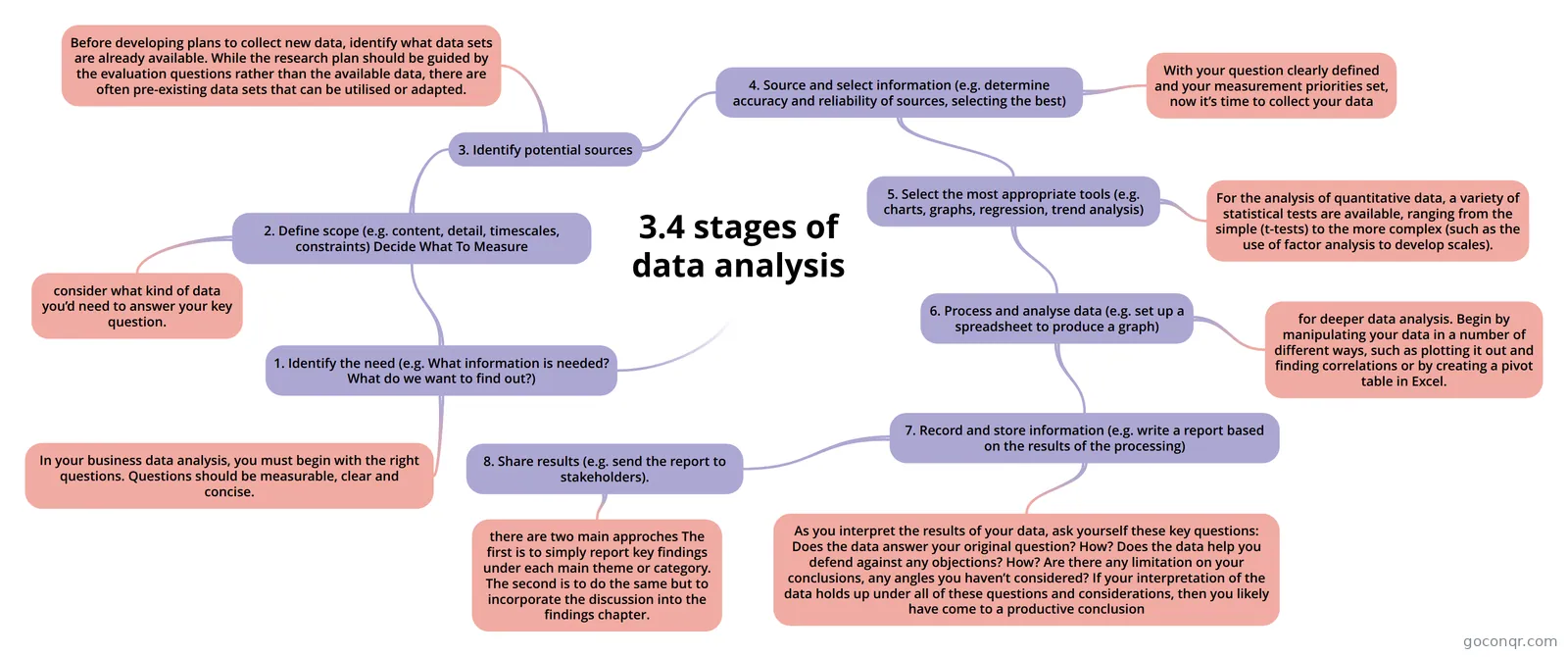
Mind map: Stages of data analysis
Inhalt der Mindmap
3.4 stages of data analysis
1. Identify the need (e.g. What information is needed? What do we want to find out?)
- 2. Define scope (e.g. content, detail, timescales, constraints) Decide What To Measure
- 3. Identify potential sources
- 4. Source and select information (e.g. determine accuracy and reliability of sources, selecting the best)
- 5. Select the most appropriate tools (e.g. charts, graphs, regression, trend analysis)
- 6. Process and analyse data (e.g. set up a spreadsheet to produce a graph)
- 7. Record and store information (e.g. write a report based on the results of the processing)
- 8. Share results (e.g. send the report to stakeholders).
- there are two main approches The first is to simply report key findings under each main theme or category. The second is to do the same but to incorporate the discussion into the findings chapter.
- As you interpret the results of your data, ask yourself these key questions: Does the data answer your original question? How? Does the data help you defend against any objections? How? Are there any limitation on your conclusions, any angles you haven’t considered? If your interpretation of the data holds up under all of these questions and considerations, then you likely have come to a productive conclusion
- 8. Share results (e.g. send the report to stakeholders).
- for deeper data analysis. Begin by manipulating your data in a number of different ways, such as plotting it out and finding correlations or by creating a pivot table in Excel.
- 7. Record and store information (e.g. write a report based on the results of the processing)
- For the analysis of quantitative data, a variety of statistical tests are available, ranging from the simple (t-tests) to the more complex (such as the use of factor analysis to develop scales).
- 6. Process and analyse data (e.g. set up a spreadsheet to produce a graph)
- With your question clearly defined and your measurement priorities set, now it’s time to collect your data
- 5. Select the most appropriate tools (e.g. charts, graphs, regression, trend analysis)
- Before developing plans to collect new data, identify what data sets are already available. While the research plan should be guided by the evaluation questions rather than the available data, there are often pre-existing data sets that can be utilised or adapted.
- 4. Source and select information (e.g. determine accuracy and reliability of sources, selecting the best)
- consider what kind of data you’d need to answer your key question.
- 3. Identify potential sources
- In your business data analysis, you must begin with the right questions. Questions should be measurable, clear and concise.
- 2. Define scope (e.g. content, detail, timescales, constraints) Decide What To Measure
Informationen
- Beschreibung
- Mindmap am 3.4 stages of data analysis, erstellt von Declan Fletcher am 27/01/2020.
- Erstellt von
- Declan Fletcher
- Aufrufe
- 1
- Bewertung