
Mindmap
Occlusion (3 Determinants: MOM,TMJ & Teeth)
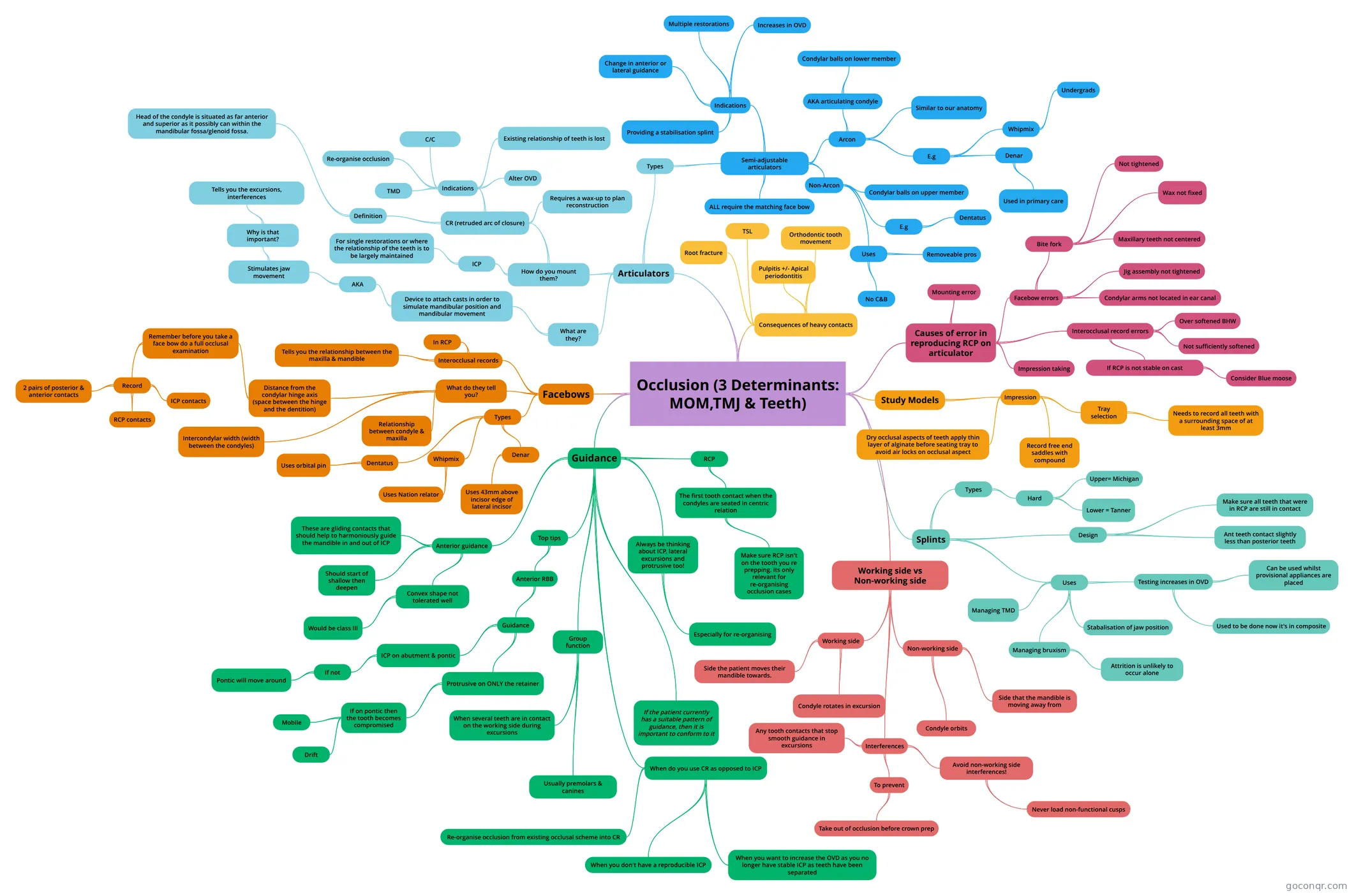
Mind map: Occlusion determinants MOM, TMJ and teeth
Inhalt der Mindmap
Occlusion (3 Determinants: MOM,TMJ & Teeth)
Articulators
- What are they?
- Device to attach casts in order to simulate mandibular position and mandibular movement
- AKA
- Stimulates jaw movement
- Why is that important?
- Tells you the excursions, interferences
- Why is that important?
- Stimulates jaw movement
- AKA
- Device to attach casts in order to simulate mandibular position and mandibular movement
- Types
- Semi-adjustable articulators
- Arcon
- AKA articulating condyle
- Condylar balls on lower member
- E.g
- Whipmix
- Undergrads
- Denar
- Used in primary care
- Whipmix
- Similar to our anatomy
- AKA articulating condyle
- Non-Arcon
- Condylar balls on upper member
- E.g
- Dentatus
- Uses
- Removeable pros
- No C&B
- ALL require the matching face bow
- Indications
- Multiple restorations
- Increases in OVD
- Change in anterior or lateral guidance
- Providing a stabilisation splint
- Arcon
- Semi-adjustable articulators
- How do you mount them?
- ICP
- For single restorations or where the relationship of the teeth is to be largely maintained
- CR (retruded arc of closure)
- Indications
- Re-organise occlusion
- Existing relationship of teeth is lost
- Alter OVD
- TMD
- C/C
- Requires a wax-up to plan reconstruction
- Definition
- Head of the condyle is situated as far anterior and superior as it possibly can within the mandibular fossa/glenoid fossa.
- Indications
- ICP
- What are they?
Facebows
- What do they tell you?
- Intercondylar width (width between the condyles)
- Distance from the condylar hinge axis (space between the hinge and the dentition)
- Remember before you take a face bow do a full occlusal examination
- Record
- ICP contacts
- RCP contacts
- 2 pairs of posterior & anterior contacts
- Record
- Remember before you take a face bow do a full occlusal examination
- Relationship between condyle & maxilla
- Types
- Whipmix
- Uses Nation relator
- Denar
- Uses 43mm above incisor edge of lateral incisor
- Dentatus
- Uses orbital pin
- Whipmix
- Interocclusal records
- Tells you the relationship between the maxilla & mandible
- In RCP
- What do they tell you?
Guidance
- Anterior guidance
- These are gliding contacts that should help to harmoniously guide the mandible in and out of ICP
- Should start of shallow then deepen
- Convex shape not tolerated well
- Would be class III
- If the patient currently has a suitable pattern of guidance, then it is important to conform to it
- Top tips
- Anterior RBB
- Guidance
- ICP on abutment & pontic
- If not
- Pontic will move around
- If not
- Protrusive on ONLY the retainer
- If on pontic then the tooth becomes compromised
- Mobile
- Drift
- If on pontic then the tooth becomes compromised
- ICP on abutment & pontic
- Guidance
- Anterior RBB
- Always be thinking about ICP, lateral excursions and protrusive too!
- Especially for re-organising
- Group function
- When several teeth are in contact on the working side during excursions
- Usually premolars & canines
- RCP
- The first tooth contact when the condyles are seated in centric relation
- Make sure RCP isn't on the tooth you re prepping. its only relevant for re-organising occlusion cases
- The first tooth contact when the condyles are seated in centric relation
- When do you use CR as opposed to ICP
- Re-organise occlusion from existing occlusal scheme into CR
- When you don't have a reproducible ICP
- When you want to increase the OVD as you no longer have stable ICP as teeth have been separated
- Anterior guidance
Consequences of heavy contacts
- TSL
- Root fracture
- Orthodontic tooth movement
- Pulpitis +/- Apical periodontitis
Working side vs Non-working side
- Working side
- Side the patient moves their mandible towards.
- Condyle rotates in excursion
- Non-working side
- Side that the mandible is moving away from
- Condyle orbits
- Interferences
- Any tooth contacts that stop smooth guidance in excursions
- To prevent
- Take out of occlusion before crown prep
- Avoid non-working side interferences!
- Never load non-functional cusps
- Working side
Splints
- Uses
- Managing TMD
- Managing bruxism
- Attrition is unlikely to occur alone
- Testing increases in OVD
- Used to be done now it's in composite
- Can be used whilst provisional appliances are placed
- Stabalisation of jaw position
- Types
- Hard
- Lower = Tanner
- Upper= Michigan
- Hard
- Design
- Make sure all teeth that were in RCP are still in contact
- Ant teeth contact slightly less than posterior teeth
- Uses
Causes of error in reproducing RCP on articulator
- Facebow errors
- Bite fork
- Not tightened
- Wax not fixed
- Maxillary teeth not centered
- Jig assembly not tightened
- Condylar arms not located in ear canal
- Bite fork
- Interocclusal record errors
- Over softened BHW
- Not sufficiently softened
- If RCP is not stable on cast
- Consider Blue moose
- Impression taking
- Mounting error
- Facebow errors
Study Models
- Impression
- Tray selection
- Needs to record all teeth with a surrounding space of at least 3mm
- Record free end saddles with compound
- Dry occlusal aspects of teeth apply thin layer of alginate before seating tray to avoid air locks on occlusal aspect
- Tray selection
- Impression
Informationen
- Beschreibung
- First Year Dentistry Mindmap am Occlusion (3 Determinants: MOM,TMJ & Teeth), erstellt von sanna pathy am 01/03/2020.
- Erstellt von
- sanna pathy
- Aufrufe
- 5
- Tags
- Verlauf
-
- Erstellt von Zainab Patel · 26 Feb 2020
- Kopiert von sanna pathy · 1 Mär 2020
- Bewertung