
Mindmap
6) Planning and risk assessment
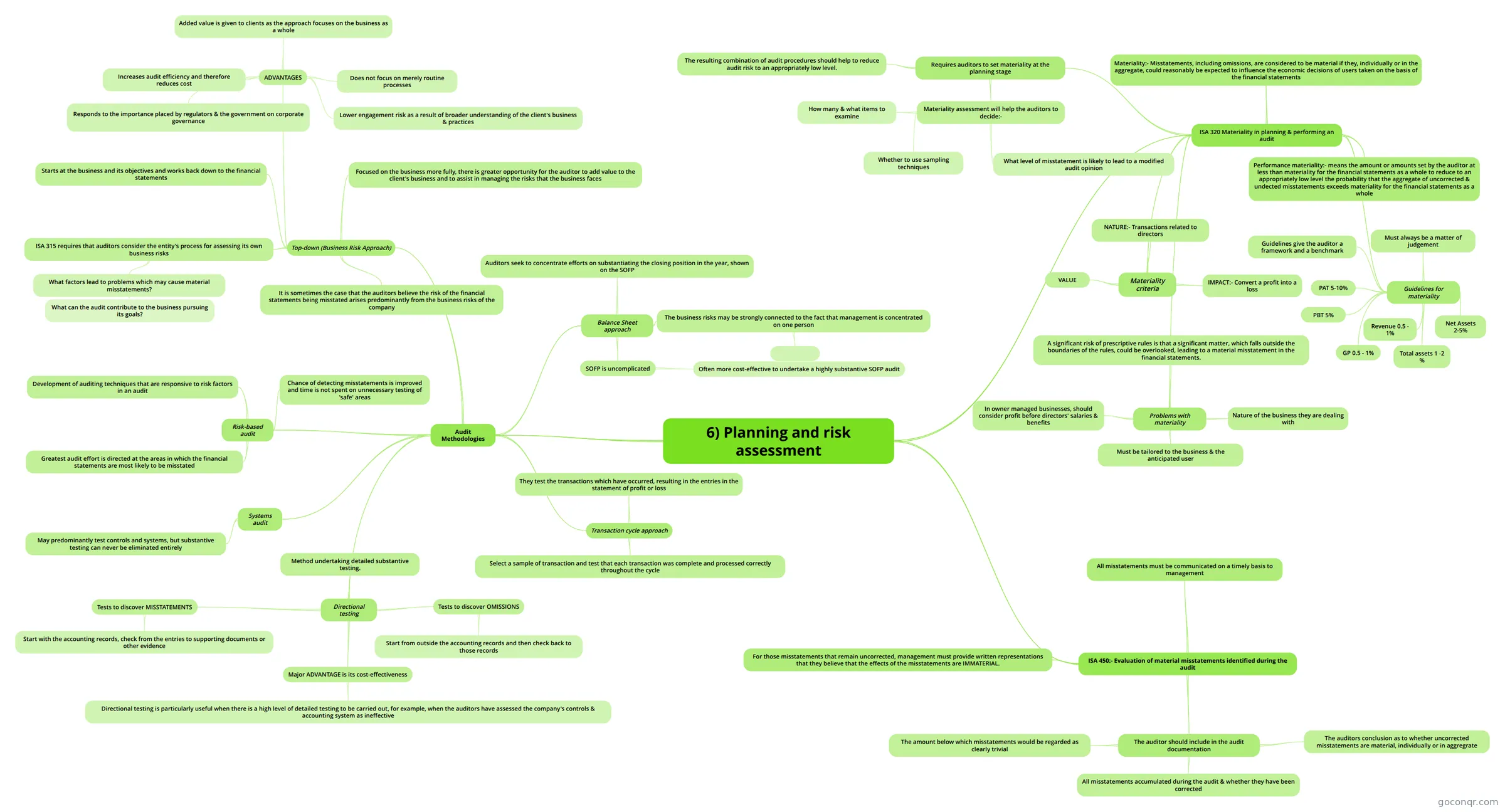
Mind map: Planning and risk assessment
Inhalt der Mindmap
6) Planning and risk assessment
Audit Methodologies
- Risk-based audit
- Development of auditing techniques that are responsive to risk factors in an audit
- Greatest audit effort is directed at the areas in which the financial statements are most likely to be misstated
- Chance of detecting misstatements is improved and time is not spent on unnecessary testing of 'safe' areas
- Top-down (Business Risk Approach)
- ISA 315 requires that auditors consider the entity's process for assessing its own business risks
- What factors lead to problems which may cause material misstatements?
- What can the audit contribute to the business pursuing its goals?
- What factors lead to problems which may cause material misstatements?
- It is sometimes the case that the auditors believe the risk of the financial statements being misstated arises predominantly from the business risks of the company
- Starts at the business and its objectives and works back down to the financial statements
- Focused on the business more fully, there is greater opportunity for the auditor to add value to the client's business and to assist in managing the risks that the business faces
- ADVANTAGES
- Added value is given to clients as the approach focuses on the business as a whole
- Increases audit efficiency and therefore reduces cost
- Does not focus on merely routine processes
- Responds to the importance placed by regulators & the government on corporate governance
- Lower engagement risk as a result of broader understanding of the client's business & practices
- ISA 315 requires that auditors consider the entity's process for assessing its own business risks
- Systems audit
- May predominantly test controls and systems, but substantive testing can never be eliminated entirely
- Balance Sheet approach
- Auditors seek to concentrate efforts on substantiating the closing position in the year, shown on the SOFP
- The business risks may be strongly connected to the fact that management is concentrated on one person
- SOFP is uncomplicated
- Often more cost-effective to undertake a highly substantive SOFP audit
- Transaction cycle approach
- They test the transactions which have occurred, resulting in the entries in the statement of profit or loss
- Select a sample of transaction and test that each transaction was complete and processed correctly throughout the cycle
- Directional testing
- Method undertaking detailed substantive testing.
- Tests to discover MISSTATEMENTS
- Start with the accounting records, check from the entries to supporting documents or other evidence
- Tests to discover OMISSIONS
- Start from outside the accounting records and then check back to those records
- Major ADVANTAGE is its cost-effectiveness
- Directional testing is particularly useful when there is a high level of detailed testing to be carried out, for example, when the auditors have assessed the company's controls & accounting system as ineffective
- Risk-based audit
ISA 320 Materiality in planning & performing an audit
- Materiality:- Misstatements, including omissions, are considered to be material if they, individually or in the aggregate, could reasonably be expected to influence the economic decisions of users taken on the basis of the financial statements
- Performance materiality:- means the amount or amounts set by the auditor at less than materiality for the financial statements as a whole to reduce to an appropriately low level the probability that the aggregate of uncorrected & undected misstatements exceeds materiality for the financial statements as a whole
- Requires auditors to set materiality at the planning stage
- Materiality assessment will help the auditors to decide:-
- How many & what items to examine
- Whether to use sampling techniques
- What level of misstatement is likely to lead to a modified audit opinion
- The resulting combination of audit procedures should help to reduce audit risk to an appropriately low level.
- Materiality assessment will help the auditors to decide:-
- Materiality criteria
- NATURE:- Transactions related to directors
- VALUE
- IMPACT:- Convert a profit into a loss
- Guidelines for materiality
- Must always be a matter of judgement
- Guidelines give the auditor a framework and a benchmark
- PBT 5%
- GP 0.5 - 1%
- Revenue 0.5 - 1%
- Total assets 1 -2 %
- Net Assets 2-5%
- PAT 5-10%
- Problems with materiality
- A significant risk of prescriptive rules is that a significant matter, which falls outside the boundaries of the rules, could be overlooked, leading to a material misstatement in the financial statements.
- In owner managed businesses, should consider profit before directors' salaries & benefits
- Nature of the business they are dealing with
- Must be tailored to the business & the anticipated user
ISA 450:- Evaluation of material misstatements identified during the audit
- All misstatements must be communicated on a timely basis to management
- For those misstatements that remain uncorrected, management must provide written representations that they believe that the effects of the misstatements are IMMATERIAL.
- The auditor should include in the audit documentation
- The amount below which misstatements would be regarded as clearly trivial
- All misstatements accumulated during the audit & whether they have been corrected
- The auditors conclusion as to whether uncorrected misstatements are material, individually or in aggregrate
Informationen
- Beschreibung
- Mindmap am 6) Planning and risk assessment, erstellt von littlepaz_2001 am 22/09/2013.
- Erstellt von
- littlepaz_2001
- Aufrufe
- 109
- Bewertung