
Mindmap
Vulnerability, Adaptation and Mitigation
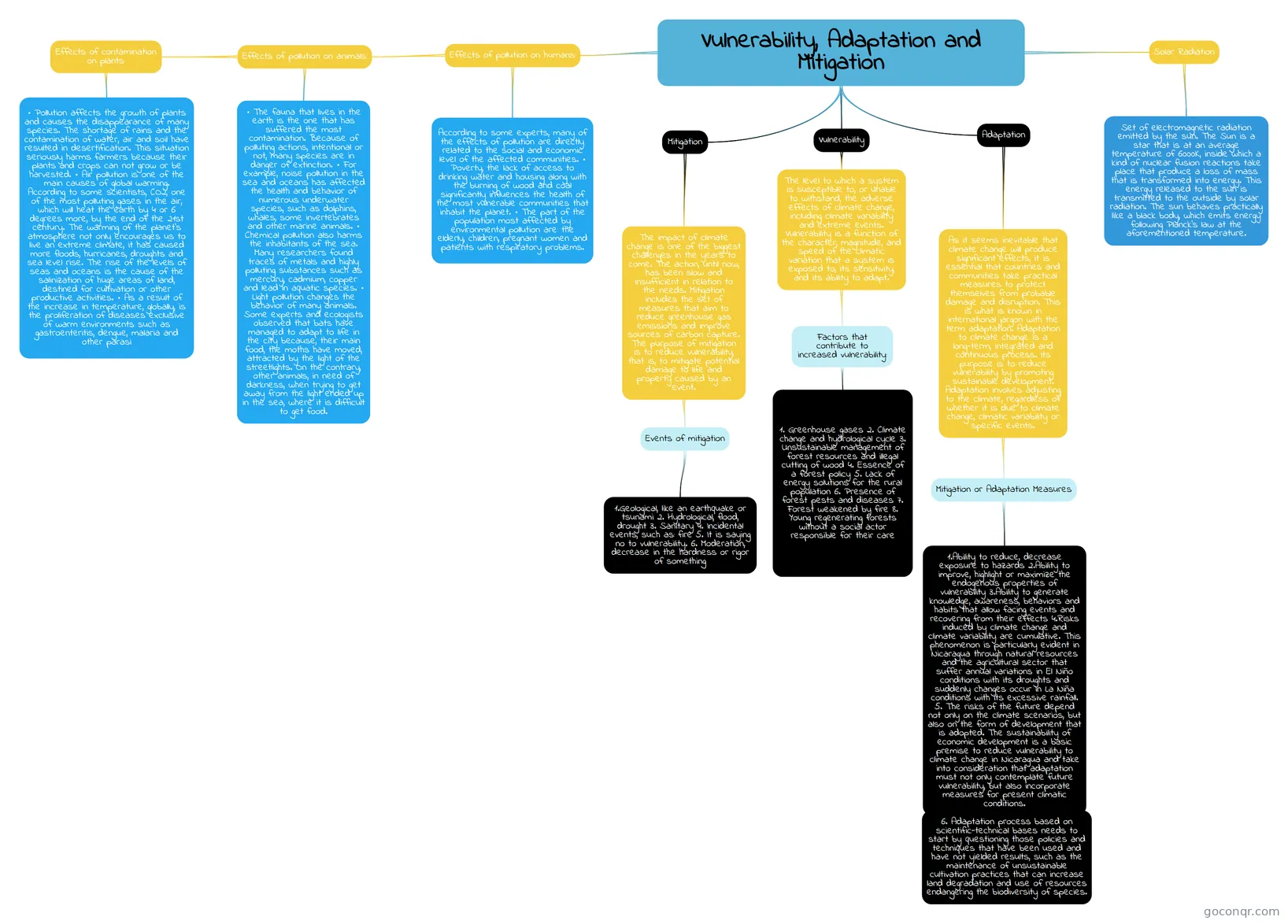
Mind map: Vulnerability, adaptation and mitigation
Inhalt der Mindmap
Vulnerability, Adaptation and Mitigation
Vulnerability
- The level to which a system is susceptible to, or unable to withstand, the adverse effects of climate change, including climate variability and extreme events. Vulnerability is a function of the character, magnitude, and speed of the climatic variation that a system is exposed to, its sensitivity, and its ability to adapt.
- Factors that contribute to increased vulnerability:
- 1. Greenhouse gases 2. Climate change and hydrological cycle 3. Unsustainable management of forest resources and illegal cutting of wood 4. Essence of a forest policy 5. Lack of energy solutions for the rural population 6. Presence of forest pests and diseases 7. Forest weakened by fire 8. Young regenerating forests without a social actor responsible for their care
- Factors that contribute to increased vulnerability:
- The level to which a system is susceptible to, or unable to withstand, the adverse effects of climate change, including climate variability and extreme events. Vulnerability is a function of the character, magnitude, and speed of the climatic variation that a system is exposed to, its sensitivity, and its ability to adapt.
Mitigation
- The impact of climate change is one of the biggest challenges in the years to come. The action, until now, has been slow and insufficient in relation to the needs. Mitigation includes the set of measures that aim to reduce greenhouse gas emissions and improve sources of carbon capture. The purpose of mitigation is to reduce vulnerability, that is, to mitigate potential damage to life and property caused by an event.
- Events of mitigation
- 1.Geological, like an earthquake or tsunami 2. Hydrological, flood, drought 3. Sanitary 4. Incidental events, such as: fire 5. It is saying no to vulnerability. 6. Moderation, decrease in the hardness or rigor of something
- Events of mitigation
- The impact of climate change is one of the biggest challenges in the years to come. The action, until now, has been slow and insufficient in relation to the needs. Mitigation includes the set of measures that aim to reduce greenhouse gas emissions and improve sources of carbon capture. The purpose of mitigation is to reduce vulnerability, that is, to mitigate potential damage to life and property caused by an event.
Adaptation
- As it seems inevitable that climate change will produce significant effects, it is essential that countries and communities take practical measures to protect themselves from probable damage and disruption. This is what is known in international jargon with the term adaptation. Adaptation to climate change is a long-term, integrated and continuous process. Its purpose is to reduce vulnerability by promoting sustainable development. Adaptation involves adjusting to the climate, regardless of whether it is due to climate change, climatic variability or specific events.
- Mitigation or Adaptation Measures
- 1.Ability to reduce, decrease exposure to hazards 2.Ability to improve, highlight or maximize the endogenous properties of vulnerability 3.Ability to generate knowledge, awareness, behaviors and habits that allow facing events and recovering from their effects 4.Risks induced by climate change and climate variability are cumulative. This phenomenon is particularly evident in Nicaragua through natural resources and the agricultural sector that suffer annual variations in El Niño conditions with its droughts and suddenly changes occur in La Niña conditions with its excessive rainfall. 5. The risks of the future depend not only on the climate scenarios, but also on the form of development that is adopted. The sustainability of economic development is a basic premise to reduce vulnerability to climate change in Nicaragua and take into consideration that adaptation must not only contemplate future vulnerability, but also incorporate measures for present climatic conditions.
- 6. Adaptation process based on scientific-technical bases needs to start by questioning those policies and techniques that have been used and have not yielded results, such as the maintenance of unsustainable cultivation practices that can increase land degradation and use of resources endangering the biodiversity of species.
- 1.Ability to reduce, decrease exposure to hazards 2.Ability to improve, highlight or maximize the endogenous properties of vulnerability 3.Ability to generate knowledge, awareness, behaviors and habits that allow facing events and recovering from their effects 4.Risks induced by climate change and climate variability are cumulative. This phenomenon is particularly evident in Nicaragua through natural resources and the agricultural sector that suffer annual variations in El Niño conditions with its droughts and suddenly changes occur in La Niña conditions with its excessive rainfall. 5. The risks of the future depend not only on the climate scenarios, but also on the form of development that is adopted. The sustainability of economic development is a basic premise to reduce vulnerability to climate change in Nicaragua and take into consideration that adaptation must not only contemplate future vulnerability, but also incorporate measures for present climatic conditions.
- Mitigation or Adaptation Measures
- As it seems inevitable that climate change will produce significant effects, it is essential that countries and communities take practical measures to protect themselves from probable damage and disruption. This is what is known in international jargon with the term adaptation. Adaptation to climate change is a long-term, integrated and continuous process. Its purpose is to reduce vulnerability by promoting sustainable development. Adaptation involves adjusting to the climate, regardless of whether it is due to climate change, climatic variability or specific events.
Solar Radiation
- Set of electromagnetic radiation emitted by the sun. The Sun is a star that is at an average temperature of 6000K, inside which a kind of nuclear fusion reactions take place that produce a loss of mass that is transformed into energy. This energy released to the sun is transmitted to the outside by solar radiation. The sun behaves practically like a black body, which emits energy following Planck's law at the aforementioned temperature.
Effects of pollution on humans:
- According to some experts, many of the effects of pollution are directly related to the social and economic level of the affected communities. • Poverty, the lack of access to drinking water and housing along with the burning of wood and coal significantly influences the health of the most vulnerable communities that inhabit the planet. • The part of the population most affected by environmental pollution are: the elderly, children, pregnant women and patients with respiratory problems.
- Effects of pollution on animals:
- • The fauna that lives in the earth is the one that has suffered the most contamination. Because of polluting actions, intentional or not, many species are in danger of extinction. • For example, noise pollution in the sea and oceans has affected the health and behavior of numerous underwater species, such as dolphins, whales, some invertebrates and other marine animals. • Chemical pollution also harms the inhabitants of the sea. Many researchers found traces of metals and highly polluting substances such as mercury, cadmium, copper and lead in aquatic species. • Light pollution changes the behavior of many animals. Some experts and ecologists observed that bats have managed to adapt to life in the city because, their main food, the moths have moved, attracted by the light of the streetlights. On the contrary, other animals, in need of darkness, when trying to get away from the light ended up in the sea, where it is difficult to get food.
- Effects of contamination on plants:
- • Pollution affects the growth of plants and causes the disappearance of many species. The shortage of rains and the contamination of water, air and soil have resulted in desertification. This situation seriously harms farmers because their plants and crops can not grow or be harvested. • Air pollution is one of the main causes of global warming. According to some scientists, CO2, one of the most polluting gases in the air, which will heat the earth by 4 or 6 degrees more, by the end of the 21st century. The warming of the planet's atmosphere not only encourages us to live an extreme climate, it has caused more floods, hurricanes, droughts and sea level rise. The rise of the levels of seas and oceans is the cause of the salinization of huge areas of land, destined for cultivation or other productive activities. • As a result of the increase in temperature, globally, is the proliferation of diseases exclusive of warm environments such as gastroenteritis, dengue, malaria and other parasi
Informationen
- Beschreibung
- Mindmap am Vulnerability, Adaptation and Mitigation, erstellt von Keysi M. Mejia R. am 08/08/2020.
- Erstellt von
- Keysi M. Mejia R.
- Aufrufe
- 6
- Bewertung