
Mindmap
Phenology
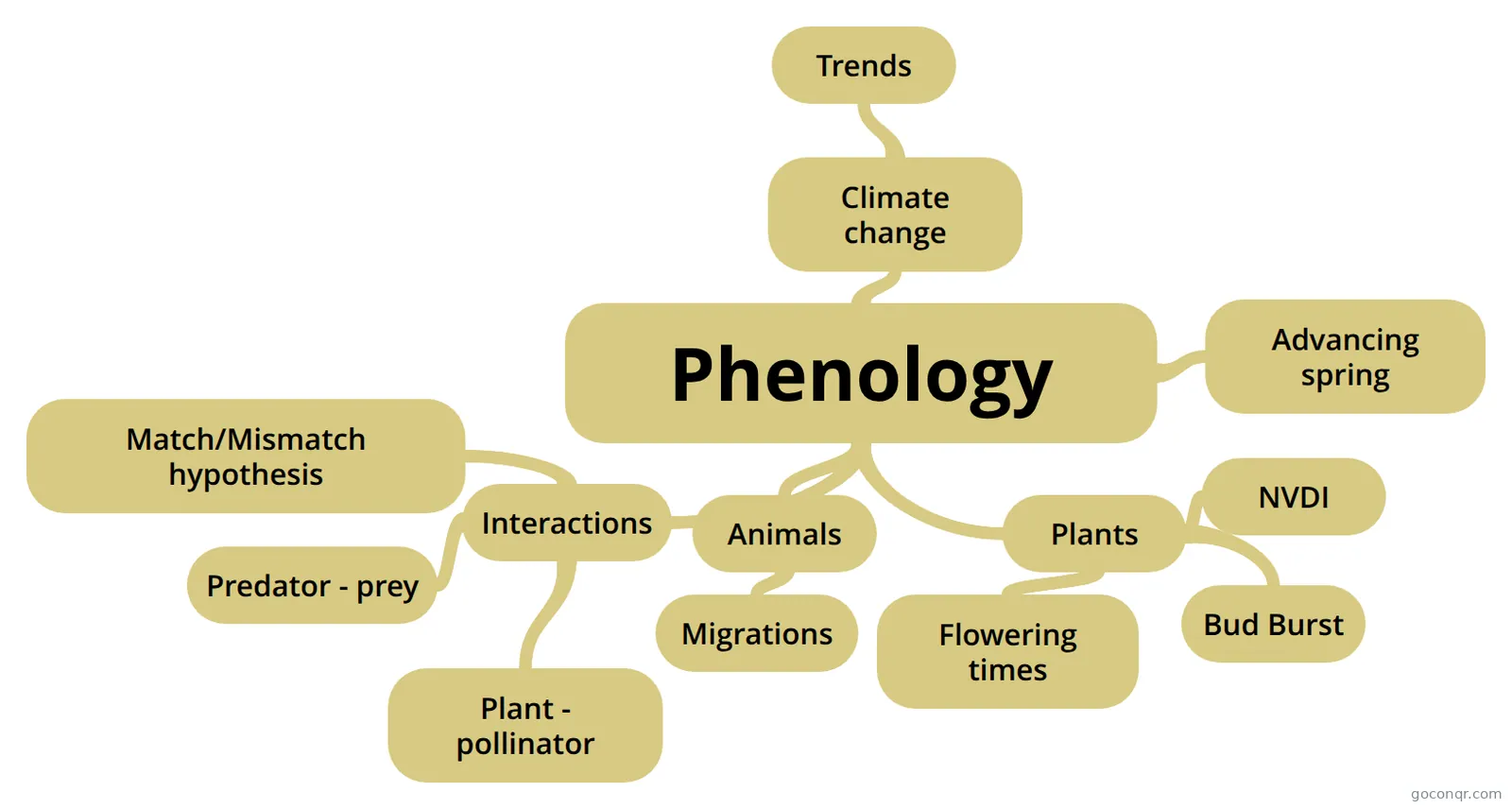
Mind map: Phenology
Inhalt der Mindmap
Phenology
- Study of the timing of recurring natural phenomena such as spring flowering and hibernation. Often linked to climate. Warmer, more food, light etc.
- Phenology – the timing of seasonal activities of animals and plants – is perhaps the simplest process in which to track changes in the ecology of species in response to climate change. Observed phenological events include leaf unfolding, flowering, fruit ripening, leaf colouring, leaf fall of plants, bird migration, chorusing of amphibians, and appearance/emergence of butterflies. Numerous new studies since the TAR (reviewed by Menzel and Estrella, 2001; Sparks and Menzel, 2002; Walther et al., 2002; Menzel, 2003; Walther, 2004) and three meta-analyses (Parmesan and Yohe, 2003; Root et al., 2003; Lehikoinen et al., 2004) (see Section 1.4.1) concurrently document a progressively earlier spring by about 2.3 to 5.2 days/decade in the last 30 years in response to recent climate warming.
- Although phenological network studies differ with regard to regions, species, events observed and applied methods, their data show a clear temperature-driven extension of the growing season by up to 2 weeks in the second half of the 20th century in mid- and high northern latitudes
- Changes also seen in autumn but not as pronounced and are more homogeneous.
Climate change
- Land has warmed more than the oceans with the greatest warming at high latitudes. Phenological advancement correlates with trends in global temperature increase.
- Biological systems show natural stochasicity but climate change is a long term persistent alteration. Affects ecosystems differently - can be difficult to predict due the the inherent variability of natural systems and the changes we are seeing being unprecedented.
- Trends
Advancing spring
- Root et al. (2003) did a meta-analysis using 61 studies that looked at the spring phenology of 694 plant and animal species, mean advance in phenology was 5.1 days per decade. Would be equal to one month over 40 years. Greater at high latitudes.
Plants
- Many aspects of plant development closely linked to temperature. WE have long term records of plants, some dating back to 1700s.
- Bud Burst
- Leaf emergence time. Rate of change varies between different regions. Different species show different rates of change.
- Satellites can be used to predict leaf emergence times. Greatest advances detected close to the poles as this is where most warming has occurred.
- NVDI
- Normalised Difference Vegetation Index - graphical indicator to analyse remote sensing imagery from satellites. Assess whether the observed target conatins live green vegetation or not. Can be used to assess whether leaves have emerged or not.
- Remotely sensed vegetation indices confirm these results.
- Flowering times
- Fritter & Fritter (2002) found that average first flowering of 385 British plant species advanced by 4.5 days during the 1990s compared with the previous 4 decades. 16% of species flowered earlier with an average advancement of 15 days per decade. Some species are more responsive (temperature sensitive) than others.
- No sign of physiological limit on earlier flowering times for many species.
Animals
- Big influence of climate change on animal migration, hibernation, reproduction. Particularly obvious for birds but other groups similarly affected. Altitudinal migrations can also reduce food availability as snow cover lasts longer at higher elevations. Earlier breeding also seen in amphibians, but not all species.
- End of hibernation cued by temperature change. Earlier emergence caused by elevated spring temperatures. Can mean animals emerge before their food is available. Can mean they are more exposed to predators as have to forage earlier, at a time that they are energetically disadvantaged from having been in hibernation e.g., Marmots in Colarado.
- Change in predator-prey interactions because of earlier emergence. May also change competitive interactions e.g., newts in Wales Chadwick 2006.
- Migrations
- Arrival dates for birds advance. Seen in many migratory bird species but differences between them. May arrive before food is available. Also delayed departure. May also alter competition with native bird species for access to resources.
Interactions
- Predator - prey
- Shift in phenology could have severe negative impacts on predator-prey interactions. Some animals will be able to track the earlier emergence of their prey but not all species will be able to keep up. Early leaf emergence and higher spring temps have been linked to advanced caterpillar emergence - they can keep up. But great tits haven't kept up with caterpillar early emergence.
- Predators often synchronise reproduction with high prey abundance - MATCH Shifts in prey phenology have to be tracked by the predator, else there is a MISMATCH Plant and animal growth, phenology, distribution and reproduction influenced by eCO2, warmer temperatures and changing precipitation patterns. Predator-prey mismatch exacerbated by CC.
- Birds may lay eggs earlier and eggs hatch earlier. Main food source of chicks - out of sync. Effects recruitment of next generation (survival into population) and possible knock on effects for species survival and biodiversity. Chicks hatching earlier may also become available as prey items earlier. Predator species such as sparrowhawks may lag behind the advancing fledging of prey species. Less fledgling juvenile passerine birds.
- Plant - pollinator
- Lots of evidence that plant flowering and pollinator appearance are advancing at different rates. Nothing to feed on. Flowers not getting pollinated - pollinator limitation. The majority of flowering plants are animal pollinated. Without pollinators many plants could not seed and reproduce. Without pollen and nectar many animal populations would decline. Pollination is an essential ecosystem service and has huge economic importance but pollinators may not be able to track the early emergence of flowers, plants can then not reproduce. Many economically important crop species animal pollinated such as tomatoes and potatoes. Potential impacts on global food security. Shifting interactions between generalist invertebrate herbivores that may target important crop plants and their specialist parasitoid predators may also impact global food security. If parasites can no longer track their hosts they can not control the invert population which may grow and kill more crops. Could have knock on effects and potentially increease climate change if humans start using more chemicals on crops to target pest species, more chemicals in atmosphere, increased greenhouse effect and global warming?
- Many plants have defined flowering times (only flower at certain times of the year) and have specialist predators. These species are more likely to be affected by climate change. Many pollinators have restricted floral preferences.
- Climate linked pollination - climate variability can effect pollination. Effects may be especially pronounced at the range limits of a species. May be an important constraint of range expansion. Plant pollinator mismatch more evident at northern end of breeding range.
- Some migratory animals such as birds will arrive at their over-wintering grounds before the first flowering of their food plants - especially detrimental for animals/birds that have migrated over vast distances and will be energetically disadvantaged already. Hummingbird breeding range may shift south - opposite of what would usually be expected. Pollinator networks robust enough to cope with phenological change? Not as simple as that. Only works if all pollinators and plants are all generalist. Not the case.
- Match/Mismatch hypothesis
- mismatch in peak breeding potential. Hypothesis seesk to explain recruitment variation in a population by means of the relationship and its phenology and that of the species at the immediate lower level.
- Climate has a clear influence on predator reproduction via its effect on the timing of food availability and the food requirements of predator young. Sparrowhawks - climate linked mismatch. Leaf emergence earlier, caterpillars emerging earlier, passerines hatching earlier - no change in sparrowhawks. Top predator is mismatched. Effects trophic dynamics of ecosystem. Results in assemblage change, alteration of biodiversity. Could effect populations but we won't know until the future. Some organisms may go extinct. Species becoming increasingly out of sync with the emergence of their prey items. More examples of asynchrony between interacting species. But is this a consistent trend?
- Reproduction in some species may be able to keep pace with earlier emergence of food/prey items. Match/mismatch will not effect all organisms. Not all species match reproduction with climate - warming is not a cue for all organisms. Tree swallows wait until their preferred prey species is abundant before they reproduce, do not rely on temperature or any other effects on their biology. Other examples of good matching.
- MISMATCH LIKELY WHEN PREDATORS AND PREY RELY ON DIFFERENT ABIOTIC CUES. Typically the predator relies on annually fixed cue e.g., day length and the prey on something that varies year to year. Mismatch more likely for specialist feeders as they can not prey switch. MATCH OCCURS WHEN PREDATOR AND PREY RESPOND TO THE SAME ABIOTIC CUE, OR WHERE THE PREDATOR USES A BIOLOGICAL CUE SUCH AS PREY ABUNDANCE. Match more likely for generalist feeders as they can easily switch to another prey source. MATCHING IS NOT ALWAYS GOOD! Populations of predatory ctenopophore and a copepod now overlap as ctenophore emerged earlier and population grown faster with spring warming. Copepod not responded to spring warming. Copepod populations declined due to predation by ctenophore. Consequences at higher trophic levels. Copepods essential prey for many commercially important fish species such as cod.
- Predicting mismatch. Memmott et al. (2007) simulated consequences of the phenological shifts expected with a doubling of atmospheric co2 - predicted that up to 50% of all pollinator species suffer disruption in food supply as mean phenologies advance by 3 weeks. Food may be curtailed (not available at the beginning or end of a pollinators activity period), gaps in food availability or no food at all. Curtailed resource supply. Plants flower earlier which reduces availability of resources to pollinators. Plants also lose their specialist pollinators if they flower early as pollinators may not have yet emerged.
- Predator - prey
Informationen
- Beschreibung
- Mindmap am Phenology, erstellt von amyycartwright am 12/04/2015.
- Erstellt von
- amyycartwright
- Aufrufe
- 3
- Bewertung