
2555326
Beschreibung

Mindmap von Rashida D-H, aktualisiert more than 1 year ago

|
Erstellt von Rashida D-H
vor fast 11 Jahre
|
|
Pricing Strategy
- Cost Orientated Pricing
- Full Cost Pricing
- Advantages
- 1. Gives an indication of
minimum price needed to
make a profit. 2. Can be
used with other methods
– acts as a constraint
- 1. Gives an indication of
minimum price needed to
make a profit. 2. Can be
used with other methods
– acts as a constraint
- Criticisms
- 1. Takes no account of
customers’ willingness to pay. 2.If
followed strictly, leads to an increase in
price when demand falls. 3. Is illogical
because a sales estimate is made before
a price is set. 4. May be problems in
allocating overheads.
- 1. Takes no account of
customers’ willingness to pay. 2.If
followed strictly, leads to an increase in
price when demand falls. 3. Is illogical
because a sales estimate is made before
a price is set. 4. May be problems in
allocating overheads.
- Advantages
- Direct (Marginal) Costing
- Involves the calculation of costs
that are likely to increase as
output increases
- Advantages
- 1. Avoids problem of allocating overheads. 2.
Avoids ‘price up as demand down’ problem.
3.Indicates lowest price at which it is sensible
to take business. 4. Enables the reduction of
the impact of excess capacity
- 1. Avoids problem of allocating overheads. 2.
Avoids ‘price up as demand down’ problem.
3.Indicates lowest price at which it is sensible
to take business. 4. Enables the reduction of
the impact of excess capacity
- Critcisms
- 1. When business is keeping afloat, gives no indication of
optimum price. 2. Cannot be used in the long-term.
- 1. When business is keeping afloat, gives no indication of
optimum price. 2. Cannot be used in the long-term.
- Advantages
- Involves the calculation of costs
that are likely to increase as
output increases
- Full Cost Pricing
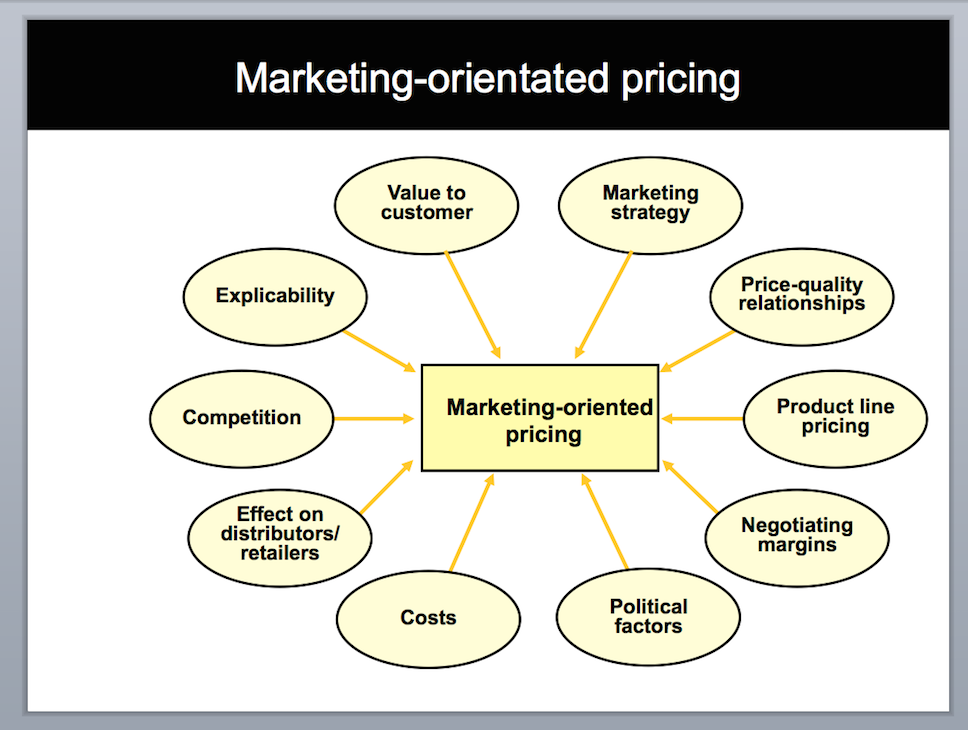
- Market Orientated Pricing
- 1.Marketing Stragy: Price of product should be inline with
marketing strategy. Danger is price is view in isolation, with
no reference to other marketing positions such as positioning.
Thus, it should be recognised that pricing decision depends on
other marketing planning process
- 2. Value To customer
- 1. Trade off analysis: Measures trade off
between price and other product features
so that their effects on product preference
can be est.
- 2. Experimentation: Attempts to overcome
the drawback of trade-off analysis where
respondents have not backed up their
preferences. Experiential pricing research
places a product on sale at different
locations with varying prices.
- 1. Trade off analysis: Measures trade off
between price and other product features
so that their effects on product preference
can be est.
- 2. Value To customer
- 1.Marketing Stragy: Price of product should be inline with
marketing strategy. Danger is price is view in isolation, with
no reference to other marketing positions such as positioning.
Thus, it should be recognised that pricing decision depends on
other marketing planning process
Medienanhänge
Möchten Sie kostenlos Ihre eigenen Mindmaps mit GoConqr erstellen? Mehr erfahren.