
Mindmap
Functions of Different Hormones
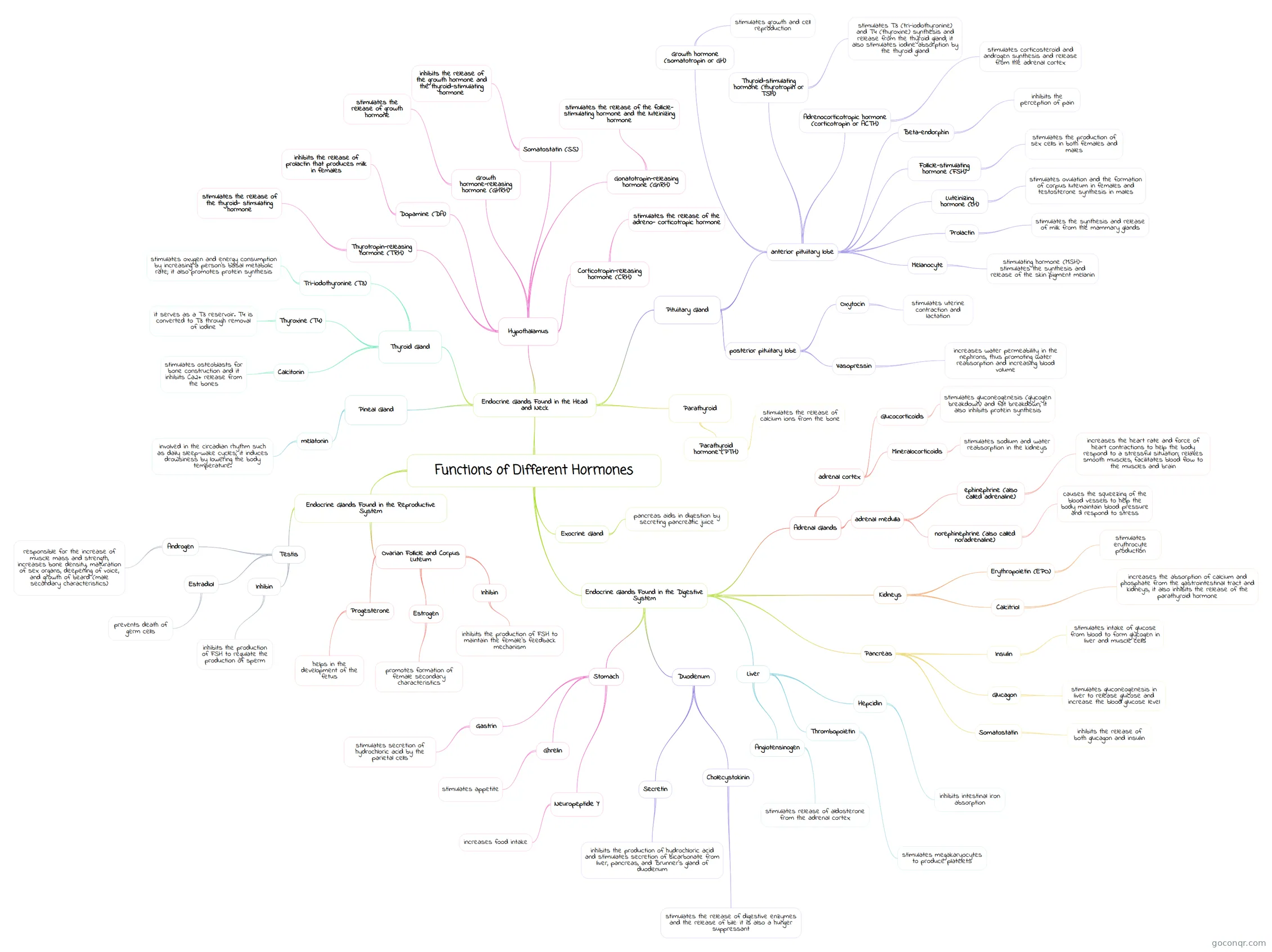
Mind map: Functions of different hormones
Inhalt der Mindmap
Functions of Different Hormones
Endocrine Glands Found in the Head and Neck
- Hypothalamus
- Thyrotropin-releasing hormone (TRH)
- stimulates the release of the thyroid- stimulating hormone
- Dopamine (DA)
- inhibits the release of prolactin that produces milk in females
- Growth hormone-releasing hormone (GHRH)
- stimulates the release of growth hormone
- Somatostatin (SS)
- inhibits the release of the growth hormone and the thyroid-stimulating hormone
- Gonatotropin-releasing hormone (GnRH)
- stimulates the release of the follicle- stimulating hormone and the luteinizing hormone
- Corticotropin-releasing hormone (CRH)
- stimulates the release of the adreno- corticotropic hormone
- Thyrotropin-releasing hormone (TRH)
- Pituitary Gland
- anterior pituitary lobe
- Growth hormone (somatotropin or GH)
- stimulates growth and cell reproduction
- Thyroid-stimulating hormone (thyrotropin or TSH)
- stimulates T3 (tri-iodothyronine) and T4 (thyroxine) synthesis and release from the thyroid gland; it also stimulates iodine absorption by the thyroid gland
- Adrenocorticotropic hormone (corticotropin or ACTH)
- stimulates corticosteroid and androgen synthesis and release from the adrenal cortex
- Beta-endorphin
- inhibits the perception of pain
- Luteinizing hormone (LH)
- stimulates ovulation and the formation of corpus luteum in females and testosterone synthesis in males
- Prolactin
- stimulates the synthesis and release of milk from the mammary glands
- Melanocyte
- stimulating hormone (MSH)- stimulates the synthesis and release of the skin pigment melanin
- Follicle-stimulating hormone (FSH)
- stimulates the production of sex cells in both females and males
- Growth hormone (somatotropin or GH)
- posterior pituitary lobe
- Oxytocin
- stimulates uterine contraction and lactation
- Vasopressin
- increases water permeability in the nephrons, thus promoting water reabsorption and increasing blood volume
- Oxytocin
- anterior pituitary lobe
- Pineal Gland
- melatonin
- involved in the circadian rhythm such as daily sleep-wake cycles; it induces drowsiness by lowering the body temperature.
- melatonin
- Thyroid Gland
- Thyroxine (T4)
- it serves as a T3 reservoir. T4 is converted to T3 through removal of iodine
- Tri-iodothyronine (T3)
- stimulates oxygen and energy consumption by increasing a person's basal metabolic rate; it also promotes protein synthesis
- Calcitonin
- stimulates osteoblasts for bone construction and it inhibits Ca2+ release from the bones
- Thyroxine (T4)
- Parathyroid
- Parathyroid hormone (PTH)
- stimulates the release of calcium ions from the bone
- Parathyroid hormone (PTH)
- Hypothalamus
Endocrine Glands Found in the Digestive System
- Pancreas
- Insulin
- stimulates intake of glucose from blood to form glycogen in liver and muscle cells
- Glucagon
- stimulates gluconeogenesis in liver to release glucose and increase the blood glucose level
- Somatostatin
- inhibits the release of both glucagon and insulin
- Insulin
- Liver
- Hepcidin
- inhibits intestinal iron absorption
- Thrombopoietin
- stimulates megakaryocytes to produce platelets
- Angiotensinogen
- stimulates release of aldosterone from the adrenal cortex
- Hepcidin
- Duodenum
- Cholecystokinin
- stimulates the release of digestive enzymes and the release of bile: it is also a hunger suppressant
- Secretin
- inhibits the production of hydrochloric acid and stimulates secretion of bicarbonate from liver, pancreas, and Brunner's gland of duodenum
- Cholecystokinin
- Kidneys
- Erythropoietin (EPO)
- stimulates erythrocyte production
- Calcitriol
- increases the absorption of calcium and phosphate from the gastrointestinal tract and kidneys, it also inhibits the release of the parathyroid hormone
- Erythropoietin (EPO)
- Adrenal Glands
- adrenal cortex
- Glucocorticoids
- stimulates gluconeogenesis (glycogen breakdown) and fat breakdown; it also inhibits protein synthesis
- Mineralocorticoids
- stimulates sodium and water reabsorption in the kidneys
- Glucocorticoids
- adrenal medulla
- ephinephrine (also called adrenaline)
- increases the heart rate and force of heart contractions to help the body respond to a stressful situation; relaxes smooth muscles, facilitates blood flow to the muscles and brain
- norephinephrine (also called noradrenaline)
- causes the squeezing of the blood vessels to help the body maintain blood pressure and respond to stress
- ephinephrine (also called adrenaline)
- adrenal cortex
- Stomach
- Gastrin
- stimulates secretion of hydrochloric acid by the parietal cells
- Ghrelin
- stimulates appetite
- Neuropeptide Y
- increases food intake
- Gastrin
- Pancreas
Endocrine Glands Found in the Reproductive System
- Testis
- Androgen
- responsible for the increase of muscle mass and strength, increases bone density, maturation of sex organs, deepening of voice, and growth of beard (male secondary characteristics)
- Estradiol
- prevents death of germ cells
- Inhibin
- inhibits the production of FSH to regulate the production of sperm
- Androgen
- Ovarian Follicle and Corpus Luteum
- Progesterone
- helps in the development of the fetus
- Estrogen
- promotes formation of female secondary characteristics
- Inhibin
- inhibits the production of FSH to maintain the female's feedback mechanism
- Progesterone
- Testis
Exocrine Gland
- pancreas aids in digestion by secreting pancreatic juice
Informationen
- Beschreibung
- Mindmap am Functions of Different Hormones, erstellt von Angelica Taniegra am 13/09/2020.
- Erstellt von
- Angelica Taniegra
- Aufrufe
- 1
- Bewertung